A good vegan Thai curry recipe starts with vegan curry paste and soy protein that is fully prepared before it reaches the coconut sauce. Choose chunks for separate bites in red curry, or strands to weave through green curry, then add the vegetables in stages so they do not all soften at once.
The two recipes below share that approach. Red curry pairs chunks with peppers and carrots; green curry pairs strands with aubergine and green beans. Each makes about four servings with rice. The ingredient amounts are a starting point for recipe-specific trials, and current product directions govern soy preparation.
Choose chunks for red curry or strands for green curry
Choose the shape according to how you want the curry to eat. Baichuan’s cubed fibrous soy protein chunks for catering are listed as small chunks. That format suits the separate, spoon-sized pieces in this vegan Thai red curry. Its shredded soy protein strands for catering offer a different route: strips distributed among aubergine and beans. Both are ingredients to prepare and season, not finished curry components.
Both products combine soybean ingredients with wheat gluten and wheat starch. They are not pure soy isolates or gluten-free choices. Check the protein, curry paste and soy sauce separately for your household’s requirements; soy and wheat are major food allergens identified by the FDA.
Once you have chosen the shape, check the paste. Red and green pastes can contain shrimp paste or fish sauce, so read the full ingredient list even when the label shows only chillies and herbs. Check any stock or finishing sauce too. Choose a clearly labelled vegan paste, and remember that colour is not a dependable heat rating. An unfamiliar paste may need a more cautious amount than one you already know.
Prepare the soy before seasoning the coconut sauce
Allow preparation time before heating the curry pan. Both product pages list a hydration time of 60–65 minutes, so neither should be treated as an instant-soaking ingredient. That is a separate lead time from the curry cooking steps below, not a complete soaking instruction: use the current directions for water quantity, temperature and any required cooking. You can prepare the vegetables during this stage.
Check a thick piece after preparation. It should be hydrated through the centre, without a dry, hard core. Drain, then gently press out loose water without crushing the chunks. Keep strands loose and intact instead of wringing them into a compact mass. This controls how much unseasoned water enters the coconut sauce and leaves room for deliberate consistency adjustments.
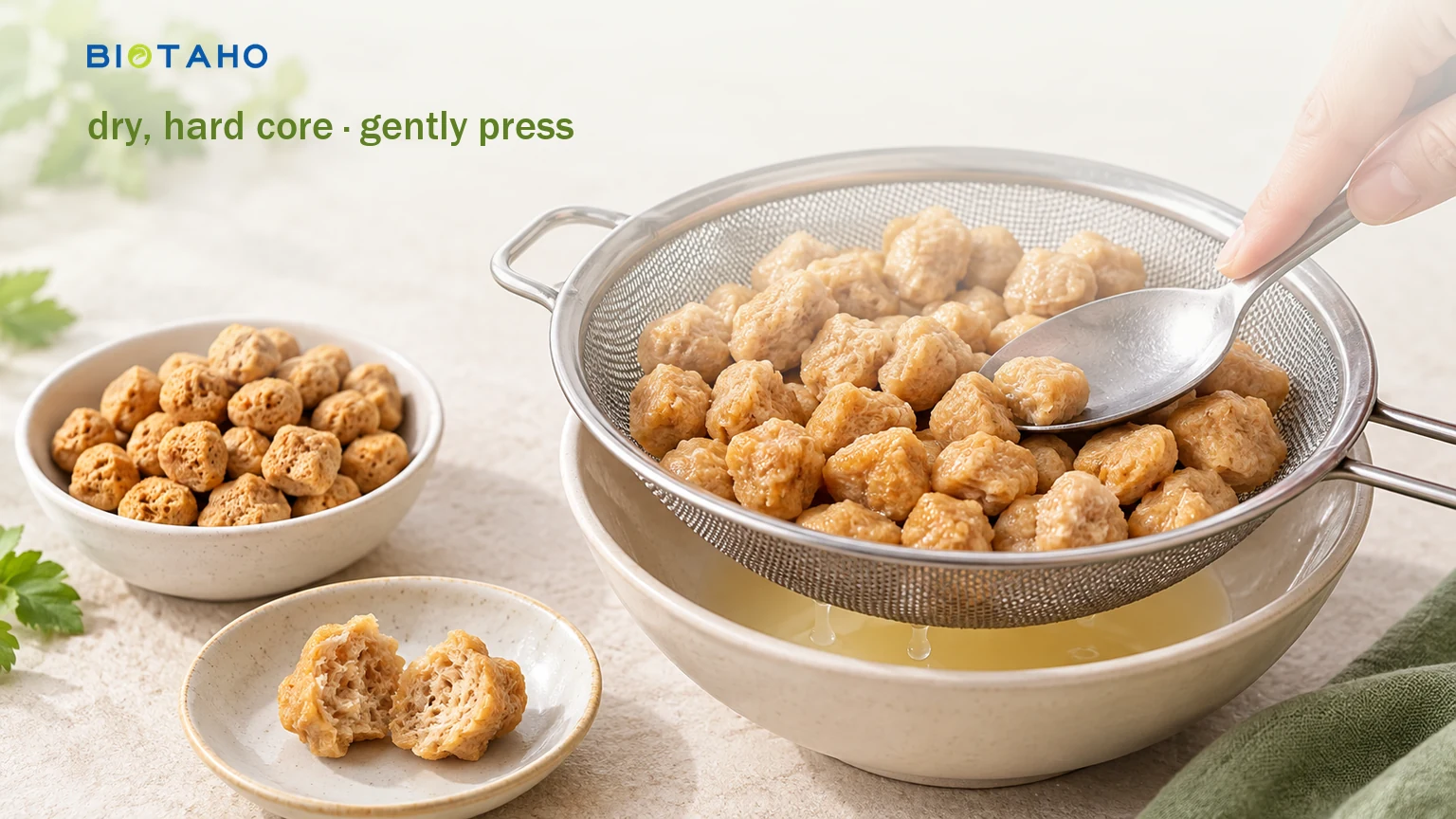
Do not count the hydration water as sauce liquid or depend on the coconut milk to finish soaking dry pieces. For additional handling guidance, see the guide to preparing and draining textured protein. Start each sauce with 100 ml water and reserve the remaining 100 ml for adjustments as the curry simmers.
Measure the ingredients below for your chosen route. The same dry weight does not guarantee identical prepared volume, so keep the drained protein loose when adding it to the pan.
| Ingredient | Red curry: about 4 servings | Green curry: about 4 servings |
|---|---|---|
| Dry soy protein | 80 g chunks | 80 g strands |
| Neutral oil | 1 tablespoon | 1 tablespoon |
| Vegan curry paste | 2 tablespoons red | 2 tablespoons green |
| Garlic and ginger, finely chopped | 2 garlic cloves; 2 teaspoons ginger | 2 garlic cloves; 2 teaspoons ginger |
| Vegetables | 1 onion, sliced; 2 peppers, sliced; 1 carrot, thinly sliced | 250 g aubergine, in 2 cm pieces; 150 g green beans, trimmed and halved |
| Unsweetened coconut milk | 400 ml | 400 ml |
| Water for sauce | 100–200 ml | 100–200 ml |
| Soy sauce and sugar | 2 teaspoons soy sauce; 1 teaspoon sugar, then adjust | 2 teaspoons soy sauce; 1 teaspoon sugar, then adjust |
| Finishing ingredients | 2 teaspoons lime juice; small handful basil | 2 teaspoons lime juice; small handful Thai basil or other basil |
| To serve | Cooked rice for 4 | Cooked rice for 4 |
Make red curry with distinct soy bites
With the soy protein chunks hydrated and drained, the red curry can cook around the vegetables’ needs. Thin carrot slices soften within the short simmer, while the peppers should retain their shape. Prepare all the vegetables before heating the pan so the garlic and paste are not left cooking while you chop.
- Prepare and drain the 80 g dry chunks as described above. Slice the onion and peppers, thinly slice the carrot, and finely chop the garlic and ginger.
- Warm the oil in a deep pan over medium heat. Add the onion and cook for about 5 minutes, stirring, until softened. Add the garlic and ginger and stir for about 30 seconds.
- Add the carrot and peppers. Cook for 3–4 minutes, stirring frequently. Stir in the red paste and cook for about 1 minute, stirring so it does not catch.
- Add the coconut milk, 100 ml water, sugar and prepared chunks. Stir to disperse the paste, then bring to a gentle simmer.
- Simmer for roughly 8–12 minutes, stirring occasionally. The carrot should yield to a fork, the peppers should retain their shape, and a chunk cut through the middle should have no dry centre. Add reserved water a little at a time if the sauce becomes too thick.
- Stir in the soy sauce. Remove from the heat, add lime juice and basil, then taste. Adjust saltiness, sweetness and acidity a little at a time before serving with rice.
Keep enough sauce to spoon over the rice. The intended result is separate chunks coated in coconut sauce, not a dry paste clinging to the protein. If the sauce needs loosening, do that before making the final seasoning decision described below.
Use strands in green curry without crowding the vegetables
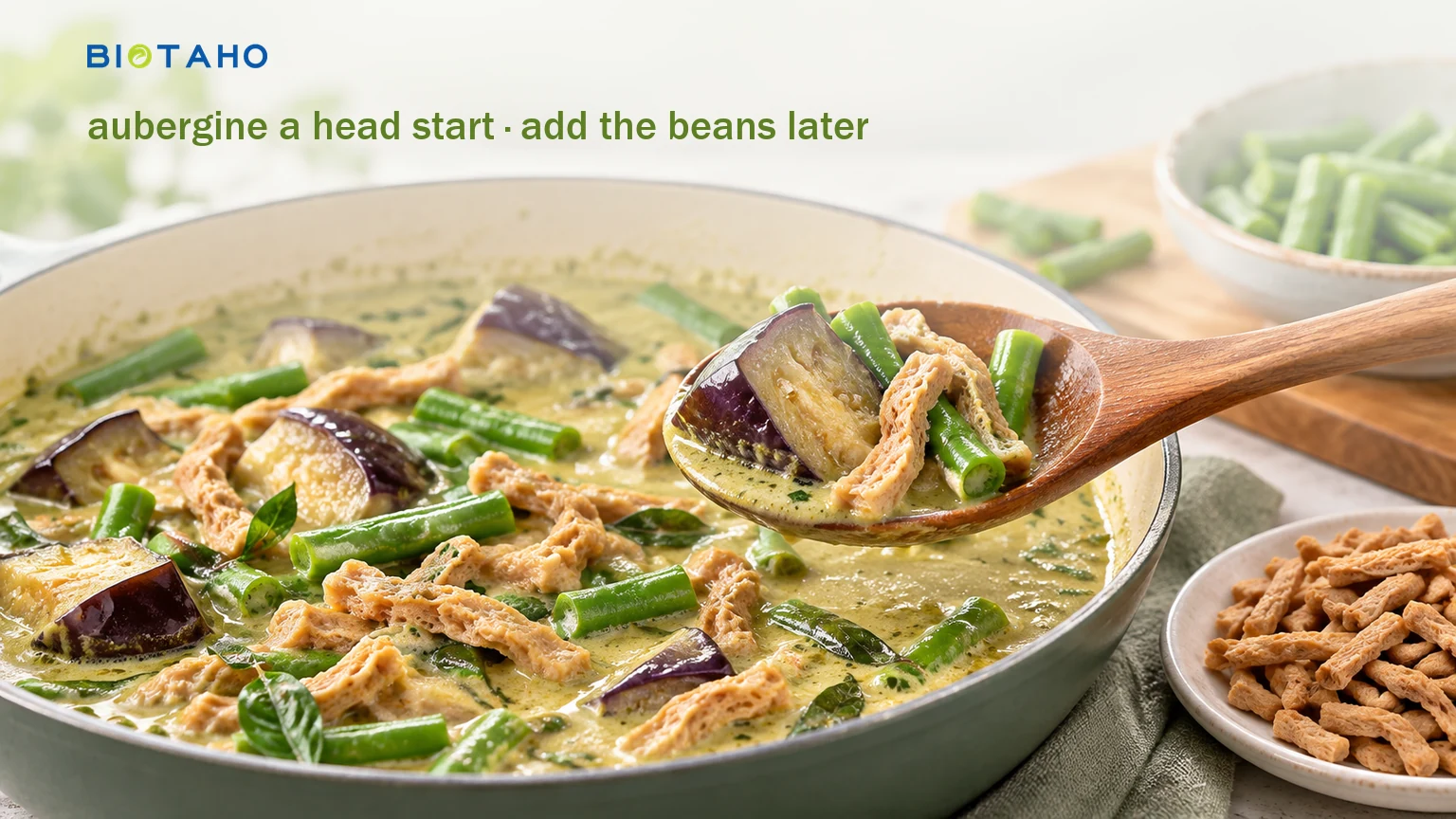
The green route uses the same separately prepared soy and reserved water, but changes the timing. Give the aubergine a head start in the coconut sauce, then add the beans and soy protein strands together. This lets the aubergine soften without requiring the beans to endure the entire simmer.
- Prepare the 80 g dry strands according to their directions, drain and gently press. If needed, cut unusually long hydrated strands into lengths that fit on a spoon.
- Heat the oil in a deep pan over medium heat. Add the garlic and ginger; stir briefly until fragrant. Add the green paste and stir for about 1 minute without letting it burn.
- Pour in the coconut milk and 100 ml water. Stir in the sugar and the aubergine, cut into 2 cm pieces. Bring to a gentle simmer and cook for about 7–10 minutes, stirring occasionally.
- Add the trimmed, halved green beans and prepared strands. Simmer for another 5–8 minutes, or until the aubergine is soft through the centre and the beans are tender with a little bite. Add reserved water as needed.
- Season with soy sauce, remove from the heat and fold in the lime juice and basil. Taste before adding more seasoning, then serve with rice.
Keep the strands spread through the sauce instead of dropping them in as a compressed bundle. Stir gently to distribute them without breaking up the softened aubergine. In this vegan Thai green curry, soft aubergine and slightly firm beans provide the contrast, so assess the vegetables separately.
Adjust seasoning after the soy has entered the sauce
For either route, judge the sauce after the prepared soy has simmered in it. Water carried in with the protein, evaporation and the vegetables all affect the final consistency. Correct that first, then taste a spoonful containing both sauce and soy before adding more seasoning.
| What you notice | Adjustment for this batch | What to note next time |
|---|---|---|
| Sauce is too thick | Add reserved water a little at a time, stir and reassess. | Record how much sauce water the prepared shape needed. |
| Sauce is watery | Simmer uncovered briefly, watching the vegetables. | Drain loose hydration water more thoroughly. |
| Strands form clumps | Separate them gently through the sauce. | Keep them loose after draining and pressing. |
| Curry tastes flat | Adjust soy sauce, lime juice and sugar separately, tasting between additions. | Record the paste used and any seasoning changes. |
Keep food safety separate from texture checks. For US home kitchens, FDA guidance is to refrigerate perishables within 2 hours, or within 1 hour when the outside temperature exceeds 90°F. Divide leftovers into shallow containers and keep the refrigerator at 40°F or below. Reheat leftovers to 165°F; FDA also advises bringing sauces to a boil when reheating.
Frequently asked questions
What are the ingredients for a vegan Thai curry?
These versions use vegan curry paste, coconut milk, prepared soy protein, vegetables and water, with soy sauce, sugar, lime juice and basil for seasoning. Use chunks with the red curry vegetables or strands with the green curry vegetables.
Are any Thai curries vegan?
Yes. They can be made entirely with plant-based ingredients, but check the paste, stock and finishing seasonings for shrimp paste, fish sauce and other animal ingredients.
Which Thai curry paste is best for vegans?
Choose a clearly labelled vegan paste whose ingredient list fits your needs. Either red or green works here. Paste strength varies, so use familiarity with the product to guide any adjustment.
Can I make Thai curry without coconut milk?
Yes, but it becomes a different, lighter curry. Vegetable stock can provide a broth-style base; start with less liquid and adjust gradually instead of replacing all the coconut milk directly.
What can I use instead of Thai curry paste?
Use a balanced recipe for a homemade chilli-and-aromatic paste. Generic curry powder is not a direct flavour substitute for Thai red or green paste.
Why is green curry not vegan?
Green curry can be vegan. Some pastes contain shrimp paste, and some finished curries include fish sauce or animal-based stock. Check each component, not just the curry’s name.
References
- Cookie and Kate: Thai Red Curry with Vegetables — vegetable-curry technique and paste ingredient checks; not a test of these soy ingredients.
- FDA: Food Allergies — major allergens and ingredient-label reading.
- FDA: Safe Food Handling — cooling, refrigeration and reheating guidance.
For a curry development trial, contact Baichuan about chunk or strand samples and request the current preparation directions for your chosen format.