When a product developer in Chicago encountered dry, rubbery soy pieces in a pilot batch of plant-based stew, she increased the soaking time, but the pieces then fractured during mixing and left excess liquid in the kettle. The visible failure appeared within minutes; the reversal came when the team separated particle size from density, weighed liquid uptake, and set a draining target. The issue was not simply a bad ingredient—it was an incomplete hydration specification.
Summary: Rehydrate fibrous soy protein against the actual grade, particle size and finished application rather than a universal water ratio. Begin with small, weighed trials—for example, 100 g dry material with 150 g and 200 g liquid—and record uptake, soak time, drained yield and shear response. The response of extrusion soy protein with an open structure may differ from that of a denser piece; liquid temperature, seasoning and the next cooking step all need to be part of the decision.
Textured vegetable protein (TVP) is a commercial description, not a single hydration behaviour. The soy raw material, formulation and extrusion conditions can produce chunks, strips, granules or fibres with different structures. Use the supplier specification, a retained sample and an application trial instead of a generic online ratio; the objective is a consistent bite and moisture level without excess broth or cook loss.
How should you set a water-to-TVP ratio for each grade?
Start with mass, not a volume estimate. A 100 g dry sample keeps the arithmetic and comparisons clear: add a measured amount of water or broth, hold at a fixed time and temperature, drain by the same method, then weigh the hydrated product. This simple gravimetric uptake test gives the production team a repeatable baseline. The 150 g and 200 g additions per 100 g dry material are useful trial points, not universal recommendations.
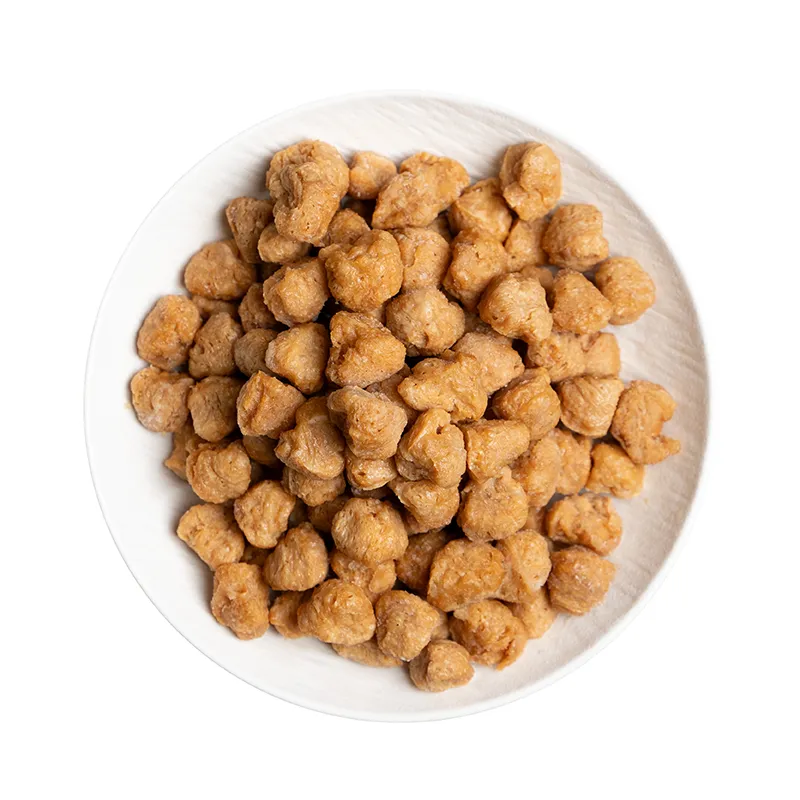
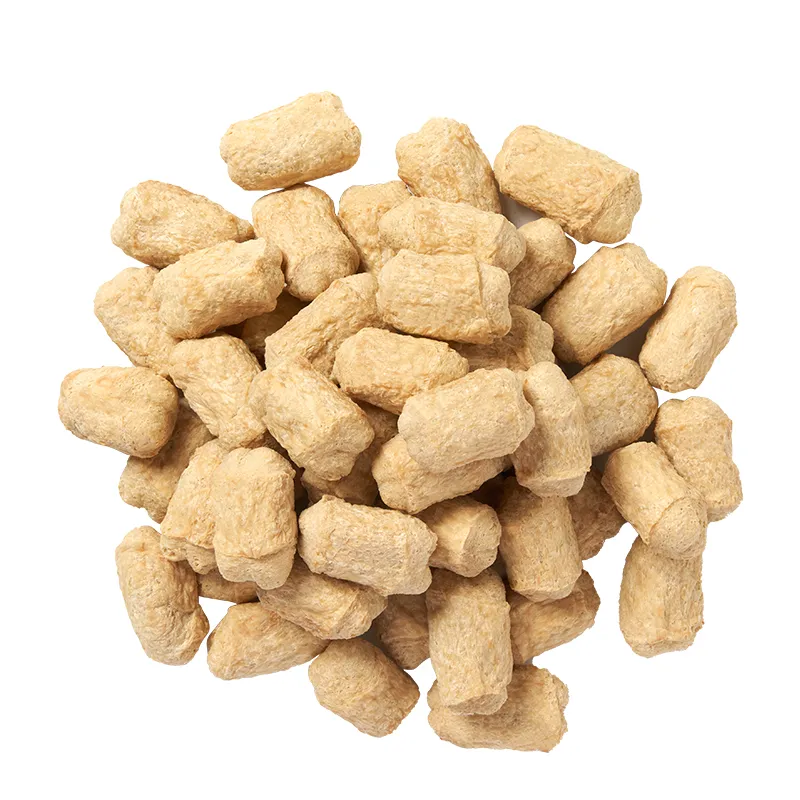
Evaluate density and particle size separately. A high density TVP grade may need more time for liquid to reach the centre of a larger piece, while a more open low density TVP structure may take up liquid quickly but lose shape when overworked. A small granule presents more surface area than a large chunk, so it can hydrate faster even when both come from similar soy inputs. Record dry bulk density when the supplier provides it, but make drained yield and bite the final decision criteria.
| Trial factor | Lower starting point | Higher starting point | What to observe |
|---|---|---|---|
| Liquid for 100 g dry material | 150 g | 200 g | Drained yield, free liquid and centre hydration |
| Particle format | Fine granule or small piece | Large chunk or strip | Time to an even interior texture |
| Density tendency | More open structure | More compact structure | Swelling, integrity and mixing tolerance |
| Final use | Moist sauce or filling | Lower-moisture topping | Whether later cooking adds or removes moisture |
The cost is often hidden in the process. Excess liquid can mean discard, a thinner sauce or longer reduction; under-hydrated pieces can draw moisture from the finished dish during hold. Compare dry-input use, liquid, drained yield, labour and rework—not purchase price alone. Treat yield calculations as illustrative until the production line confirms them.
When should hot water or broth be used?
Water gives the clearest view of the ingredient’s native uptake and texture, so it is the right control for first-pass supplier comparisons. Broth adds salt, savoury notes and other dissolved solids; it can suit a sauce, filling or ready meal when the hydrated piece needs to carry flavour into the next step. Run a second trial with the planned broth because its salt level, fat and seasoning solids can affect flavour carry, free-liquid appearance and subsequent cooking behaviour.
Hot liquid can shorten soaking, but “hot” is not a complete instruction. Set the liquid temperature, hold time, vessel cover, batch mass and food-safety controls in the work instruction. For chilled or ready-to-eat products, the hydration step must fit the facility hazard analysis and validated time-temperature controls; U.S. FDA current good manufacturing practice and preventive-controls requirements are in 21 CFR Part 117. That rule governs the operation, not a universal ratio.
How do soaking time and draining determine the final texture?
There is no defensible single soaking time for every TVP. Fine formats can hydrate rapidly, while large chunks and strips need enough time for interior uptake; the same format can also behave differently from one formulation or lot to another. Build time points around the target process—such as 5, 10 and 15 minutes for a small-scale screen—and stop when the centre is hydrated and the exterior still tolerates the planned mixing, forming or cooking step. Those time points are a screening design, not a product claim.
Drain in a consistent way. A short, defined gravity-drain interval is easier to standardise than squeezing by hand, which can damage a fibrous piece and introduce operator variation. For a high-shear filling, retain a little more bound moisture only if the next process holds it without leaking. For a topping or a product going into a wet sauce, a longer drain may be needed to prevent dilution. Measure both the drained mass and the liquid released after a short hold; this is a practical water-holding-capacity check, not a substitute for a validated laboratory method.
| Checkpoint | How to assess it | Decision enabled |
|---|---|---|
| Interior hydration | Cut several representative pieces | Increase time or adjust particle grade if cores remain dry |
| Drained yield | Weigh dry input, added liquid and drained output | Set batch water and portioning assumptions |
| Shear tolerance | Mix a defined sample for a fixed time | Confirm suitability for filling, sauce or forming |
| Hold stability | Observe released liquid after a defined hold | Protect sauce viscosity and pack appearance |
A modest, documented validation plan reduces unnecessary rework. Use at least three representative pieces per particle format, repeat the preferred condition on a fresh sample, and retain the written observation sheet with the formulation record. If the product is sold on a moisture, protein, yield or texture claim, confirm the test method and acceptance limit with qualified technical and regulatory personnel. The relevant method may be a laboratory moisture method or a finished-product procedure; it should not be represented as a certification merely because it is repeatable.
Which safety, allergen and compliance checks apply?
Rehydration is a food-manufacturing step, so its controls depend on the destination market, intended use and product claims. In the U.S., FDA food-label rules identify soy among the major food allergens; ingredient declarations and allergen controls must be reviewed for the actual formula and market. FDA’s Part 117 rule requires covered facilities to use current good manufacturing practice and, where applicable, preventive controls. Codex’s General Standard for Contaminants and Toxins in Food and Feed (CXS 193-1995) is a reference framework for contaminant management, not a certificate for a particular TVP product.
For procurement, ask for the current product specification, allergen statement, microbiological and moisture information where applicable, country-of-sale documentation, and change-notification process. Verify any nutrition or protein claim against the finished formulation and local label rules. Unsupported claims can trigger relabelling, customer rejection or a delayed launch; equally, a standard test method does not prove that a supplier or a product is certified unless a valid certification scope is supplied.
How can a hydration trial become a purchase specification?
Define the target format first: loose granule, fibrous chunk, strip, filling or topping. Then document the hydration liquid, temperature band, target hold window, gravity-drain procedure and acceptable centre texture. Include a scale-up check after the bench trial, because vessel depth and batch mass can affect exposure to liquid. Finally, agree on the response if density, particle distribution or formulation changes.
For buyers comparing high density TVP and lower-density options, request samples in the intended application rather than selecting on appearance alone. Check the current product specification, allergen statement, microbiological and moisture information where applicable, country-of-sale documentation and change-notification process. BCTVP’s quality and safety information is a useful starting point for questions to confirm against current product documents. For a broader format comparison, see this discussion of extrusion soy protein and textured soy protein.
Frequently asked questions
How do you rehydrate textured soy protein?
Weigh the dry material, add a measured amount of water or broth, hold for a defined time, then drain consistently. Inspect several pieces for centre hydration and run a small mixing or cooking check before fixing the process specification.
Do I have to rehydrate TVP?
Not always. Some applications add dry TVP directly to a sufficiently wet cooking system, but that approach still needs a controlled test because the material may draw moisture from the sauce or filling. Rehydrating separately gives better control of uptake and drained texture.
What is the best water-to-TVP ratio?
There is no best ratio for every grade. Start with weighed comparison trials, such as 150 g and 200 g liquid per 100 g dry ingredient, then select the condition that meets the target yield, bite and free-liquid limit for the finished application.
How long should TVP be soaked?
Soak only until representative pieces are hydrated through the centre and still hold their intended shape. Time varies with particle size, density, liquid temperature and the next processing step, so validate a short series of time points with the supplied grade.
Should TVP be hydrated with water or broth?
Use water first for a neutral comparison of uptake and texture. Use broth when flavour carry-through matters, then repeat the drained-yield and hold-stability checks because its composition can affect the finished system.
How do you drain TVP after rehydration?
Use a documented gravity-drain method with the same sieve, load and interval for every trial or batch. Avoid arbitrary squeezing, since it can break fibrous pieces and makes the final moisture level operator-dependent.
Authoritative sources and further reading
- U.S. FDA, 21 CFR Part 117—Current Good Manufacturing Practice and Preventive Controls for Human Food
- U.S. FDA, Food Allergies
- Codex Alimentarius, CXS 193-1995: General Standard for Contaminants and Toxins in Food and Feed
- ISO 22000:2018 Food safety management systems
The best hydration instruction specifies the material, liquid and decision point—not just a number on a recipe card. When the team is ready to turn bench results into a sourcing brief, review the available BCTVP product options and contact the team with the target application, sample results and required documentation.