Summary: Fibrous Soy Protein and textured soy protein are related, but they are not always interchangeable. Textured soy protein is the broader soy-based textured protein category, while Fibrous Soy Protein is usually a more specialized format designed for stronger fiber direction, layered bite, and meat-like texture. The difference affects hydration ratio, water absorption, chewiness, seasoning uptake, reheating stability, and final application suitability. For plant-based beef strips, vegetarian chicken chunks, vegan jerky, and ready-meal toppings, Fibrous Soy Protein may offer better structural performance. For mince, fillings, and cost-sensitive formulas, standard textured soy protein may be enough. Buyers should compare hydrated texture, protein content, COA, allergen labeling, microbiological data, and certifications before bulk purchasing.
Why Fibrous Soy Protein and Textured Soy Protein Are Often Confused
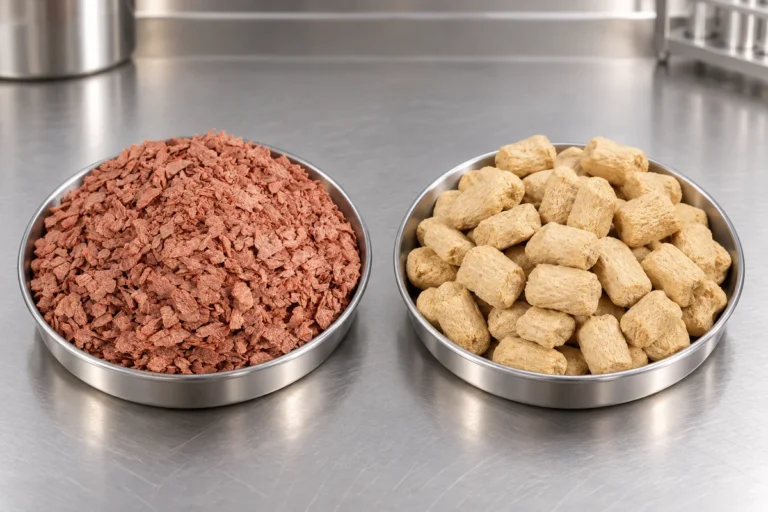
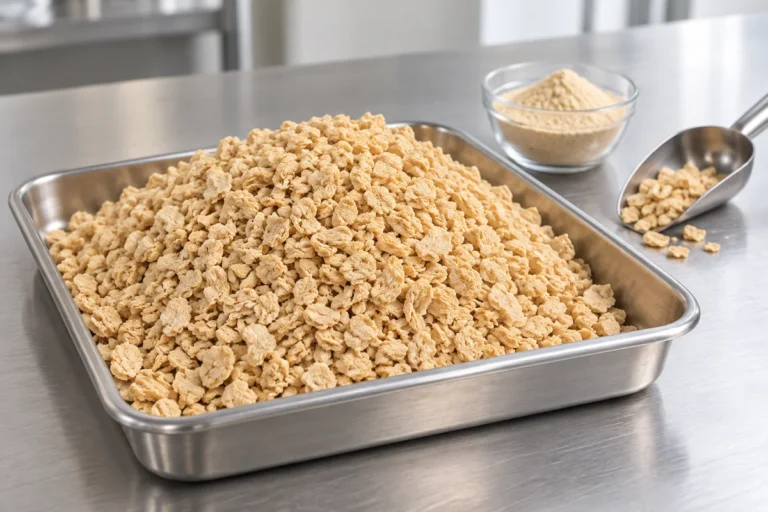
Textured soy protein is a broad category of soy-based textured protein ingredients. It can appear as granules, flakes, mince, chunks, strips, or larger pieces depending on the extrusion process and cutting method. It is widely used in vegetarian foods, meat-free mince, frozen meals, fillings, sauces, and ready-meal applications.
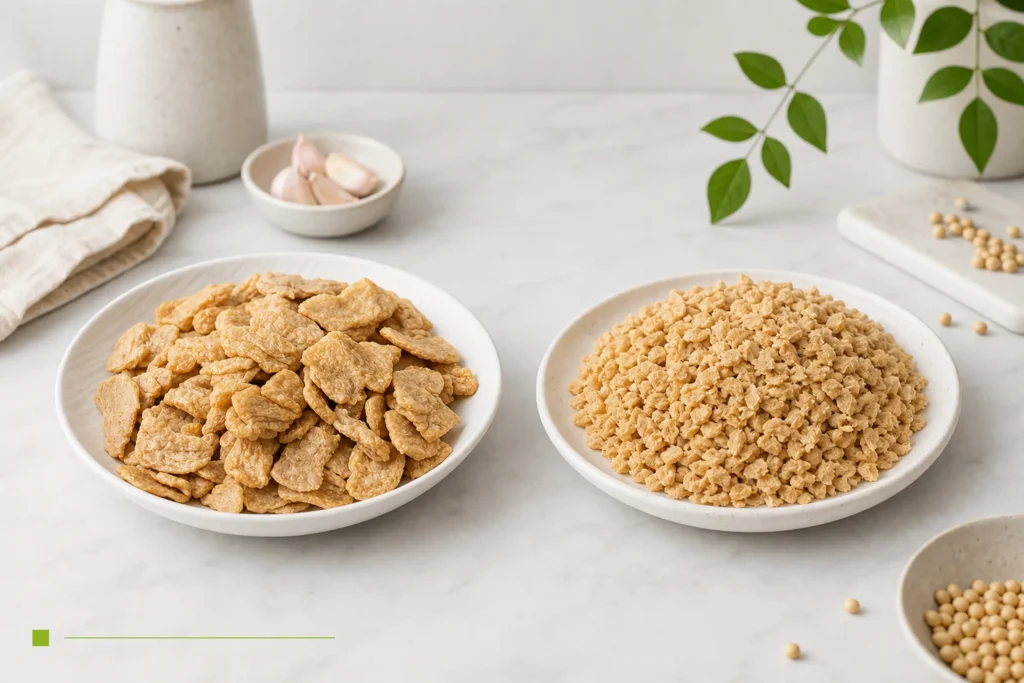
Fibrous Soy Protein, by comparison, is usually a more specialized format within that broader category. It is designed to provide stronger fiber direction, layered bite, and a more meat-like chewing experience. This makes it more suitable for applications such as plant-based beef strips, vegetarian chicken chunks, shredded meat alternatives, and vegan jerky.
The confusion often comes from supplier naming practices. One supplier may describe a product as “textured soy protein strips,” while another may call a similar-looking product “fibrous soy protein.” On B2B platforms, terms such as soy TVP, soya fiber protein, textured vegetable protein, and soy protein fiber may also appear together.
For procurement, the product name should only be the starting point. Buyers should review the actual specification, including protein content, moisture, shape, fiber direction, hydration ratio, texture after reheating, COA, allergen statement, and batch traceability. Typical dry soy protein ingredients may contain around 50% to 70% or higher protein depending on specification, with moisture often controlled at low levels, commonly below about 10%.
From a quality perspective, ISO 22000 emphasizes traceability and food safety management, while Codex Alimentarius hygiene principles support controlled production and documentation. These standards remind buyers that naming consistency is useful, but technical verification is more important.
Production Process: Standard Texturization vs Fibrous Structuring
Both textured soy protein and Fibrous Soy Protein are commonly produced through extrusion. During extrusion, soy protein materials are hydrated, heated, pressurized, sheared, and shaped to create a structured protein matrix.
Standard textured soy protein is often produced through low-moisture extrusion. This process is suitable for shelf-stable dry products such as granules, flakes, mince-style pieces, chunks, and slices. These formats are practical when the final product does not require a strong visible fiber structure.
Fibrous structuring requires more precise control of protein alignment, moisture, temperature, die design, and post-extrusion shaping. In some applications, high-moisture extrusion or more directionally controlled structuring can create a clearer fiber network and a stronger meat-like bite. This is why Fibrous Soy Protein is often preferred for strips, chunks, jerky, and products that need pull-apart texture.
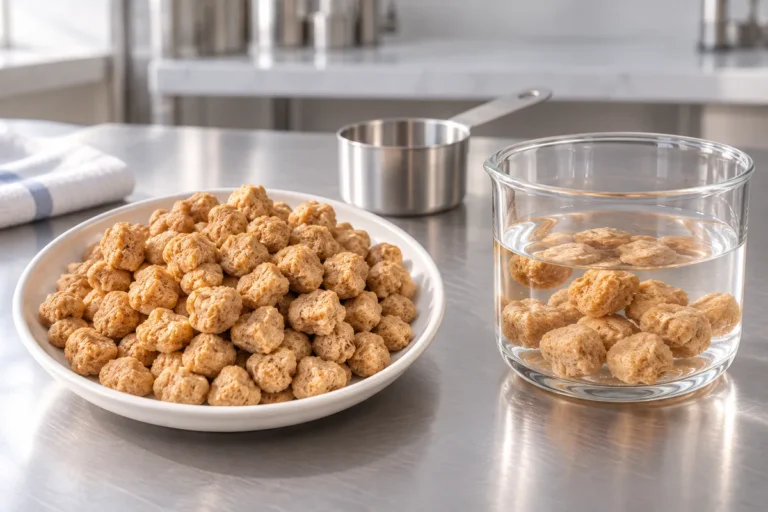
In practical production, hydration conditions often start around 50–70°C, with soaking times of about 20–40 minutes and hydration ratios around 1:2.5 to 1:3.5. These numbers should not be treated as universal rules; they are starting points that must be tested against the actual product formula, particle size, seasoning system, and cooking process.
HACCP principles and FDA FSMA preventive controls both support the idea that process risks should be identified before commercial production. In plant-based meat, texture failure is not only an ingredient issue; it is often a combined result of raw material selection, hydration, formulation, and processing control.
Texture, Hydration, and Reheating Performance
The biggest practical difference between standard textured soy protein and Fibrous Soy Protein appears after hydration, seasoning, and reheating.
Standard textured soy protein can perform well in many applications, especially where the ingredient is chopped, minced, mixed into fillings, or used as part of a composite formula. In these cases, water absorption, cost control, protein content, and flavor compatibility may matter more than visible fiber direction.
Fibrous Soy Protein is selected when the finished product needs a more meat-like texture. For example, plant-based beef strips, vegetarian chicken chunks, vegan jerky, shredded meat alternatives, and food service stir-fry products usually require stronger bite and better structure retention after cooking.
The dry appearance can be misleading. Two samples may look similar before hydration but behave very differently after pressing, seasoning, freezing, steaming, pan-frying, microwaving, or retort processing. One may absorb water quickly but become soft after reheating; another may hydrate more slowly but hold structure better in the final product.
We recommend testing the ingredient through the same process the finished product will experience. Hydration, pressing loss, seasoning uptake, cooling-stage odor, reheating texture, and final bite are all more meaningful than dry sample appearance alone.
Hidden Costs When Buyers Choose the Wrong Soy Protein Type
A low unit price can become expensive when the ingredient does not fit the application. In B2B plant-based meat manufacturing, the wrong soy protein format can lead to reformulation work, unstable yield, higher seasoning cost, delayed buyer approval, and repeated pilot testing.
The practical cost is not only the ingredient price per kilogram. It also includes hydration yield, processing time, defect rate, sensory approval risk, documentation review, and batch consistency. A simple procurement formula is:
Total application cost = ingredient price + hydration yield + processing time + seasoning adjustment + defect rate + buyer approval risk + documentation cost
This is why standard textured soy protein may be more economical for mince, fillings, sauces, and cost-sensitive formulas, while Fibrous Soy Protein may deliver better total value in plant-based strips, chunks, and jerky where structure is central to the product experience.
The honest answer is that the right choice should follow the final application, not only the quotation title.
Fibrous Soy Protein vs Textured Soy Protein: B2B Comparison
| Comparison Point | Textured Soy Protein | Fibrous Soy Protein | B2B Buyer Note |
|---|---|---|---|
| Category scope | Broad soy-based textured protein category | More specialized fibrous format within the category | Related, but not always interchangeable |
| Texture structure | Granular, flaky, chunky, or mince-like | More directional, layered, and fiber-like | Check hydrated structure, not only dry appearance |
| Hydration behavior | Designed for general water absorption | Selected for structure retention after hydration | Test hydration ratio and water release |
| Bite and chewiness | Moderate chew depending on grade | Stronger fibrous bite and meat-like texture | Critical for strips, jerky, and chunks |
| Best applications | Mince, fillings, sauces, toppings, patties | Beef strips, chicken chunks, jerky, shredded products | Application determines the better fit |
| Reheating performance | Suitable when strong fiber structure is not required | Better when bite must survive reheating | Test real cooking and reheating conditions |
| Cost and ROI | Often more cost-flexible | May cost more but reduce reformulation risk | Compare total application cost |
The honest answer is that the difference is not only linguistic. In procurement, the difference affects hydration behavior, bite, yield, seasoning strategy, reheating stability, and buyer approval.
How to Choose Between Textured Soy Protein and Fibrous Soy Protein by Application
| Final Application | Better Fit | Why It Matters | Quality Risk to Test |
|---|---|---|---|
| Plant-based beef strips | Fibrous Soy Protein | Needs visible fiber and chew | Weak bite or breakage after reheating |
| Vegetarian chicken chunks | Fibrous Soy Protein | Requires layered bite and chunk integrity | Soft texture after cooking |
| Vegan jerky | Fibrous Soy Protein | Needs chew, tear, and drying stability | Brittle or rubbery texture |
| Meat-free mince | Textured soy protein | Fiber direction is less critical | Mushiness or excess water absorption |
| Ready-meal toppings | Depends on product | Must survive storage and reheating | Water release or odor return |
| Food service fillings | Textured soy protein | Cost and hydration efficiency matter | Inconsistent yield |
| Canned or retort products | Application-specific | Heat stability is critical | Texture collapse after sterilization |
Product application should drive ingredient choice. Strips, chunks, jerky, and shredded meat alternatives generally need stronger fibrous structure. Mince, fillings, and cost-sensitive formulas may perform well with standard textured soy protein. Frozen, chilled, canned, and retort products should always be tested under real processing conditions before bulk procurement.
Standards and Compliance: What B2B Buyers Should Verify
Food ingredient sourcing is not only about texture. Documentation can decide whether a material passes buyer review, import inspection, or factory audit.
For soy protein ingredients, buyers should pay attention to food safety management, allergen control, traceability, and batch documentation. ISO 22000, HACCP principles, Codex Alimentarius hygiene guidance, FDA FSMA preventive controls, EU Regulation EC No. 178/2002, IFS Food Standard, Halal certification, MUI Halal Certification, COA, and soy allergen labeling are all relevant depending on the destination market and buyer requirements.
The main commercial risks of weak documentation are audit failure, import delay, allergen labeling disputes, batch rejection, formulation approval delays, and potential recall exposure in serious cases. This is not legal advice; it is practical procurement risk management. Buyers should verify whether the documents apply to the specific product, batch, and destination market before placing bulk orders.
Selection Guide: How Buyers Can Avoid Costly Mistakes
For food manufacturers choosing between textured soy protein and Fibrous Soy Protein, the safest approach is to test by application rather than by product name. A dry sample may look acceptable, but the real performance appears after hydration, seasoning, cooking, cooling, and reheating.
Before bulk purchasing, buyers should compare the specification sheet, COA, allergen statement, microbiological data, certification documents, shelf life, storage conditions, and batch consistency. They should also check whether the supplier can provide technical support for hydration, seasoning, and application testing.
A practical sourcing review should focus on four questions: whether the hydrated structure matches the final product, whether the ingredient holds texture after reheating, whether the documents are complete for the target market, and whether the supplier can maintain batch consistency.
As a soy protein supplier, Baichuan provides Fibrous Soy Protein, textured soy protein, and soy-based plant protein ingredient solutions for B2B food manufacturers, with quality-management documentation such as HACCP, ISO 9001, ISO 22000, ISO 14001, ISO 45001, HALAL, MUI Halal Certification, and IFS-related support depending on product specification and market requirements.
FAQ
What are the disadvantages of TVP?
TVP can have a dry or spongy texture if it is not hydrated and seasoned properly. Some TVP products may also have a noticeable beany flavor, especially when used in lightly seasoned formulas. Since most TVP is made from soy, it is not suitable for people with soy allergies. For B2B food manufacturers, another disadvantage is that TVP quality can vary by supplier, particle size, protein content, water absorption, and batch consistency. This is why buyers should test hydration behavior, texture after reheating, and documentation before bulk purchasing.
Is TVP better than tofu?
TVP is not simply better than tofu; they serve different purposes. TVP is usually dry, shelf-stable, high in protein, and designed to provide chew and structure in meat alternative products. Tofu is moist, softer, and commonly used for fresh, refrigerated, or lightly processed foods. For plant-based meat applications such as mince, fillings, strips, or ready meals, TVP may be more practical because it absorbs seasoning and holds texture after processing. For soft-texture dishes, tofu may be more suitable.
Is it okay to eat TVP every day?
For many people, TVP can be part of a regular diet when consumed in reasonable amounts as part of a balanced eating pattern. However, TVP is usually made from soy, so people with soy allergies should avoid it. Some consumers may also prefer to monitor total intake of highly processed foods or sodium if the TVP is used in heavily seasoned ready meals. This is general nutrition information, not medical advice. Anyone with allergies, digestive concerns, or specific health conditions should consult a qualified healthcare professional.
Does textured soy protein have fiber?
Textured soy protein may contain dietary fiber, but the amount depends on the raw material, formulation, and processing method. Some textured soy protein products are made from soy flour or soy concentrate and may retain part of the soybean fiber. Others may be formulated mainly for protein structure and texture rather than fiber content. Buyers should not assume the fiber level from the name alone. The accurate value should come from the product specification sheet, nutrition panel, or COA provided by the supplier.
What are the different types of soy protein?
The main types of soy protein include soy flour, soy protein concentrate, soy protein isolate, textured soy protein, and Fibrous Soy Protein. Soy flour is less refined and contains protein, carbohydrate, and fiber from soybeans. Soy protein concentrate has a higher protein level and is often used in processed foods. Soy protein isolate is more refined and usually has the highest protein concentration. Textured soy protein is structured through processing to create chew and water absorption. Fibrous Soy Protein is a more specialized textured soy protein designed for stronger fiber-like texture and meat alternative applications.