When a vegan-meat startup in Amsterdam iterated through three standard TVP suppliers and still could not replicate the “pull” of chicken breast, the breakthrough came only when they switched to fibrous soy protein — a material whose directional fibers tear like muscle instead of crumbling like sponge. Eleven months and roughly forty formulation trials had gone into binders, methylcellulose replacements, hydrocolloid blends and marinade systems, all of them attempts to fix a texture problem that lived in the base material rather than in the recipe. The first fibrous trial, run with no binder changes at all, scored higher on “meat-like” than any previous version. Standard TVP had hit its ceiling; fibrous soy protein was the next tier. Finding a fibrous soy protein manufacturer in China is therefore a different, more demanding search than buying commodity TVP.
Why Fibrous Beats Standard TVP
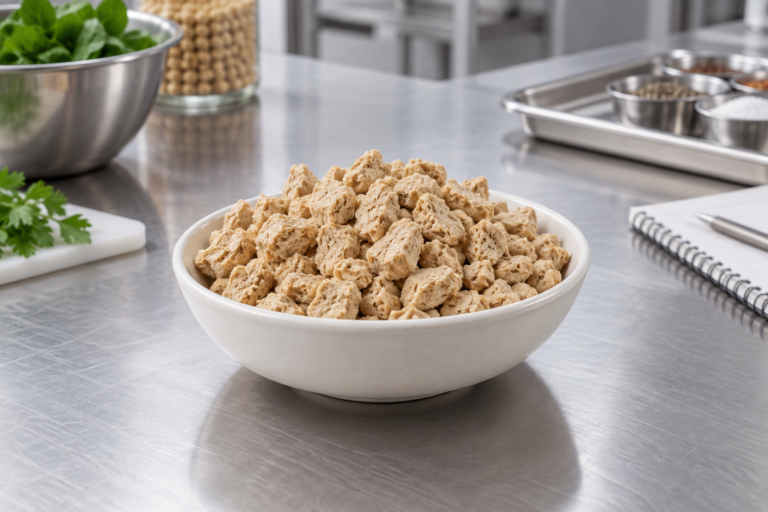
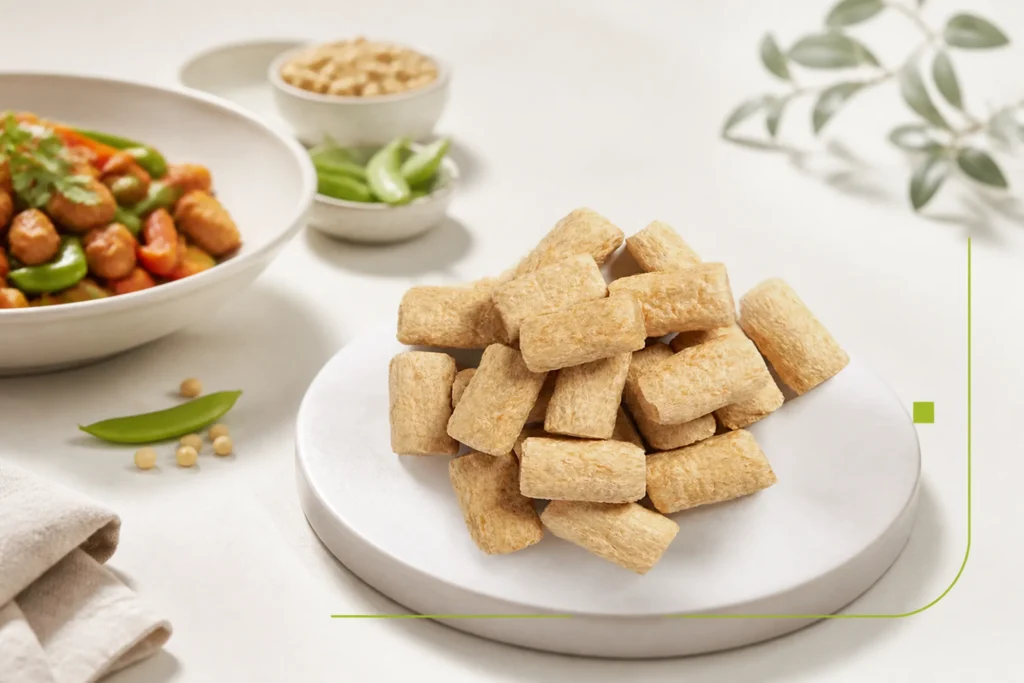
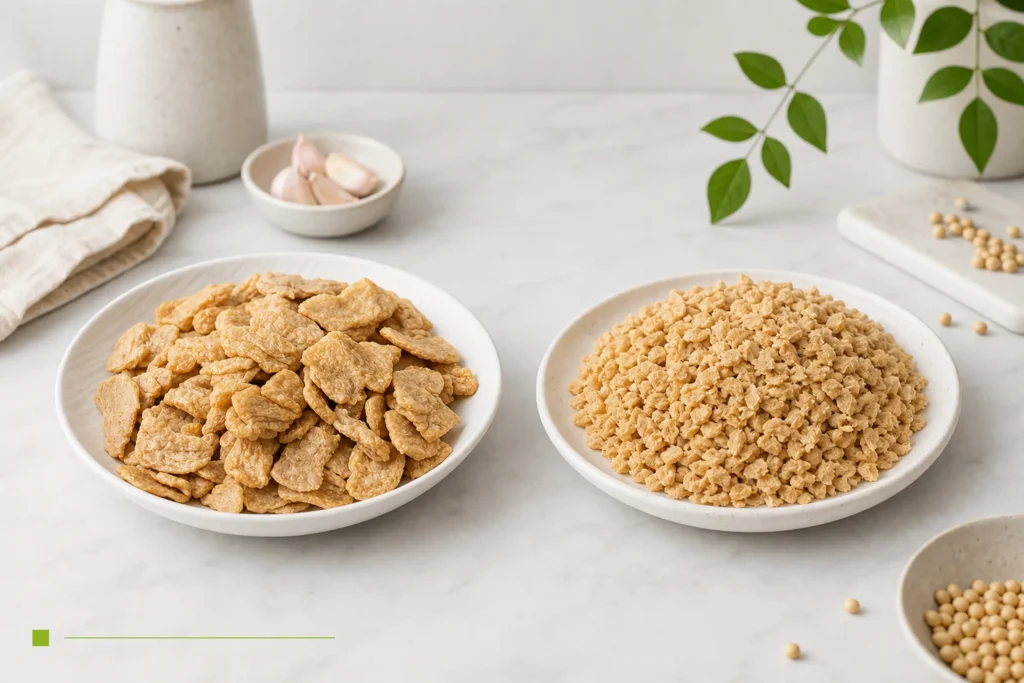
Standard TVP is expanded; fibrous soy protein is oriented. The fiber direction creates tensile bite and sauce-holding structure. Compare in our TVP types guide. The physical difference happens at the die. In conventional extrusion the protein melt exits into atmosphere, water flashes to steam, and the material puffs into an isotropic open cell structure — strong in no particular direction, which is exactly why it crumbles evenly. In high-moisture or long-cooling-die extrusion the melt is held between 60–75°C in a laminar flow channel for several seconds while it sets, so the protein chains align along the flow axis and cross-link into stacked sheets. Cut across that grain and you get a face that looks like muscle fiber; pull along it and it tears in strands. No downstream binder, marinade or cutting technique recreates that from an expanded base.
| Property | Standard TVP | Fibrous Soy Protein |
|---|---|---|
| Structure | Expanded | Directional fiber |
| Bite | Spongy | Meat-like |
| Heat stability | Moderate | High |
| Protein | 50–60% | 60–70% |
Applications
Vegan chicken strips, plant-based beef, shredded “pork”, meat jerky and center-plate analogs. For strip shape specifically, see TVP strips. Each application leans on a different property of the fiber. Vegan chicken depends on clean white fiber bundles that separate under a fork, so brands prioritize light color, neutral flavor and a medium fiber diameter. Vegan beef needs density and resistance, achieved with a thicker fiber and higher bulk density so the piece pushes back before yielding. Shredded pork analogs are made by tearing rather than cutting, which only works when the grain runs consistently through the whole block. Vegan jerky is the most demanding case: the product is dried back down to 15–25% moisture and eaten cold, meaning every structural weakness is exposed with no sauce to hide it — expanded TVP simply shatters, while fibrous grades bend and tear correctly.
Manufacturing Difficulty
Fibrous extrusion demands tighter control of moisture, shear and cooling than commodity TVP; few Chinese lines do it well. Our evaluation guide helps screen capability. Three constraints explain the scarcity. Cooling dies are long, water-jacketed and expensive, and they must hold a temperature profile within a few degrees across the full width or the fiber structure becomes patchy. Throughput drops sharply — a line producing several tons per hour of granules may manage a third of that on fibrous grades, which raises fixed cost per kilogram. And process windows are narrow: a small drift in barrel moisture or screw speed shifts the product from fibrous to expanded, so statistical process control and trained operators matter more than nameplate capacity. This is why buyers should confirm dedicated fibrous capability rather than accepting a claim built on a retrofitted standard line.
Cost Logic: Per Kilo Versus Per Serving
Fibrous soy protein carries a premium over commodity TVP, and buyers who compare only dry landed price will reject it. The comparison that matters is cost per acceptable serving. Higher protein at 60–70% means a lower inclusion rate reaches the same label claim. Better hydration retention means more finished weight per dry kilogram and less purge in the pack. Superior structure removes the binder and hydrocolloid layer many brands add to compensate for a weak base — often several cents per unit in ingredient cost plus a clean-label penalty on the pack. And the commercial effect is larger still: products that eat convincingly hold repeat purchase, while spongy ones churn. In practice a fibrous grade priced 25–40% above standard TVP frequently lands neutral or favorable once inclusion rate, yield and removed additives are counted.
Working With Fibrous in the Plant
Fibrous grades reward slightly different handling than commodity TVP, and teams that carry over their old process often blame the material for their own settings. Hydrate at 1:2.8–3.2 in water or broth at 80–85°C for 20–30 minutes; fibrous pieces are denser and take longer to wet through than an expanded granule, and a rushed soak leaves a dry core that turns chalky after frying. Salt the hydration water at 0.8–1.2% to firm the fiber. Drain, then press to a consistent free-water level rather than eyeballing it, because the water carried into the mixer is the single largest source of yield variance. Marinate after hydration, ideally under light vacuum tumbling for 20–30 minutes, so flavor travels along the fiber channels instead of sitting on the surface. When shredding, tear along the grain by hand or with a low-speed paddle; high-shear equipment destroys the very structure you paid a premium to obtain. For jerky, dry back gradually to 15–25% moisture — aggressive drying case-hardens the exterior and leaves the interior tough.
Certification, Documentation and Market Access
Premium plant-based brands sell into audited retail channels, so the compliance package around fibrous soy protein is part of the product, not paperwork attached to it. Baichuan operates HACCP hazard control with ISO 9001 quality management, ISO 22000 food safety management, ISO 14001 environmental management and ISO 45001 occupational health and safety. HALAL certification, including MUI Halal recognition, opens Indonesian and wider Southeast Asian markets where importers verify the certifying body rather than accepting a generic claim, and IFS supports European retailer private-label programs. When qualifying any fibrous supplier, confirm the certificate scope names the actual extrusion line, request the allergen management statement covering soy cross-contact, and ask the plant to demonstrate a mock recall within its stated window. Buyers requiring identity-preserved non-GMO soybeans should confirm segregation is documented from the crushing plant forward, since that is a supply-chain commitment rather than a certificate issued on demand.
Why Baichuan
Baichuan’s fibrous soy protein is engineered for structure and stability, supported by sample testing and full export documentation — HACCP, ISO 22000, ISO 9001 and Halal certified. The management system additionally covers ISO 14001 environmental management and ISO 45001 occupational health and safety, with HALAL recognized under MUI Halal for Indonesian and Southeast Asian markets and IFS available for European retail programs. Each lot ships with a certificate of analysis reporting protein by AOAC 992.23, moisture ≤10%, ash, fat, bulk density and microbiological results, and cook-test or fiber-orientation evidence can be supplied with development samples.
Selection Checklist
- Request fiber-orientation microscopy or cook-test proof.
- Validate third-cycle heat stability.
- Confirm dedicated fibrous lines (not retrofitted standard TVP).
- Hand-tear a hydrated sample — it should strand along a grain, not break into crumbs.
- Model cost per finished serving, not per dry kilogram.
- See why brands choose Baichuan.
Baichuan provides textured soy protein and fibrous soy protein with the certifications global B2B buyers require, so a brand can trial a standard grade and a fibrous grade side by side under one document set and one shipment.
FAQs
Why is fibrous more expensive?
Dedicated extrusion and higher protein yield; the cost guide shows it can be cheaper per serving.
Can fibrous soy protein replace methylcellulose in my formula?
Often partially. Because the base material already supplies structure, many developers cut binder dose substantially — but validate bind in your own process before removing it entirely.
What is soy protein fiber?
In the food industry, soy protein fiber, or fibrous soy protein, is an extruded plant ingredient processed under high heat and pressure to create a stringy, muscle-like texture that mimics animal meat.
What is an example of fibrous protein?
In biology, collagen and keratin are classic examples. In the plant-based food industry, fibrous soy protein and fibrous pea protein are common examples used to replicate meat textures.
Is soya protein high in fiber?
It depends on the processing. Soy protein isolate has almost no dietary fiber because it is highly purified, while defatted soy flour and standard textured vegetable protein (TVP) retain a significant amount of natural dietary fiber.
What is the difference between fibrous and non-fibrous proteins?
Fibrous proteins are long, strand-like, water-insoluble molecules that provide structural support, such as muscle or hair. Non-fibrous, or globular, proteins are compact, spherical, water-soluble molecules that perform functional roles like enzymes and antibodies.
What are the two kinds of fibrous proteins?
In biology, the two most prominent kinds of fibrous proteins are collagen, which provides strength to connective tissues, and keratin, which forms protective structures like hair and nails.
References
- ISO 22000:2018 — Food safety management
- AOAC 992.23 — Protein determination
- ISO 9001:2015 — Quality management systems
- Codex Alimentarius CAC/RCP 1-1969 — General principles of food hygiene (HACCP)
- IFS Food Standard v8 — Retail-brand food product audits
Explore Baichuan: TVP & Fibrous Soy Protein Products · About Baichuan’s Manufacturing · Contact Us for Samples & Quotes