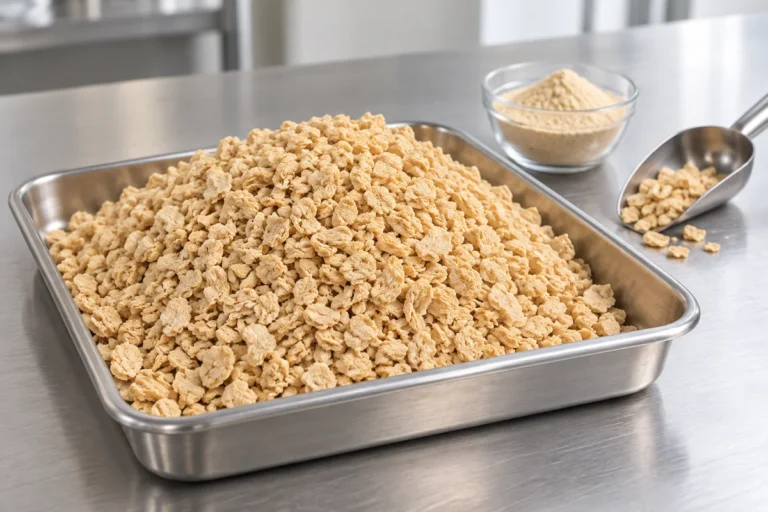
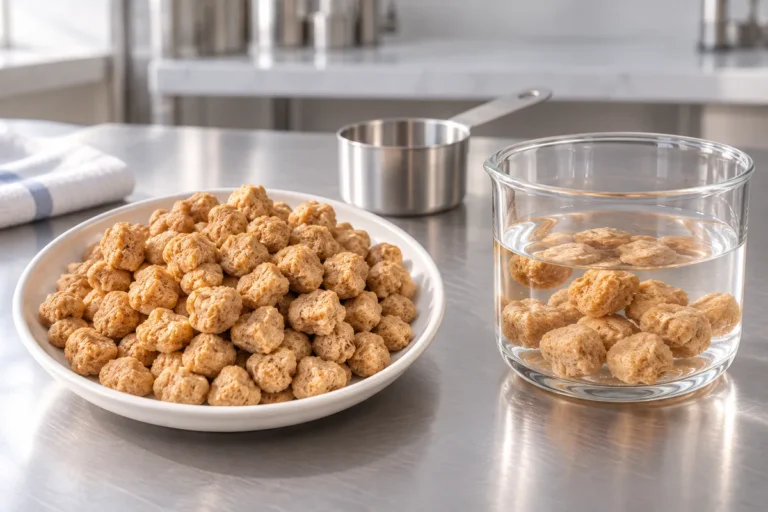
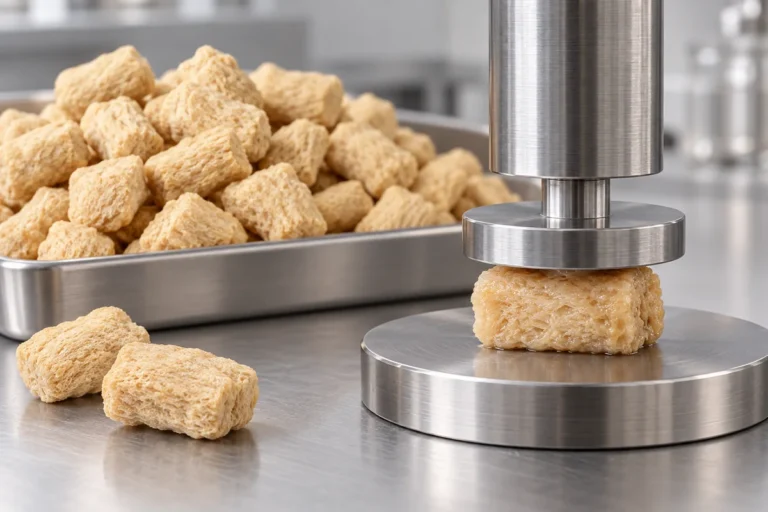
When a procurement manager in Rotterdam encountered crumbling pieces during a pilot run of a plant-based ragù, she first asked for a “better TVP.” The visible failure appeared within minutes of hydration: fine fragments swelled unevenly, then broke down under mixing. A review of the purchase specification reversed the diagnosis. The issue was not simply a bad product; the brief had never stated the soy raw material, particle shape, bulk density, or target hydration ratio.
Summary: Fibrous soy protein and textured vegetable protein (TVP) overlap, but they are not reliably interchangeable buying terms. TVP describes a textured vegetable-protein ingredient category, while “fibrous soy protein” usually describes a soy-based product engineered for a more meat-like strand or bite. Buyers should specify the starting material, form, density, particle size, protein basis, and hydration test—not just the name. In the United States, ingredient names must be declared in descending order by weight under 21 CFR 101.4; that makes the actual formulation material to both purchasing and labeling.
Why should buyers define the ingredient before using the trade name?
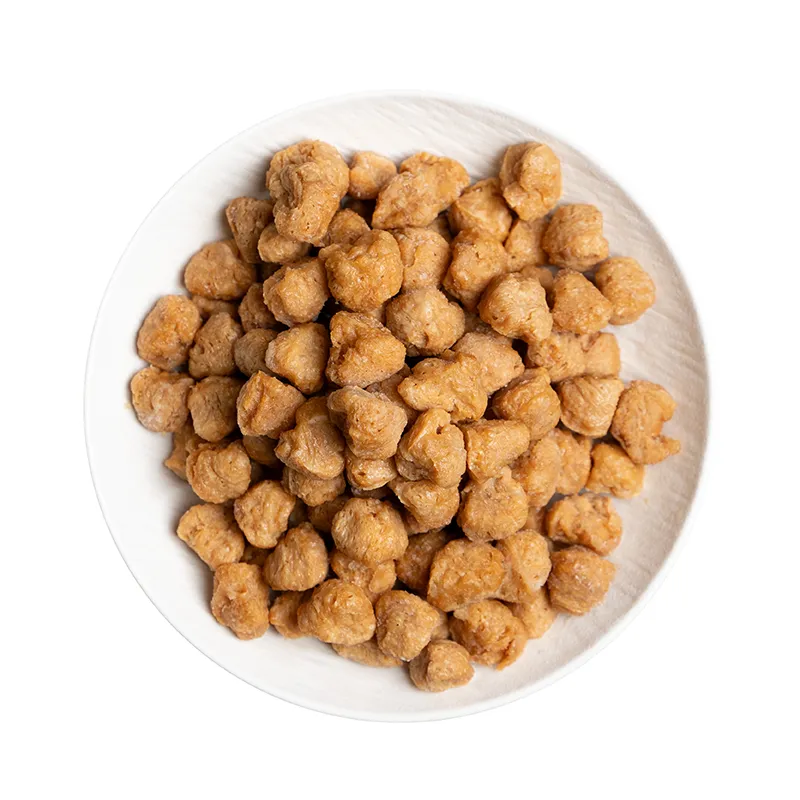
TVP is widely used as a commercial umbrella term for vegetable proteins that have been texturized, most often by extrusion. It can be made from soy, other plant proteins, or blends. Textured soy protein is narrower because it identifies soy as the source. “Fibrous soy protein” usually describes the structure and intended eating experience, not a universal regulatory grade.
That distinction matters when a brief calls for soy protein isolate TVP. Soy protein isolate is a high-protein soy ingredient class; a TVP made from it may perform differently from one made with defatted soy flour or soy protein concentrate. Before treating the terms as interchangeable, request the ingredient statement, allergen information, protein declaration on the same moisture basis, and a sample tested in the intended process.
How does extrusion affect TVP performance in a finished food?
For soy-based TVP, manufacturers commonly start with defatted soy flour, soy protein concentrate, soy protein isolate, or a blend. The dry mix is conditioned with water and processed in an extruder, where heat, pressure, shear, and die shape reorganize the protein matrix. When the material leaves the die, pressure drops and moisture flashes off; the resulting structure can be cut into granules, flakes, strips, chunks, or other formats.
Extrusion is not one fixed recipe. Feed moisture, temperature profile, screw configuration, die geometry, drying, and post-cutting affect porosity, density, and particle integrity. Two products sold as TVP can therefore take up water at different rates or behave differently in a retort, freezer-thaw cycle, or high-shear sauce. A workable specification states the end use and hydration conditions: water temperature, ingredient-to-water ratio, soak time, draining method, and whether the weight is recorded before or after cooking.
For a mince application, a lower-density porous piece may hydrate quickly. In a formed patty or chunky sauce, a denser, more coherent fibrous piece may retain its identity through mixing. Neither is automatically better; the relevant cost is usable yield after hydration and processing, including trim, breakage, seasoning adjustment, and sensory rework.
How should protein and water absorption be compared?
Protein should be compared on a stated basis. Specifications often report protein “as is,” while technical comparisons may use a dry basis; those figures are not directly comparable when moisture differs. ISO 20483 describes Kjeldahl-based determination of nitrogen and calculation of crude protein for cereals, pulses, and related products. It is a test method, not a promise that every soy ingredient will provide the same protein percentage.
Water absorption TVP is also a test result, not a fixed attribute. It is commonly expressed as grams of water retained per gram of dry ingredient, but the answer changes with the hydration ratio, water temperature, soak time, and the way free water is removed before weighing. Ask suppliers for the method and acceptance range instead of accepting an unqualified “high absorption” statement.
| Decision point | Fibrous soy protein focus | General TVP focus | Commercial implication |
|---|---|---|---|
| Raw material | Confirm soy source and protein class | Confirm plant source or blend | Supports allergen, label, and nutrition review |
| Structure | Strand-like cohesion and bite after cooking | Granule, flake, strip, or chunk geometry | Determines visible identity and breakage risk |
| Hydration | Retention under mixing and sauce load | Rate, uptake, and drained yield | Changes batch yield and seasoning balance |
| Protein comparison | State moisture basis and analytical method | State moisture basis and analytical method | Avoids false like-for-like comparisons |
| Unit-cost tendency | May reflect a more application-specific structure | Depends on raw material and grade | Evaluate cost per finished serving, not dry price alone |
For formulations where yield matters, evaluate moisture retention soy protein under the actual sauce, salt, fat, and thermal conditions. Salt, fat, and seasoning can change how a hydrated piece carries flavour and free moisture; a dry-bench result is useful for screening but does not replace a line trial. Illustratively, an ingredient with a higher dry-kilogram cost can still lower finished-unit cost if it provides stable hydrated yield with less breakage. The calculation must use the buyer’s measured yield and reject rate.
Which particle size and texture grade fit the application?
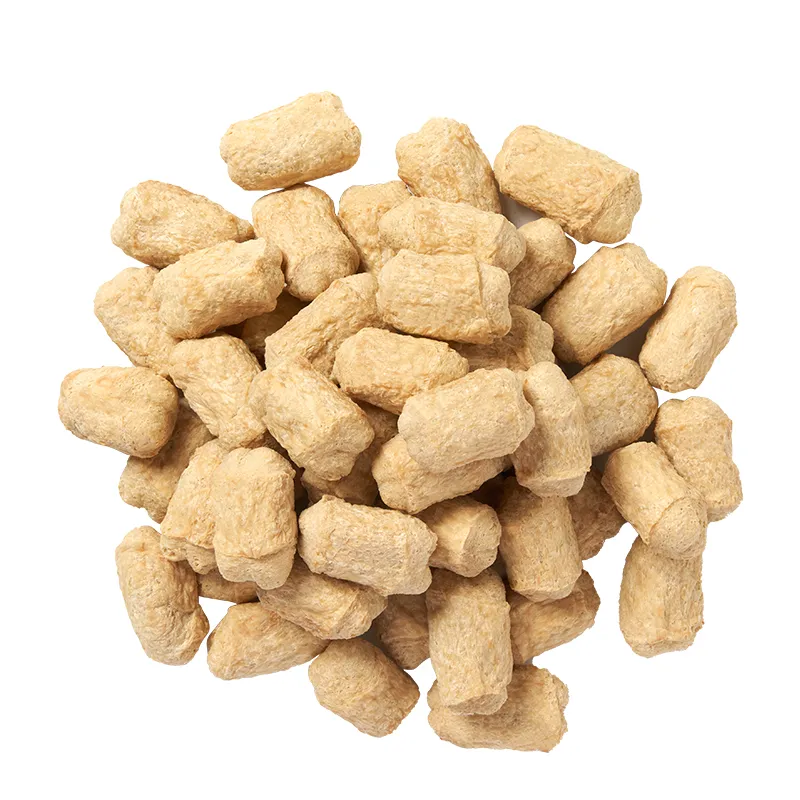
Particle selection starts with the finished product. Fine granules can suit seasoned fillings, crumbles, and products where a uniform matrix is desired. Medium pieces can work in meatless sauces or stuffed products. Larger chunks, strips, and irregular fibrous pieces are more appropriate when consumers should see and bite a distinct inclusion.
Do not rely on labels such as “fine,” “medium,” or “chunk” without a sample and a grading definition. Request a sieve or dimensional range, bulk density, broken-piece allowance, and photographs of the hydrated ingredient. If the product will pass through pumps, depositors, or filling heads, test the largest particle and its hydrated resilience in that equipment. This is where water absorption TVP data becomes operational rather than merely technical.
| Application | Usually suitable grade | Specification to prioritize | Trial watch-out |
|---|---|---|---|
| Seasoned filling or dry mix | Fine granule | Particle distribution and dispersion | Dusting or rapid over-hydration |
| Pasta sauce or chilli-style dish | Medium granule or small chunk | Hydrated integrity and sauce uptake | Breakage during kettle mixing |
| Formed burger or nugget | Fine to medium, formulation-dependent | Binding contribution and moisture control | Texture becoming pasty |
| Visible meat-alternative pieces | Chunk, strip, or fibrous piece | Shape retention and bite | Inconsistent size after cooking |
What should buyers verify for sourcing and compliance claims?
“Non-GMO” is a sourcing and claim question, not a synonym for food safety. In the United States, the National Bioengineered Food Disclosure Standard in 7 CFR Part 66 governs disclosure of bioengineered foods in its defined scope; it does not itself certify a product as non-GMO. Destination-market rules, the formulation, and the exact package claim determine what documentation is needed.
Soy is also a major food allergen in the United States, so finished-food labeling and cross-contact controls deserve early review. Requirements differ by market, and an ingredient supplier’s certificate should be checked for scope, current status, and the specific manufacturing site. ISO 22000, for example, concerns a food-safety management system; it is not a blanket product-quality claim. See BCTVP’s guide to fibrous versus textured soy protein for related terminology, then confirm the documents applicable to the intended market with the supplier and the buyer’s regulatory team.
What belongs in a reliable procurement trial?
Before approval, ask for five things: the exact soy starting material and ingredient statement; a protein result with moisture basis and analytical method; particle-size and bulk-density limits; a written hydration protocol with ratio, time, draining method, and target retained-water range; and documentation supporting any origin, identity-preserved, non-GMO, or food-safety claim. Build the pilot specification around the food you will actually make, rather than the supplier’s dry sample description.
BCTVP can be a useful discussion point once those requirements are defined: its product range can be reviewed against the buyer’s selected format, hydration approach, and documentation needs. The goal is not to force every application into one texture grade, but to match a stated process and eating experience to a reproducible ingredient specification.
Frequently asked questions
What is fibrous soy protein?
Fibrous soy protein generally refers to a soy-based textured ingredient designed to create a strand-like or layered, meat-like bite. It is a commercial description, so buyers should still confirm the soy raw material, shape, density, and post-hydration performance. A sample evaluated in the finished recipe is more informative than the label alone.
What is textured vegetable protein?
Textured vegetable protein is a broad term for plant protein that has been processed into a structured form, commonly through extrusion. Soy is a frequent source, but the term does not guarantee that soy is the only or even the stated raw material. Check the ingredient statement and technical sheet when allergen, nutrition, or claim language matters.
Is TVP good or bad for you?
TVP is an ingredient, not a complete nutritional judgment. Its role in a finished food depends on the source protein, formulation, sodium, fat, serving size, and an individual’s dietary needs. Soy allergy and any market-specific labeling requirements should be considered during product development.
Is TVP just tofu?
No. Tofu is made by coagulating soy milk into a curd, whereas TVP is a dry or semi-dry textured protein ingredient commonly produced by extrusion. They can both be soy-based, but their structure, handling, and use in industrial formulations are different.
Is TVP a highly processed food?
TVP is processed because it is made by extracting or concentrating plant protein and texturizing it. Whether a finished product is described as highly processed depends on the classification system and the complete formulation, not TVP alone. Buyers should focus on transparent ingredients, validated nutrition, and claims appropriate to their target market.
Is textured soy protein the same as TVP?
Textured soy protein is often called TVP in everyday purchasing language, but the terms are not perfectly interchangeable. TVP can be a broader category that includes non-soy vegetable proteins, while textured soy protein identifies soy as the source. Specify the raw material and functional requirements to prevent an avoidable substitution.
References
- U.S. eCFR, 21 CFR 101.4: Food ingredient labeling
- U.S. eCFR, 7 CFR Part 66: National Bioengineered Food Disclosure Standard
- ISO 20483:2013: Determination of nitrogen content and calculation of crude protein content
- U.S. FDA: Food allergies
A name on a specification sheet is only a starting point; a defined ingredient, hydration method, and application trial make the buying decision dependable.
When you are ready to turn those requirements into a workable ingredient brief, explore BCTVP textured protein product options and contact the BCTVP team about your application.