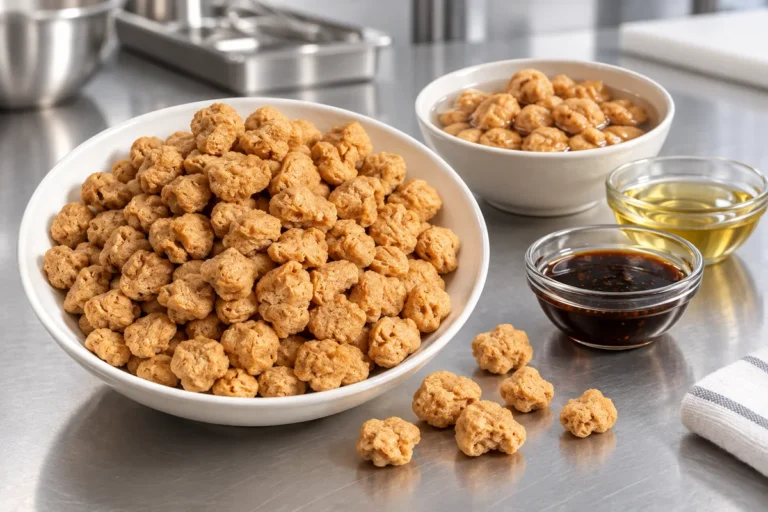
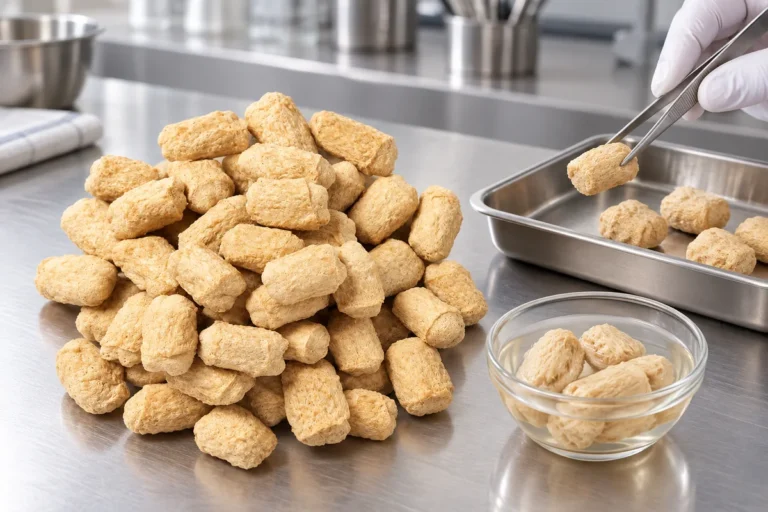
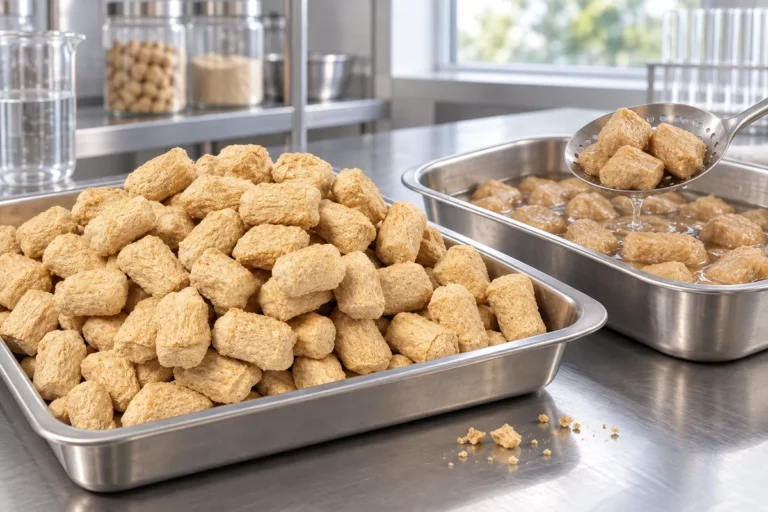
A pork-style piece can look promising after hydration, then soften, fade in colour, or release liquid only after filling and heating. That failure is rarely explained by a single ingredient property. It usually reflects a mismatch among particle architecture, water phase, fat placement, seasoning sequence and the complete intended process.
Summary: Start with the eating format and validate the material after the final thermal and handling sequence, not at the mixer. Codex CXS 175-1989 distinguishes soy protein flour, concentrate and isolate by dry-basis protein content, but those compositional categories do not predict finished bite. The practical decision is whether the exact soy grade holds its intended structure, water, colour and flavour in the full formula and actual production route.
Fibrous or textured soy protein is an expanded matrix that can contribute visible strands, particle identity and moisture management. It is not a universal pork analogue. A pulled product needs separable fibres; a diced item needs a defined cross-section; a formed item needs cohesion; a sauced item needs controlled surface softening; and a retorted item must be judged only after its validated container process. Every trial and operating condition discussed here is provisional and must be validated with the exact soy grade, full formula, actual equipment, and complete intended process.
Define each pork-style format before selecting particle architecture
Write an acceptance brief before selecting a grade. It should describe what the buyer and eater should see, feel and taste at the point of use, as well as the process stages the product must survive. This prevents a tender pulled target from being assessed with the same criteria as a firm diced target, or a freshly cooked sample from standing in for a chilled, reheated or shelf-stable product.
Set separate acceptance criteria for pulled, diced, formed, sauced and retorted products
Pulled pork-style products should separate along intended fibre direction without turning into long elastic strands. Diced products should retain a recognisable core and clean edges after cutting, heating and holding. Formed products need enough cohesion to keep their shape without becoming paste-like. Sauced products need to tolerate immersion, agitation and dwell time while still carrying flavour on and through the piece. Retorted products require a separate acceptance review after the full scheduled process, cooling and intended reheating.
| Finished format | Structure to screen | Failure to watch | Provisional validation check |
|---|---|---|---|
| Pulled | Longer fibrous pieces with a visible tear direction | Rubbery strands, fines or weak separation | Pull, chew and cooled-texture review after the complete intended process |
| Diced | Uniform chunks with a resilient interior | Hard centres, eroded edges or fracture during handling | Cut-face inspection and piece-integrity review after final heating |
| Formed | Particles that support a cohesive matrix | Cracking, a pasty bite or particle loss | Forming, cooling and reheating assessment on the actual equipment |
| Sauced | Pieces that accept coating without rapid softening | Surface erosion, diluted flavour or free liquid | Sauce-hold and served-temperature sensory review |
| Retorted | Pieces matched to the container and scheduled process | Syneresis, collapse or excessive breakage | Post-process piece count, drained appearance and reheating review |
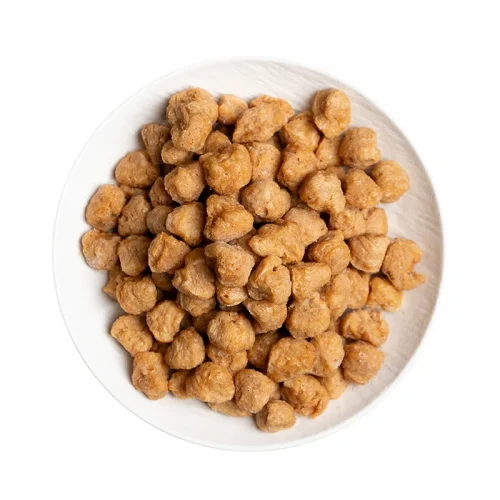
Particle size is only a starting description. Larger pieces may make a lean-meat identity more visible, while flakes can disperse through formed systems or sauces. A blend may create both fibre cues and smaller moisture-holding spaces, but it also creates different hydration responses. Compare each candidate under a documented, provisional procedure; then confirm the preferred direction with representative samples from the actual equipment.
Separate retained water from apparent uptake before setting a process
Soak gain is not the same as usable yield. Water may enter an open structure during hydration and leave later under shear, salt, acid, heating or cooling. Track dry input, hydrated drained mass, loss during mixing, loss after heating, and cooled finished mass separately. A simple mass balance makes it easier to identify whether the issue is incomplete core hydration, surface over-softening, mechanical damage or thermal release.
Use a controlled hydration screen only as a provisional development tool. Hold the water source, contact method, drain method, loading pattern and sample selection consistent while comparing candidates. Cut representative pieces before mixing to look for dry cores and swollen edges; repeat the examination after the final process. Any water addition, temperature, dwell time or mixing condition must be validated with the exact soy grade, full formula, actual equipment, and complete intended process before it is used as an operating condition.
Seasoning ingredients can complicate an early hydration result. Salt, sugar, acids, broth solids and oil can alter water movement or coat the particle, so an unseasoned screen should not be treated as a finished-formula answer. If a supplier reports a protein value, compare the stated basis and analytical method with the purchasing specification. Under Codex CXS 175-1989, the category definition is compositional; it does not establish water retention, tenderness or retort stability for a plant-based pork product.
Distribute fat to shape tenderness and flavour release without assuming a universal formula
Fat affects more than richness. A well-dispersed fat phase can change lubrication during chewing and carry fat-soluble aroma, while large or poorly integrated deposits can create uneven tenderness, visible separation or an oily first bite. The same total fat can therefore perform differently when its droplet size, placement, binder interaction, particle surface and thermal history change. There is no universal formula or addition sequence for pork-style products.
Screen fat distribution alongside the hydrated soy structure rather than as an isolated variable. Observe whether the product feels dry before flavour develops, whether aroma arrives only at the surface, and whether the centre remains under-seasoned. Evaluate appearance, bite, flavour release and aftertaste at the intended serving temperature. Then repeat the review after cooling and reheating, because a fat phase that appears stable before heating may migrate or expose different flavour notes later.
Seasoning should be checked in the complete product, not only in a pre-heat bowl sample. Assess colour and seasoning after the full process: heating can change browning, sauce appearance, salt perception and aroma retention, while cooling and reheating can reveal separation or muted flavour. Use blind comparative sensory work where practical, but treat all sensory observations as product-specific evidence rather than proof that a grade will behave the same way elsewhere.
Validate texture, colour and seasoning at every thermal checkpoint
Thermal processing is part of product design, not a final obstacle to texture work. For a pasteurized product, assess the item after its validated pasteurization route and subsequent cooling. For hot-filled products, assess the effects of fill handling, closure, cooling and intended use. For retorted low-acid foods in hermetically sealed containers for the United States, 21 CFR Part 113 is relevant; the required scheduled process and associated controls must be established and reviewed by qualified food-safety professionals. Texture trials cannot replace process validation.
| Checkpoint | What can change | What to verify after the step | Why the check matters |
|---|---|---|---|
| Pasteurization | Set, colour and surface moisture | Piece integrity, cut face and seasoning perception | A passing pre-heat sample may not represent the cooled item |
| Hot filling | Shear, sauce coverage and fill appearance | Breakage, colour uniformity and free liquid | Filling conditions can alter both structure and visual quality |
| Retort | Softening, flavour change and phase separation | Drained texture, sauce condition, colour and seasoning | The full scheduled process is the only relevant texture test |
| Cooling | Set-back, purge and fat migration | Package appearance, bite and surface condition | Defects may emerge after heat rather than during it |
| Reheating | Additional softening and aroma loss | Colour, flavour release, chew and piece survival | Procurement approval should cover the actual use cycle |
These checkpoints are a review framework, not a process schedule. The precise process must be validated with the exact soy grade, full formula, actual equipment, and complete intended process. Keep safety and texture decisions separate: do not reduce a validated thermal treatment merely to preserve bite. Where storage, distribution or customer reheating is intended, include those stages in the qualified development and regulatory review.
Apply soy allergen and food-information rules to the destination market
Soy must be addressed in both specification and label review. FDA allergen guidance identifies soy as a major food allergen in the United States. In the European Union, soybeans and products thereof are listed in Annex II of Regulation (EU) No 1169/2011, subject to the regulation’s stated scope and exceptions. Ingredient naming, allergen emphasis and any accompanying statement should be reviewed against the destination market, complete formula and finished-pack presentation by qualified regulatory personnel.
Codex CXS 175-1989 is a standard for soy protein products, not a certification of a supplier, an ingredient lot or a finished plant-based pork product. A compositional specification, allergen statement or analytical result should likewise not be presented as a food-safety certification or market authorization. Confirm the applicable documentation, change-control expectations and label claims with qualified reviewers before commercial release.
Qualify a soy protein candidate against the finished application
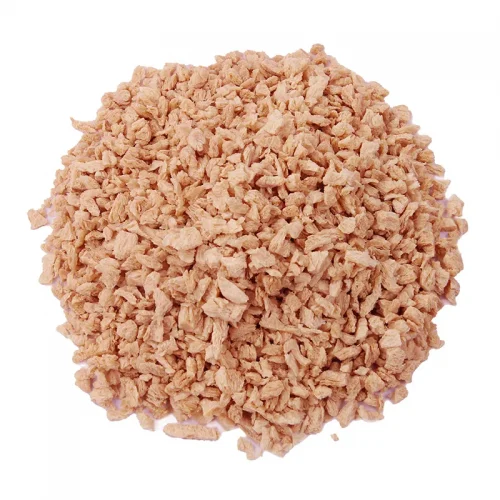
Procurement can reduce avoidable rework by asking for application-relevant samples, a clear specification and controlled comparison material. For diced ham-style products, screen high protein soy protein for ham as a format-specific candidate, then assess core hydration, cut face and cooled bite in the complete intended process. For a formed or sauced system, consider whether flakes provide the needed dispersion and particle definition; textured soy protein flakes are a relevant format to evaluate rather than a performance guarantee.
For retorted applications, high protein soy protein for canned meat must be assessed only after the scheduled process, cooling and intended reheating. Where a protein component is being considered for a sauce or coating, treat solubility, viscosity and heat response as distinct questions from fibrous texture. high protein soy protein for sauce should be evaluated in the actual sauce and full process, not inferred from a chunk trial. For all candidates, retain the lot details and record particle breakage, free liquid, colour, seasoning and sensory findings after each relevant stage.
BCTVP offers textured soy protein product formats that can be considered during an application screen. The commercially useful choice is the one that meets the agreed finished-product brief with appropriate documentation and qualified review, not the one that looks most fibrous in a dry sample.
Resolve common procurement questions before approving a formula
Can fibrous soy protein be used in plant-based pork products?
Yes. Fibrous soy protein can contribute visible structure, chew and moisture management in pulled, diced, formed, sauced and retorted pork-style products. Suitability must be confirmed with the exact soy grade, full formula, actual equipment, and complete intended process.
Is soy protein suitable for plant-based pork?
Soy protein can be suitable when its flavour, texture and allergen profile fit the product brief and destination market. Review the finished product after its full heating, cooling, storage and intended-use cycle, then obtain qualified regulatory review for the market-specific label.
What texture should soy protein have for plant-based pork?
The desired texture depends on the format: separable fibre for pulled products, a resilient core for diced pieces, cohesion for formed items, and controlled softening for sauces. Define observable acceptance criteria before trialling, then validate them with the exact soy grade, full formula, actual equipment, and complete intended process.
How much water does TVP absorb in plant-based pork formulation?
There is no responsible universal absorption figure because grade, geometry, water phase, formula, shear and thermal route all affect retained moisture. Use a provisional, controlled comparison and measure drained mass, process loss and finished texture; validate any operating condition with the exact soy grade, full formula, actual equipment, and complete intended process.
Can textured soy protein improve yield and juiciness?
It may support moisture retention and a juicier eating experience, but the result cannot be assumed from hydration weight alone. Evaluate retained mass, free liquid, tenderness and flavour release after the complete intended process, including cooling and reheating where relevant.
What allergens and labels should be considered for plant-based pork?
Soy is the central allergen consideration, and other ingredients in the full formula may introduce additional requirements. Check ingredient declaration, allergen communication and claims against the destination market, and have qualified personnel approve final artwork and compliance decisions.
Verify the regulatory and technical sources used for product decisions
- Codex Alimentarius, CXS 175-1989: General Standard for Soy Protein Products.
- Electronic Code of Federal Regulations, 21 CFR Part 113.
- 21 U.S.C. 343, including major food allergen labeling provisions, U.S. Government Publishing Office.
- Regulation (EU) No 1169/2011 on food information to consumers, Annex II.
Specify the eating experience, then prove it after the process the customer will actually use.
If you are comparing high protein soy protein for ham, high protein soy protein for canned meat or high protein soy protein for sauce, contact BCTVP with the finished format, full formula and complete intended process to discuss suitable candidates for provisional, controlled trials.