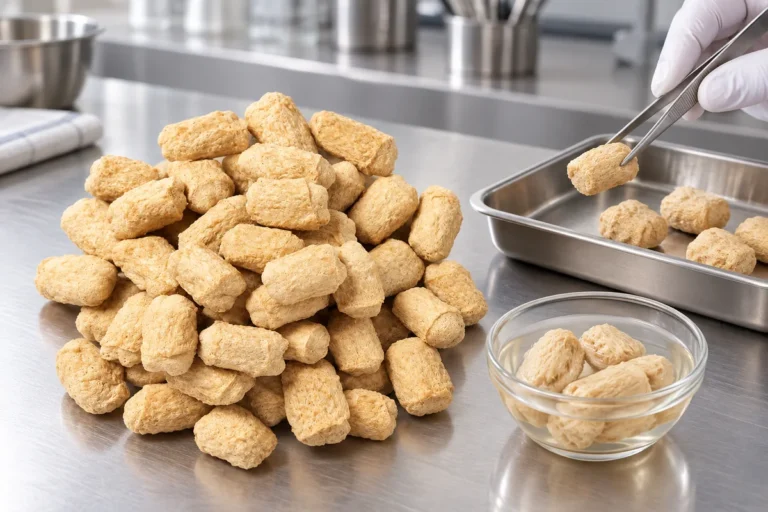
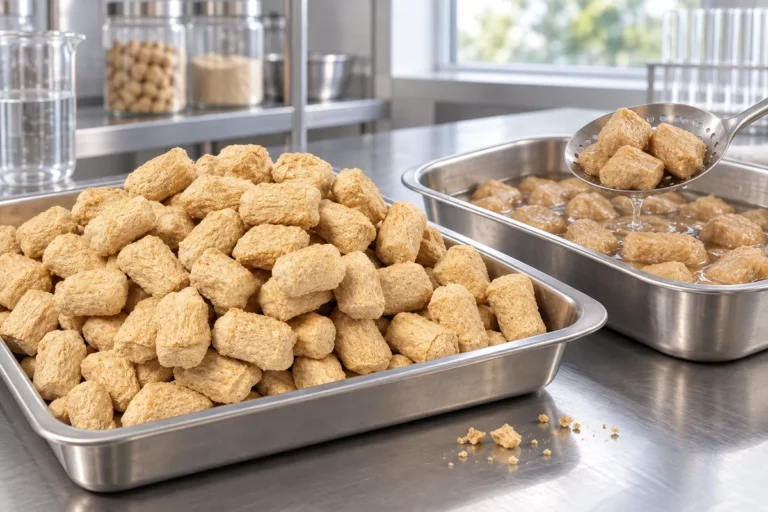
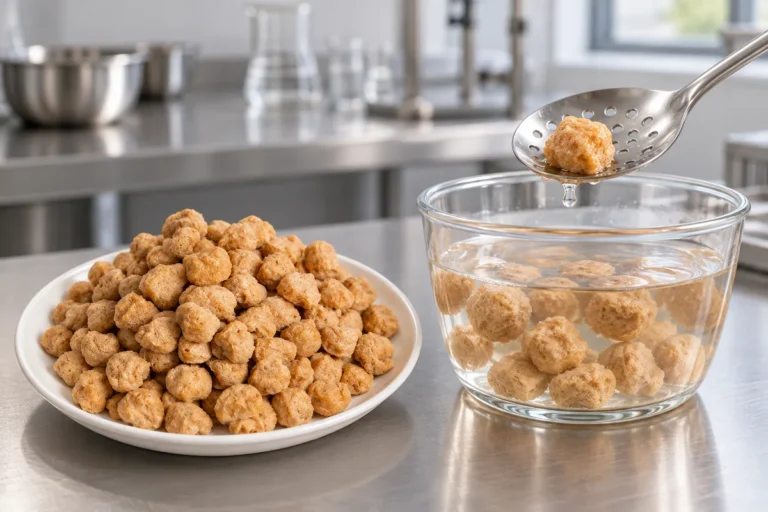
Changing from a fine textured protein to fibrous chunks without redesigning the process can leave a dry center, weak edges, uneven seasoning, or a browned surface that disappears in sauce. Those outcomes do not prove that the ingredient is defective. They show that chunk geometry, hydration, addition order, cooking, and final handling must be evaluated as one application system.
Summary: A convincing beef-style chunk needs a defined fracture pattern, a controlled chewing sequence, appropriate sauce uptake, and enough piece integrity to survive the full use cycle. Select the plant-based meat protein, hydrate the meat analog protein, and finish the plant-based beef substitute under controlled trial conditions. Do not copy a fixed liquid ratio or approve a fresh sample alone. Validate the exact grade, formula, equipment, and process, including hot holding or reheating. Standards can guide testing and labeling, but they are not product certifications.
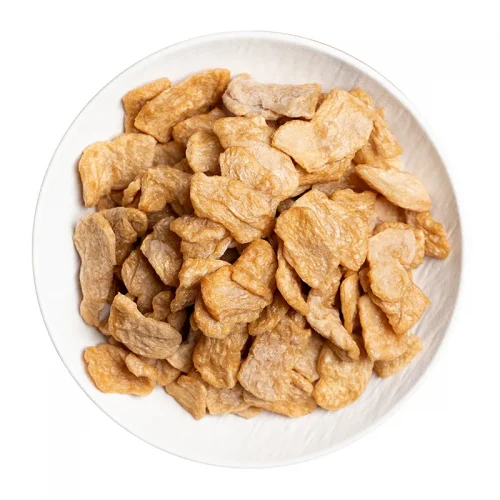
Fibrous soy protein is produced by extrusion, which reorganizes protein material into a structured form. A peer-reviewed review of meat-analogue extrusion describes ingredient composition, moisture, temperature, screw configuration, die conditions, and cooling as interacting influences on the resulting structure. That evidence explains why texture is process-dependent; it does not predict the behavior of every purchased grade in every recipe.
Define the Beef-Chunk Target Before You Select the Soy Structure
Start with the eating experience rather than a catalogue size. A stew chunk may need to remain coherent during a long sauce exposure, while a pan-seared piece may need a drier surface and a fracture that follows visible layers. A pulled concept may benefit from directional separation, but a diced ready meal may need more resistance to pumping and filling. The same dry dimensions can therefore lead to different results when density, porosity, layer orientation, and edge shape differ.
Write an acceptance description that separates four questions. How does the piece fracture under the first bite? How many chews are acceptable before it breaks down? Does sauce enter the center, remain mainly at the surface, or collect as free liquid? What proportion of representative pieces remains recognizable after each handling stage? These are development criteria, not universal specifications. Their limits must be set for the intended product and verified with the exact plant-based meat protein grade.
Measure the Eating Sequence Instead of Relying on One Hardness Reading
An instrumental compression test can compare samples when probe, sample orientation, compression, speed, and temperature are held constant. It should not replace sensory evaluation because two pieces can produce similar peak force while breaking in different directions. Build a descriptive sensory profile under ISO 13299 guidance, then define attributes such as initial firmness, fiber separation, chew-down, juiciness, coating, and residual toughness. ISO 13299 describes a method for developing sensory profiles; following it does not certify the product or guarantee consumer acceptance.
Cut representative pieces after hydration and final heating; record the center, edges, fracture face, and serving temperature. Sample across the batch rather than selecting only the best-looking chunk.
| Structure under review | Useful target question | Process risk to test | Decision evidence |
|---|---|---|---|
| Compact chunk | Does the center hydrate before the surface softens? | Core-to-edge variation | Cut-open inspection plus controlled bite assessment |
| Layered fibrous chunk | Do layers separate in the intended direction? | Delamination during mixing or filling | Fracture description before and after line handling |
| Large steak-style piece | Can it be cut or pulled without excessive fines? | Damage during cutting, pumping, or packing | Piece survival and fines recorded at each stage |
| Mixed piece distribution | Does variation create a natural bite or inconsistent cooking? | Uneven hydration and sauce loading | Representative sampling across the finished batch |
Control Hydration by Endpoint, Not by a Universal Liquid Ratio
There is no defensible absorption ratio for all fibrous soy proteins. Piece dimensions, internal structure, liquid composition, temperature recovery, agitation, time, and draining method can change apparent uptake. The useful endpoint is a hydrated center with the surface strength needed for the next operation. A copied ratio may leave a dense core or create free liquid and fragile edges.
Begin with a neutral liquid when screening structure. Salt, sugar, acid, dissolved solids, and oil can change wetting or make the result harder to interpret. Weigh dry material, added liquid, drained material, free liquid, broken fines, pre-cook product, and cooled product using a documented method. Apparent uptake after draining is not the same as retained mass after cooking, and neither should be presented as yield until the complete commercial process has been validated.
Drain consistently and define whether the operation uses gravity, a screen, light pressing, or another repeatable method. Aggressive squeezing can remove useful liquid and damage layers; insufficient draining can carry uncontrolled water into the sauce or binder. The selected method must be compatible with the intended line rather than optimized only for a bench sample.
Hydration also affects total cost. Fines, purge, extra handling, variable fill weights, or rejected packs can offset a low ingredient price. High apparent uptake has little value if the meat analog protein loses structure during cooking.
Decide Whether Flavor Must Enter the Core or Stay on the Surface
Marinade penetration and surface coating solve different problems. Penetration aims to distribute water-soluble taste through the piece; coating concentrates color, aroma, fat, or seasoning at the exterior. A chunk can taste bland at the center even when its surface is heavily seasoned, while a strongly flavored hydration liquid can still produce a weak cooked aroma if volatile notes are lost during heating.
Separate the variables in the trial. Establish hydration first, then compare aqueous seasoning added during hydration, after draining, or in a staged process. Observe center flavor, surface intensity, free liquid, and piece damage. Next assess the fat phase. Fat can change lubrication and aroma release, but uneven application can create greasy patches or poor sauce adhesion. Addition order should therefore be chosen according to the desired flavor location and the mixing energy the chunk can tolerate.
Match Browning and Fat Placement to Pan-Seared or Sauced Products
For a pan-seared concept, surface moisture management matters because excess liquid can delay browning and encourage steaming. Apply a surface system that can contact the hot cooking surface, then judge color, roasted aroma, adhesion, and toughness after the complete cook. For a sauced concept, intense early browning may soften or become hidden during the later sauce stage. The development question shifts to whether browned notes remain balanced and whether the coating stays attached during holding.
Do not treat darker color as proof of beef-like flavor. Color, aroma, salt impact, umami, fat release, and aftertaste should be scored separately. Ingredient declarations and destination-market claim rules also need review before a browning or flavor component is adopted. A plant-based beef substitute should be approved on its full sensory profile, not on appearance alone.
Prove the Chunk Survives Cooking, Hot Holding, and Reheating
A fresh bench sample is only one point in the product’s life. Mixing can erode edges, pumping can fracture layers, sauce holding can soften the surface, chilling can change fat perception, and reheating can increase toughness or release liquid. Approval should therefore cover the sequence the customer or consumer will actually use.
Track the batch through hydration, draining, seasoning, mixing, filling, cooking, cooling, storage, hot holding where relevant, and reheating. At each gate, record intact pieces, fines, free liquid, dimensions, photographs, and a defined sensory profile. Piece count may be more informative for large chunks, while separated mass may be more practical when fragments are numerous. Use the same chosen method across trial conditions.
| Validation gate | Question to answer | Evidence to retain | Reason to reject or retest |
|---|---|---|---|
| After hydration and draining | Is the center hydrated while the edge remains coherent? | Cut-open images, drained mass, free liquid, surface notes | Dry core, sloughing, or uncontrolled carryover liquid |
| After mixing and filling | Do pieces survive the actual mechanical path? | Intact-piece record, fines, distribution in pack | Layer loss, settling, blockage, or uneven distribution |
| After cooking and cooling | Are bite, sauce uptake, and purge still acceptable? | Sensory profile, finished mass, purge, fracture images | Weak bite, dry center, excessive softness, or separation |
| After hot hold or reheat | Does the approved fresh texture remain within target? | Time-and-temperature record plus repeated sensory checks | Toughening, breakup, flavor loss, or coating failure |
This table defines questions, not passing values. Every trial condition and acceptance limit must be established and confirmed for the exact grade, formula, equipment, process sequence, package, storage plan, and serving method. A change to any of these variables can justify targeted revalidation.
Treat Allergen and Label Rules as Market-Specific Requirements
Soybeans are a major food allergen under U.S. law, and Regulation (EU) No 1169/2011 lists soybeans and their products in Annex II. The applicable ingredient naming, allergen emphasis, nutrition information, cross-contact controls, and voluntary claims depend on the destination market and the finished formulation. Supplier information supports the review, but the food business remains responsible for its product and label.
Codex CXS 1-1985 provides a general international reference for labeling prepackaged foods; national and regional rules govern products placed on a specific market. Terms such as “beef,” “meat,” “vegan,” and nutrition claims may also require jurisdiction-specific review. Product name, imagery, ingredient list, allergen declaration, and sales channel should be checked together rather than as separate tasks.
Keep the distinction between evidence and certification clear. ISO 13299 is sensory-method guidance, Codex CXS 1-1985 is a labeling standard, and Regulation (EU) No 1169/2011 is legislation. None of them is a certification for a soy ingredient or finished chunk. Likewise, a supplier specification or certificate of analysis does not replace the manufacturer’s hazard analysis, label approval, or application validation.
Approve the Exact Grade With a Gate-by-Gate Scale-Up Plan
- Define the intended fracture, chew-down, sauce behavior, appearance, and survival criteria before requesting samples.
- Review available plant-based meat protein chunk structures, then screen geometry and hydration without a complex flavor system.
- Compare an adjacent meat analog protein format only when its larger geometry fits the cutting, mixing, filling, and eating concept.
- Validate seasoning location, fat distribution, browning, sauce exposure, cooling, hot holding, and reheating; use the relevant plant-based beef substitute application page as a discussion starting point, not as proof of performance.
- Review the wider textured soy protein portfolio, then lock the approved item, specification, ingredient declaration, allergen information, and change-control expectations to the tested grade.
Baichuan can support grade selection and sample discussions, but its guidance remains a starting condition. Approve only material that has passed the buyer’s formula, equipment, process, market, and use-cycle checks.
Frequently Asked Questions
Can fibrous soy protein be used in plant-based beef chunks?
Yes. A suitable fibrous grade can provide recognizable pieces and directional bite when its geometry, hydration, and handling match the application. Confirm suitability in the complete formula and on representative equipment, including the intended cooking and reheat steps.
Is soy protein suitable for plant-based beef?
Soy protein can supply the structured base for beef-style analogues and can carry aqueous seasoning and fat systems. Suitability is grade- and process-specific, so texture, flavor release, allergen controls, labeling, and line behavior should be assessed together.
What texture should soy protein have for plant-based beef?
The target is a coherent piece that fractures in the intended direction, chews down without persistent toughness, and survives the required handling. A stew chunk, pulled piece, and pan-seared cube need different sensory and process criteria, so no single texture is correct for every product.
How much water does TVP absorb in plant-based beef formulation?
No universal figure applies. Uptake depends on the exact grade, piece structure, liquid, temperature, time, agitation, and drain method; retained liquid can change again during cooking and cooling. Measure it with a documented method, then validate the formula on the intended equipment and process.
Can textured soy protein improve yield and juiciness?
It may help retain liquid and support a juicier eating experience in a compatible system, but the effect cannot be assumed or quantified without a controlled comparison. Record free liquid, fines, purge, finished mass, and sensory results before making a yield or performance claim.
What allergens and labels should be considered for plant-based beef?
Review soy allergen disclosure, the ingredient list, product name, nutrition information, cross-contact controls, and voluntary claims for each destination market. Also check whether “beef,” “meat,” or “vegan” terminology is restricted or needs qualification in that jurisdiction.
Use These Sources to Set Testing and Compliance Boundaries
- High moisture extrusion cooking of meat analogs: A review of mechanisms of protein texturization, Comprehensive Reviews in Food Science and Food Safety.
- ISO 13299:2016, Sensory analysis — Methodology — General guidance for establishing a sensory profile.
- 21 U.S.C. § 321, including the U.S. major food allergen definition.
- Regulation (EU) No 1169/2011 on the provision of food information to consumers.
- Codex Alimentarius CXS 1-1985, General Standard for the Labelling of Pre-packaged Foods.
The reliable rule is to define the finished bite, separate the variables, and approve the exact material through the complete process.
For a plant-based beef chunk project, share the target geometry, processing sequence, destination market, and evaluation criteria with Baichuan; contact the team to discuss suitable samples and the documentation needed for your own validation.