Turn the product brief into measurable requirements
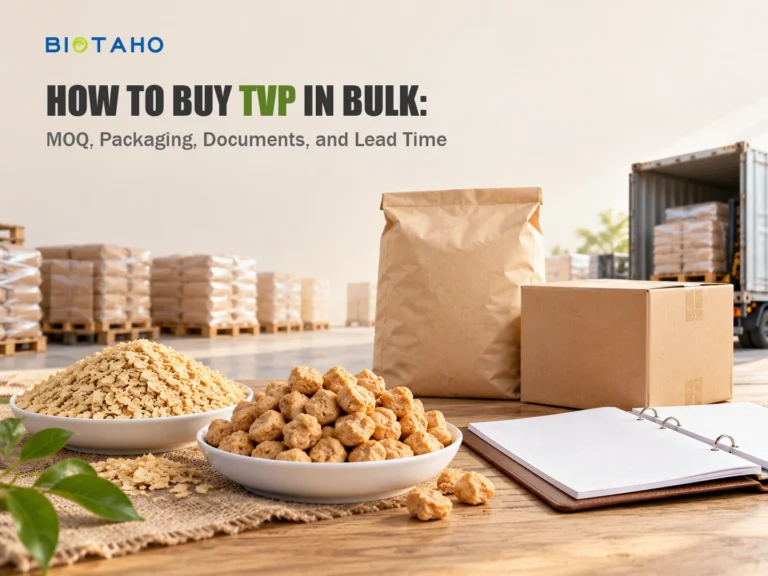
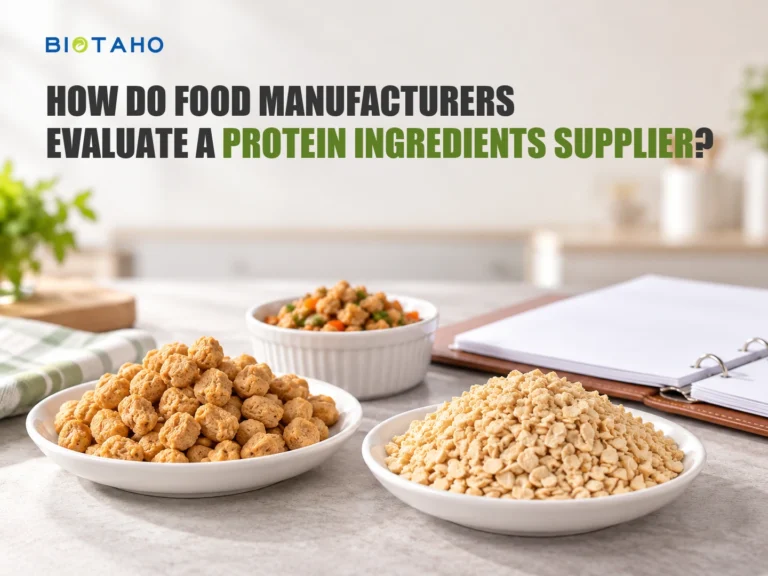
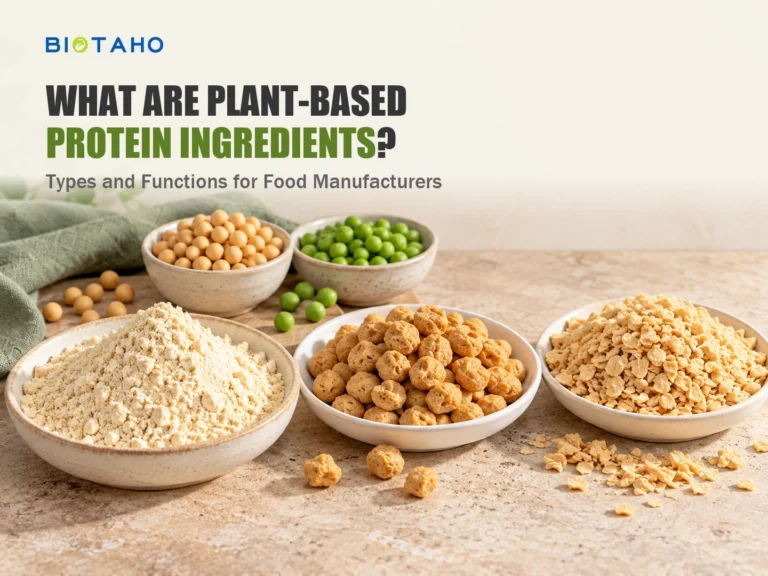
Fibrous soy protein is a textured plant protein used to add structure, bite, and protein to formulated foods. Its behavior depends on the raw material, texturizing conditions, particle geometry, moisture, protein content, and the customer’s hydration and mixing process. A supplier’s country of origin may matter for logistics and documentation, but it does not establish technical suitability.
Start with a one-page brief. State the finished application, inclusion rate, target protein contribution, preferred particle appearance, hydration equipment, water temperature, mixing sequence, shear, hold time, cooking steps, packaging, and destination market. Separate must-haves from preferences. A dry granule that works in a formed filling may not suit a sauce, instant noodle topping, or heat-processed product. A fibrous soy protein supplier can recommend a grade more responsibly when these conditions are visible.
Define acceptance criteria before samples arrive. For example, the team might require a specified hydrated yield, no unacceptable free water after the normal hold, a defined bite, and no visible separation after cooking. These are internal targets, not universal product claims. The point is to make supplier comparisons repeatable across development, quality, and procurement.
Read protein basis and particle size as control points
Protein content is a useful screening measure, but it is not a complete performance forecast. Ask whether the declared value is on an as-is or dry basis, which analytical method was used, and what tolerance applies. Confirm the moisture range separately. If one supplier reports protein on a dry basis and another reports it as received, convert them before comparing nutrition or formulation cost.
For a quick formulation check, calculate protein contribution from the ingredient inclusion rate and the declared protein fraction on the same moisture basis. Do not compare an unqualified percentage with a guaranteed minimum as if they were equivalent. The certificate of analysis should identify the method—such as a recognized AOAC method where applicable—and the specification should state the acceptance limit rather than only a typical value.
Particle size deserves the same attention. Request the nominal range, sieve or measurement approach, percentage of fines, oversize tolerance, and lot-to-lot control. A modest shift in geometry can change water demand, feeder behavior, visual uniformity, and mouthfeel. The right question is not whether a catalog offers “small” or “large” particles; it is whether the range fits the cutter, feeder, mixer, filling head, and finished bite.
| Evaluation dimension | Broad, general-purpose specification | Application-matched specification | Evidence to request |
|---|---|---|---|
| Protein contribution | May suit a wide formulation range, with more adjustment left to the plant | Selected against the finished recipe and nutrition target | Basis, analytical method, value, and tolerance |
| Particle geometry | Can require changes to feeding, hydration, or mixing | Aligned to equipment, visual appearance, and desired bite | Range, fines, oversize, and sieve or measurement method |
| Hydration and texture | Often assessed with a standard internal procedure | Assessed under the customer’s water, time, temperature, and shear | Protocol, hydrated yield, free water, hold time, and texture record |
| Process efficiency | May appear simple at quotation stage but need more line tuning | Can reduce trial iterations when the fit is right | Illustrative labor, rework, and downtime assumptions |
| Compatibility | May be acceptable in one food matrix and weak in another | Chosen for the sauce, filling, topping, or formed product | Application trial under defined cooking and holding conditions |
| Supply continuity | Depends on generic availability and planning visibility | Depends on grade control, capacity planning, and change notification | MOQ, lead-time assumptions, lot release, and escalation route |
| Total cost | May have a lower apparent ingredient cost | May justify a different cost when it reduces waste or rework | Freight, water, labor, scrap, testing, and inventory model |
Make the sample trial represent the line
Use a three-stage sample plan: inspect the dry material, run a controlled bench hydration, and then test the most promising grade in a line-relevant pilot. Record dry mass, water mass, water temperature, addition order, mixing time, hydration time, hydrated yield, free water, and texture after a defined hold. Keep the protocol identical for every candidate; otherwise, the trial measures operator technique instead of ingredient performance.
Include the real process steps that can change the result. If the finished food is cooked, chilled, frozen, or retorted, include the applicable step and the normal cooling or holding period. Assess bite, cohesiveness, visual uniformity, sauce separation, seasoning compatibility, and rehydration speed. A supplier’s recommended water ratio is a starting condition, not an acceptance limit for every recipe.
Ask for the supplier’s test method and conditions before comparing internal data with your trial. A result such as “high water uptake” has little meaning without the water ratio, temperature, mixing energy, time, sample basis, and measurement endpoint. Keep photographs or coded sensory notes, but use them alongside measured conditions rather than as a substitute for a repeatable protocol.
Audit the COA, quality system, and certification scope
A strong technical sample still needs document control. Request a lot-specific certificate of analysis with the product name and grade, lot identifier, production or release date where applicable, test results, limits, methods, and approval status. Ask which results are routine release tests and which are periodic checks. A supplier may monitor microorganisms, heavy metals, moisture, crude protein, or urease activity, but your quality plan should define what must be present on each COA and what requires separate supporting evidence.
Also request the controlled product specification, allergen statement, origin information, packaging details, storage conditions, traceability approach, complaint process, and change-notification procedure. Confirm that the documents match the proposed grade and manufacturing site. A generic brochure or an old sample COA cannot replace order-level release documentation.
Separate a management-system certificate from a product certification or regulatory approval. If a supplier presents HACCP, ISO 22000, IFS, Halal, or another credential, verify the current certificate, issuing body, site, scope, covered activities, and validity. The certificate may apply to a particular facility or management system; it does not automatically certify every product, lot, claim, or destination market. The same caution applies to “non-GMO,” protein, and nutritional-equivalence statements: review the supporting documents and the final label wording.
| Application or decision stage | Product-development evidence | Procurement and quality evidence |
|---|---|---|
| Sauce or filling | Hydrated protein holds structure without unacceptable free water or separation | Particle size, moisture, protein basis, and lot tolerances are documented |
| Instant noodle topping or seasoning | Rehydrates within the preparation window and carries seasoning evenly | Packaging, storage, foreign-material, and release controls are defined |
| Formed or minced product | Supports the desired bite after mixing, forming, and cooking | Lot release data, complaint handling, and change notice are available |
| Commercial launch | Scale-up conditions and acceptance criteria are recorded | MOQ, lead-time assumptions, capacity window, forecast process, and escalation route are written |
| New market or claim | Recipe, label, and use conditions have been reviewed together | Destination-market documents and claim support are current and grade-specific |
Check capacity, MOQ, lead time, and change control
Capacity is more than an annual volume figure. Ask whether the proposed grade is made at the stated site, how production is planned during maintenance or peak demand, and how the supplier allocates capacity when forecasts change. Confirm the packaging format and whether the same grade can be supplied consistently in the pack size your plant can receive and store.
MOQ and lead time should be written for the exact grade, pack, destination, and order type. Separate sample timing, first commercial production, repeat-order lead time, and any documentation lead time. A low MOQ may reduce inventory exposure but can increase ordering frequency; a longer lead time may require safety stock. Neither is automatically better—the right choice depends on shelf life, demand variability, warehouse space, and the cost of a line interruption.
Change control is a practical test of supplier maturity. Ask how the supplier handles changes to raw material, process parameters, site, packaging, specification limits, analytical methods, or allergen controls. Define what notice you receive, what evidence accompanies a change, and when a new sample or requalification is required. Put the agreed route into the approval record rather than relying on an informal email chain.
Model total cost before approval
Compare total cost, not only the dry ingredient line on a quotation. Include ingredient, freight, water, storage, labor, energy where material, quality testing, rejected batches, rework, trial time, inventory, and possible line downtime. For an illustrative model, compare two grades using the same production volume and add the cost of each failed or repeated trial; label all assumptions clearly because the calculation is not a supplier quote or a guaranteed saving.
Performance can change the economics in both directions. A grade with a higher apparent unit cost may be sensible if it gives a wider operating window and less rework. A lower-cost grade may be the better choice when its texture and hydration fit the process without extra handling. Let the trial data and documented supply terms decide the trade-off.
Use a stage-gated supplier approval sequence
- Write the brief. State the application, protein basis, particle target, hydration protocol, process limits, packaging, forecast, and destination markets.
- Screen the documents. Check the product specification, COA format and methods, allergen statement, quality-system scope, traceability, and change-control process before spending time on a trial.
- Run matched trials. Compare candidate grades under the same water, time, temperature, mixing, cooking, and holding conditions; record results against pre-set acceptance criteria.
- Confirm commercial fit. Ask about MOQ, sample-to-production timing, repeat-order lead time, capacity planning, forecast visibility, technical support, complaint response, and order-level terms.
- Approve with a control plan. Define incoming checks, release criteria, retained samples, requalification triggers, document owners, and the escalation route for a change or nonconformance.
A practical soy protein supplier should be able to support this sequence with clear answers, relevant samples, and grade-specific documents. Baichuan can be included in the candidate set when its proposed grade, evidence, and supply terms match the brief. Buyers should still confirm the exact product, site, documentation scope, and commercial conditions for their own order rather than treating a general product page as approval evidence.
Frequently asked questions
What are the 5 key supplier evaluation criteria?
For a food manufacturer, five useful criteria are technical fit, documented quality, compliance for the destination market, supply continuity, and total cost. Score each criterion against evidence such as a sample trial, a lot-specific COA, certificate scope, and written MOQ or lead-time terms. Weight the criteria according to product risk; a texture-critical filling may need more technical evidence than a low-inclusion topping.
What are the 7 steps of the supplier selection process?
A practical seven-step sequence is define the brief, shortlist sources, review documents, request samples, run matched trials, confirm supply terms, and approve with a control plan. Keep the same acceptance criteria from bench to pilot so a promising sample does not bypass quality review. Add a requalification trigger when the process, site, formulation, or destination market changes.
What are the criteria for selecting suppliers?
Select suppliers on evidence relevant to your product: consistent specification, fit-for-purpose trials, transparent COA methods, applicable compliance documents, and the ability to meet pack, MOQ, lead-time, and change-control requirements. Check whether support is available during scale-up and complaint handling. Record unanswered questions as open approval items instead of assuming that a catalog statement resolves them.
What are the 10 C’s of supplier evaluation?
The 10 C framework is commonly used as a procurement checklist for competency, capacity, commitment, control, cash or financial resilience, cost, consistency, culture, clean or compliance considerations, and communication. Organizations label the Cs differently, so use the framework as a checklist for evidence rather than as a food-safety certification. For this ingredient, translate each C into a document, a written term, or a trial outcome.
What are the 5 criteria of evaluation?
Five practical evaluation criteria are product performance, quality controls, regulatory fit, supply reliability, and commercial fit. Test performance under actual hydration and cooking conditions, then confirm the other four through current documents and written terms. Recheck them when the grade, site, recipe, or destination market changes.
What are the four stages of supplier selection?
The four stages are define, assess, validate, and approve. Define the brief; assess documents and supply capacity; validate the sample in a controlled trial; then approve the grade with release, change-control, and requalification rules. If validation fails, return to the brief instead of forcing the source through.
Standards and references
Compliance depends on the destination market, product category, recipe, facility, and label claims. Codex texts can help frame an international food-safety and labeling review, while United States regulation 21 CFR 101.4 addresses ingredient declaration. Neither source approves a supplier or proves that a formulation is compliant in every market.
Analytical methods also need careful reading. ISO 21528-2 concerns enumeration of Enterobacteriaceae by the colony-count technique, and ISO 16649-2 concerns enumeration of beta-glucuronidase-positive Escherichia coli by the colony-count technique. They are test methods, not product certifications. Use the method required by your quality plan, customer specification, or destination-market authority, and confirm the applicable edition and laboratory requirements.
Soy allergen labeling and cross-contact expectations should be reviewed for the destination market. Marketing language can create additional obligations, especially for protein, halal, non-GMO, or nutritional-equivalence claims. Have regulatory and quality teams approve the final ingredient statement, supporting certificates, and claim wording before launch.
- FAO/WHO Codex Alimentarius: Codex texts and standards
- Electronic Code of Federal Regulations: 21 CFR 101.4
- ISO 21528-2 official standard page
- ISO 16649-2 official standard page
The best supplier decision is the one that still makes sense after water, heat, shear, labeling, and a real production schedule enter the discussion.
If Baichuan is on your shortlist as a textured soy protein supplier, review the product range, then use the quality and safety information and contact page to request a grade-specific specification, sample plan, COA format, MOQ, lead-time assumptions, and change-control terms for your market.