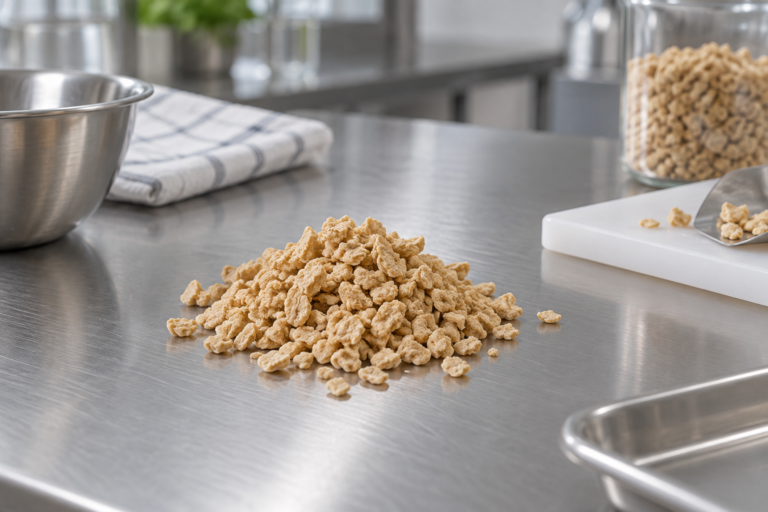
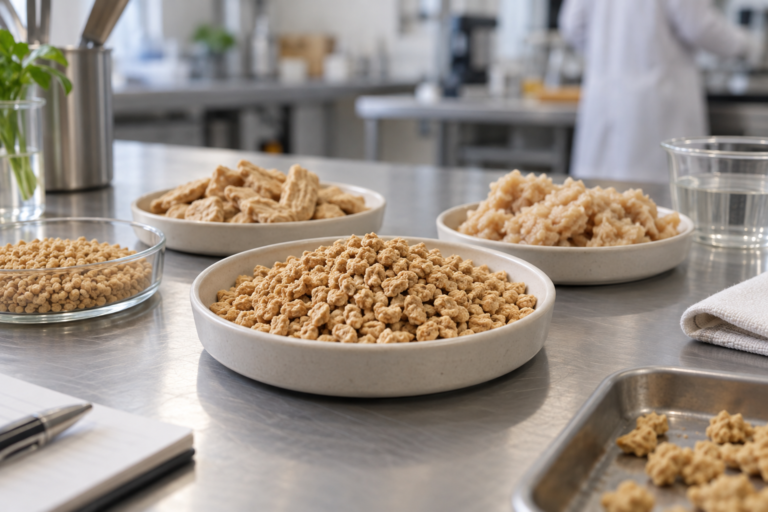
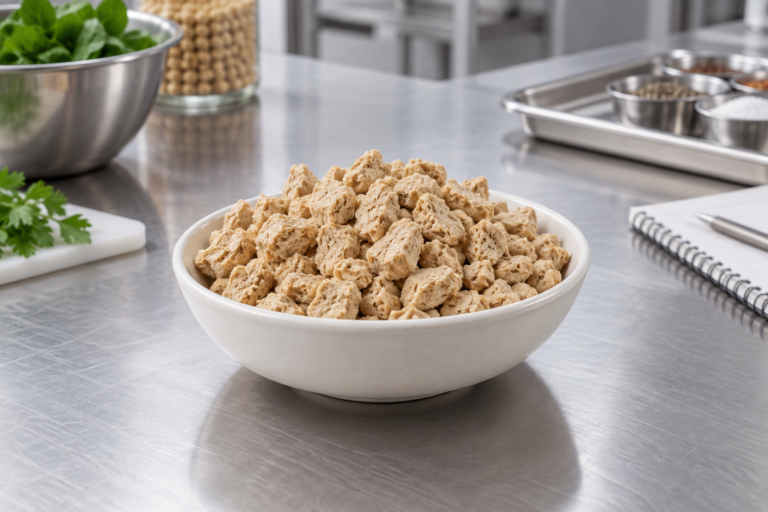
When a multinational prepared-foods team in Hamburg needed one supplier to cover granules for a sauce, chunks for a bowl and fibrous protein for a premium line across three factories, managing four vendors became its own full-time job. Four specification sheets, four audit cycles, four sets of COAs in four formats, and a category manager spending more hours reconciling paperwork than developing product. The breaking point came when one vendor’s granule mesh drifted mid-quarter and the sauce line ran two days off-target before anyone connected the dots. Consolidating with a single textured soy protein partner cut their supplier audit load by 75% and, more importantly, made variance traceable to one process instead of four. Breadth of format, not just price, is what global manufacturers actually buy. For context, see our TVP manufacturer China overview.
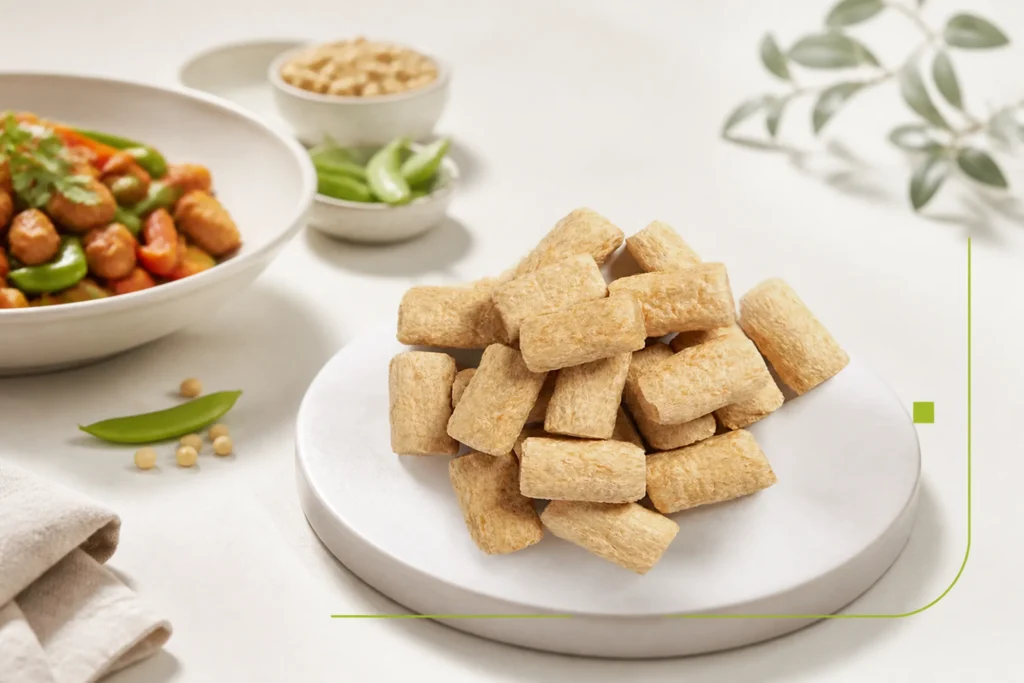
The Format Coverage
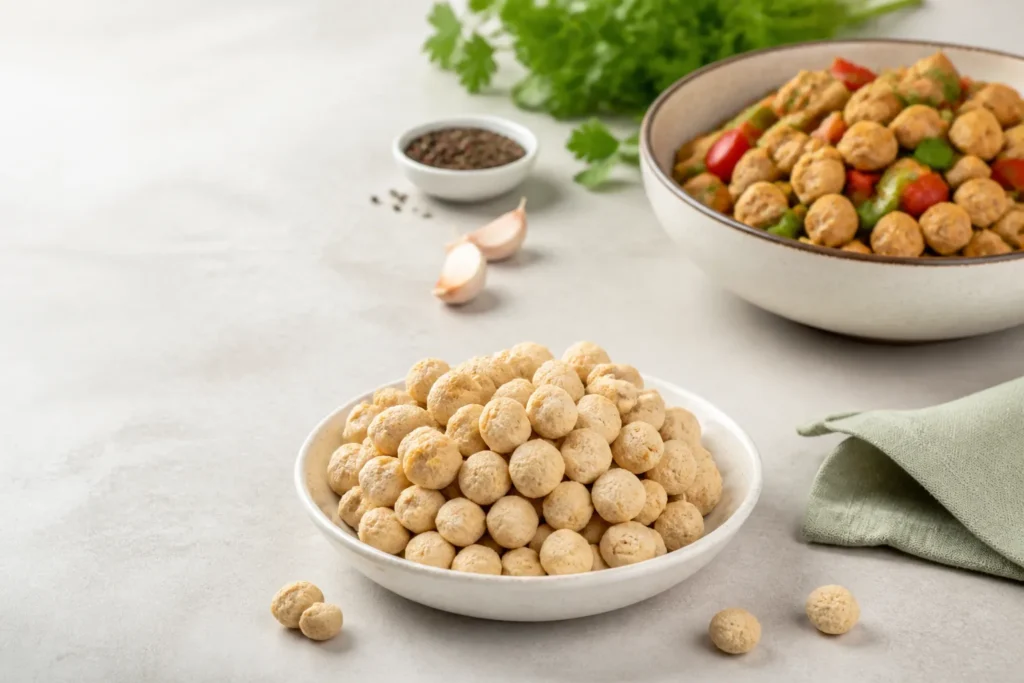
One partner, every format: granules for mince and fillings, chunks for ready meals, strips for plant-based meat, and fibrous soy protein for premium texture. Each format is a different answer to the same question — how should this protein behave in the mouth — and choosing correctly is the single largest lever on finished-product quality.
| Format | Baichuan Offers | Certified |
|---|---|---|
| Granules | Yes (multi-mesh) | HACCP/ISO/Halal |
| Chunks | Yes (5–20 mm) | HACCP/ISO/Halal |
| Strips | Yes (structural) | HACCP/ISO/Halal |
| Fibrous Soy Protein | Yes (flagship) | HACCP/ISO/Halal |
Matching Format to Application
Format selection should start from the process the material will endure, not from the shape that photographs well. The comparison below maps Baichuan’s four formats against typical specification and application boundaries.
| Format | Typical Protein | Dimension | Rehydration | Best-Fit Applications | Process Tolerance |
|---|---|---|---|---|---|
| Granules | 50–55% | Multi-mesh, fine to coarse | 1 : 2.5–3 | Mince, bolognese, fillings, patties, pet food | Excellent in high-shear mixing |
| Chunks | 50–55% | 5–20 mm cube or nugget | 1 : 3 | Curries, stews, retort ready meals, canned lines | Holds through 121°C retort |
| Strips | 50–60% | Elongated, structural | 1 : 3 | Stir-fry, fajita, skewer, shredded concepts | Good under wok heat and marination |
| Fibrous soy protein | 60–70% | Directional fibre bundle | 1 : 2.5–3.5 | Vegan beef, chicken, jerky, centre-plate analogs | High heat stability, low breakage |
All four formats share the same base specification discipline: moisture ≤10% at packing, fat ≤1.0%, total plate count below 10,000 CFU/g, Salmonella negative per 25 g, and protein reported by AOAC 992.23 with the basis stated. That common baseline is what makes cross-format consolidation practical — a QA team learns one specification language rather than four.
Beyond Product: The Support Layer
Documentation (full export pack), sample testing, and consistent batch supply turn ingredients into a managed program. The document pack is issued per lot in English: specification sheet, COA with cited methods, allergen statement covering soy and cross-contact, microbiological report, and storage and shelf-life guidance. Certificates travel with it — HACCP, ISO 9001, ISO 22000, ISO 14001, ISO 45001, HALAL, MUI Halal Certification and IFS International Food Standard Certification.
The sample layer runs on the same standard. Buyers submit an application brief, receive matched formats with lot-coded documentation, run hydration and cook trials, then feed measured results back so the specification can be locked before bulk. For a multi-format buyer this matters twice over: the same brief can be answered with two or three candidate formats side by side, and the comparison happens in the buyer’s own kitchen rather than across three unconnected vendor conversations.
What Consolidation Actually Saves
The cost of a supplier is never only the price per kilogram. Every additional vendor adds a qualification file, an annual audit, a separate document format for QA to interpret, its own lead-time profile, its own freight booking and its own variance signature. When a finished product drifts, a multi-vendor bill of materials makes root-cause analysis slower because each ingredient has to be excluded in turn.
Consolidation compresses all of that. One audit covers the formats. One document template feeds the QA system. One production calendar governs lead times, which allows a manufacturer to align call-offs across factories instead of managing four independent replenishment cycles. And because granules, chunks, strips and fibrous protein come off the same certified process discipline and the same raw material sourcing standard, lot-to-lot variation is correlated rather than random — a far easier problem to manage.
Supply Stability, Packaging and Logistics
Format breadth only helps if the supply behind it is predictable. Textured soy protein is a low-density product, so containers usually reach volume limits long before weight limits — which makes packaging format a real commercial variable rather than a detail. Baichuan supplies in standard multi-wall paper bags with an inner liner, typically 15–20 kg, with palletised and shrink-wrapped configurations for European retail-supplying customers who need pallet-in, pallet-out handling at the receiving warehouse.
Shelf life is normally 24 months from production when stored below 25°C at relative humidity under 65%, in the original sealed packaging, away from strong odours. Because the material leaves the plant at moisture ≤10%, the main storage risk is not spoilage but moisture pickup in humid ports and warehouses; a bag left open on a Southeast Asian dock in July will cake regardless of how well it was made. Buyers running long inland legs should specify liner thickness in the agreed specification rather than assume it.
On planning, a multi-format buyer gains a scheduling advantage that a multi-vendor buyer cannot replicate. Granules, chunks, strips and fibrous protein can be produced against one forecast and consolidated into shared containers, which improves fill rate, lowers freight cost per kilo of protein and reduces the number of arrival events a warehouse team has to process. Retained samples are held against each lot for the declared shelf life, so if a finished-product query surfaces twelve months after delivery, the investigation can be run against physical material and the original lot record rather than reconstructed from memory.
Why Consolidate with Baichuan
Fewer suppliers means fewer audits, fewer logistics variables, and tighter batch consistency. Our company page details the B2B model. Baichuan is a manufacturer rather than a trading intermediary, which changes three practical things for a global buyer. Specification changes are process decisions made by the people who run the line, not requests relayed through an unseen third party. Documentation is generated at the lot where the product is made, so batch codes reconcile across bag, packing list and COA. And capacity planning is a direct conversation, which matters when a retailer promotion doubles a call-off with six weeks’ notice.
The recommendation for most global manufacturers is straightforward: run one structured sample round covering every format you actually need, verify two consecutive lots on the formats you intend to scale, and consolidate the qualified formats under a single agreement. Buyers can review the full Baichuan product range first, then request multi-format samples and quotes through our contact page. If premium bite is the priority, begin with Baichuan fibrous soy protein; if you are still mapping the category, the types of TVP guide is the better starting point.
FAQ
Does Baichuan make all TVP formats?
Yes — granules, chunks, strips and fibrous soy protein under one roof, produced under a single certified food safety system with a common specification baseline across the line.
Is fibrous soy protein Baichuan’s focus?
It is the flagship; see the fibrous page. Fibrous protein carries the highest protein content at 60–70% and the directional structure premium plant-based meat brands require.
Can one contract cover multiple formats?
Yes — consolidated supply is a core Baichuan advantage for global manufacturers. A single agreement, one document template and one production calendar can cover granules, chunks, strips and fibrous protein shipped to multiple destinations.
Are all formats certified?
Yes — HACCP, ISO 22000, ISO 9001 and Halal across the line, with ISO 14001, ISO 45001, MUI Halal Certification and IFS International Food Standard Certification available in the document pack.
How do I compare formats before committing?
Send one application brief covering all target products and request candidate formats together through Baichuan sample testing, so the comparison happens under your own process conditions.
References
- ISO 22000:2018 — Food safety management
- ISO 9001:2015 — Quality management systems
- AOAC Official Method 992.23 — Protein determination
- MUI Halal Certification standards
- IFS International Food Standard
Explore Baichuan: TVP & Fibrous Soy Protein Products · About Baichuan’s Manufacturing · Contact Us for Samples & Quotes