When a product-development manager in Chicago encountered a weak bite in a pilot sausage run, she increased seasoning and extended mixing, only to watch the cooked links release moisture and turn pasty on the line. The reversal came when the team changed the hydrated-particle specification and addition sequence: the issue was not simply a bad ingredient, but an unsuitable texture grade and process fit.
Resumen: Textured soy protein is a soy-based, extruded ingredient that can add structure, protein, and water management to formulated foods. Its protein level and hydration behavior must be verified on the supplier specification; for example, nitrogen-based protein testing is commonly performed by methods such as AOAC 990.03. For sausage, tuna-style alternatives, and formed meat products, start by matching particle size, hydration ratio, ingredient statement, and finished-product claims to the formula and destination market before scaling a trial.
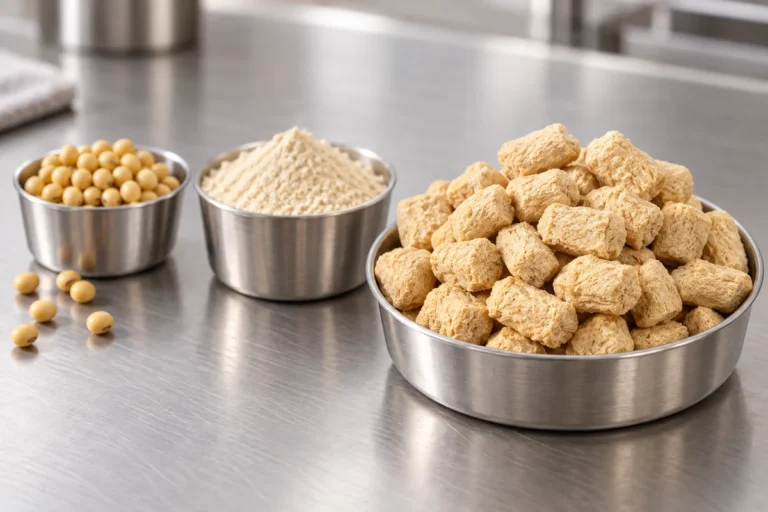
Also called textured vegetable protein (TVP) when soy is the source, it is generally made from defatted soy flour, soy protein concentrate, or soy protein isolate. Heat, moisture, pressure, and mechanical shear in extrusion transform the powder into porous granules, flakes, or chunks. That structure is useful because it takes up water and seasoning and can contribute chew after hydration, but it does not eliminate the need to balance fat, binders, salt, pH, and thermal processing.
How does soy become a porous textured ingredient?
The starting material shapes the result. Defatted soy flour typically retains more carbohydrate and fiber than more-refined protein ingredients, while concentrates and isolates can support different protein targets and functional profiles. In extrusion, a conditioned soy mix passes through a heated barrel and die under moisture, pressure, and mechanical shear. When it leaves the die, the pressure drop lets water flash off and forms the expanded, porous structure of dry TVP. Because processors use different raw materials and operating conditions, a purchase specification should identify the soy base, allergen status, moisture, microbiological limits, particle grade, and any required identity-preservation documentation.
Protein is normally reported on a defined basis, often “as is” or dry basis, so buyers should not compare figures without checking the moisture basis. AOAC International lists validated methods for protein determination, including combustion-based AOAC 990.03; it is a laboratory method, not a certification of a finished food. Moisture can likewise be tested by recognized oven-drying methods, and its control affects storage stability, hydration calculations, and the weight of dry ingredient needed per batch.
Water absorption is a formulation property, not a universal number. A supplier may recommend a water-to-product ratio and hydration time, but the plant trial should confirm both under the intended salt, oil, and heat profile. Measure rehydrated yield, drained yield, free purge after cooking, and sensory texture; also check whether seasoning is carried evenly and whether added fat coats the particles or separates during heating. An illustrative calculation: if 10 kg of dry ingredient yields 30 kg after controlled hydration, a 3:1 hydrated yield helps plan dosing, but it does not predict every recipe’s final yield or eating quality.
How should manufacturers choose a textured soy protein grade?
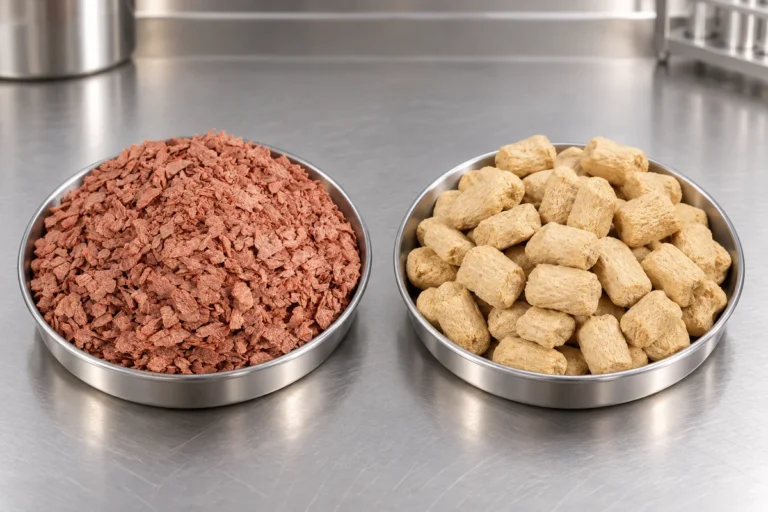
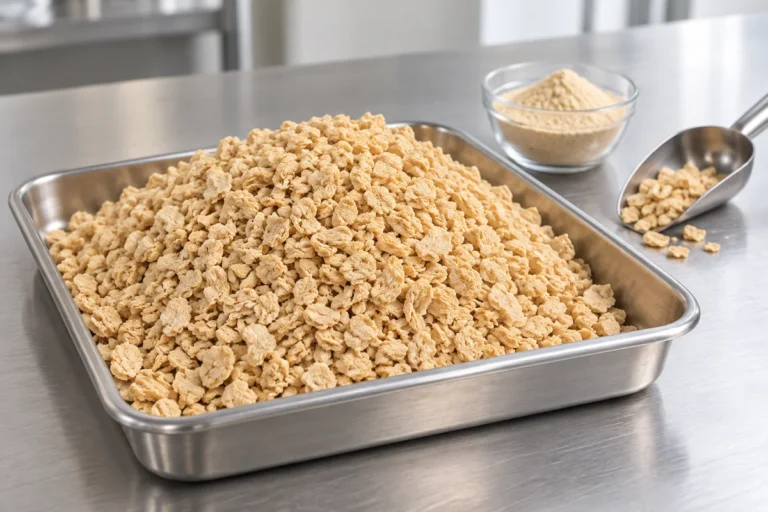
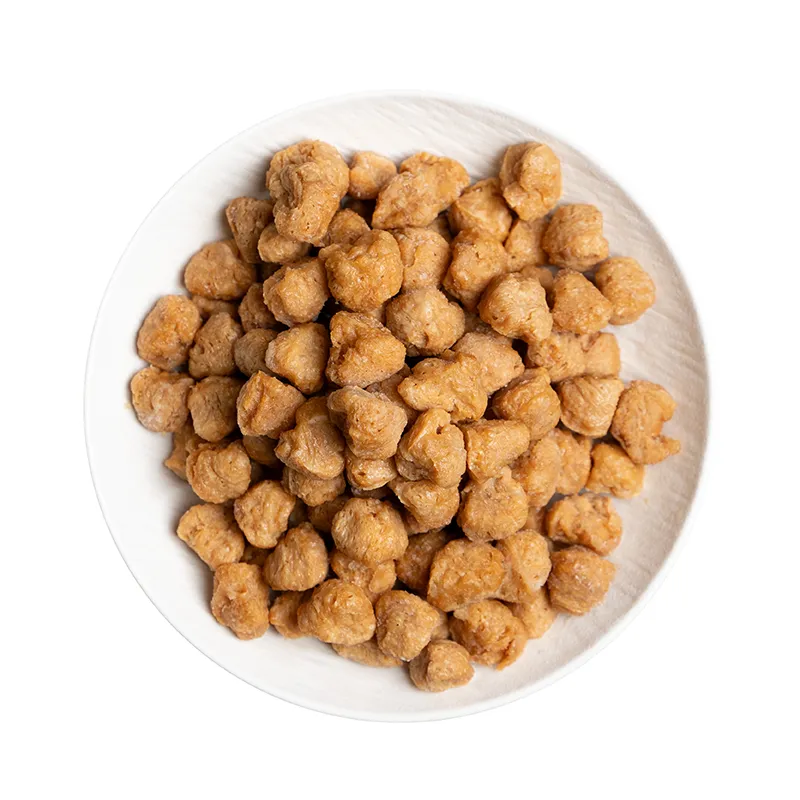
A texture grade is more than a label such as “fine” or “chunk.” Particle size, bulk density, porosity, shape, and hydration time affect dispersion, water uptake, and the bite that remains after cooking. Fine granules can distribute more evenly through an emulsion; larger chunks are more visible and can create a clearer piece identity. Screen analysis or a supplier-defined sieve range makes particle language measurable, while a retained-sieve result is a test result—not a guarantee of identical texture in every finished food.
| Grade tendency | Useful formulation role | Process point to verify | Potential trade-off |
|---|---|---|---|
| Gránulos finos | Uniform distribution in patties, fillings, and emulsified systems | Dispersion during mixing | Can soften the bite if overhydrated or overmixed |
| Medium granules or flakes | Balanced particulate texture in crumbles and fillings | Hydration time and drained yield | May require tighter water control for batch consistency |
| Trozos o piezas más grandes | Visible pieces in pulled, diced, or tuna-style concepts | Piece integrity through cook and pack | May need gentler mixing and a longer hydration step |
For textured soy protein for sausage production, decide whether the ingredient is a fine particulate aid, a visible inclusion, or a partial meat replacement. Then test hydration before grinding or mixing, the order of salt and water addition, seasoning distribution, fat handling, stuffing behavior, and cook loss. A sound cost comparison includes dry inclusion rate, hydrated yield, pre-hydration labor, hold time, waste, and any line-speed effect—not only the quoted price per kilogram.
Which food applications suit textured soy protein?
Textured soy can suit meat-containing and plant-forward foods that need a defined particulate structure. In sausages, it may be hydrated into the batter or used as a visible inclusion, subject to local composition and labeling rules. In burgers, meatballs, fillings, and crumbles, the grade is chosen for particle size, hydration response, and seasoning uptake. Application fit is decisive: a chunk that performs well in a bowl meal can be disruptive in a narrow-diameter sausage.
For soy protein for canned tuna replacement, a fibrous appearance is only the starting point. The chosen pieces must remain intact through hydration, blending, filling, retort or other applicable heat treatment, and storage. Assess flake separation, oil or brine compatibility, can-fill weight, headspace, flavour distribution, and post-process texture; a bench sample cannot establish commercial process authority. For shelf-stable products sold in the United States, low-acid canned-food requirements can apply depending on the formulation and process, and the scheduled process must be established by qualified expertise.
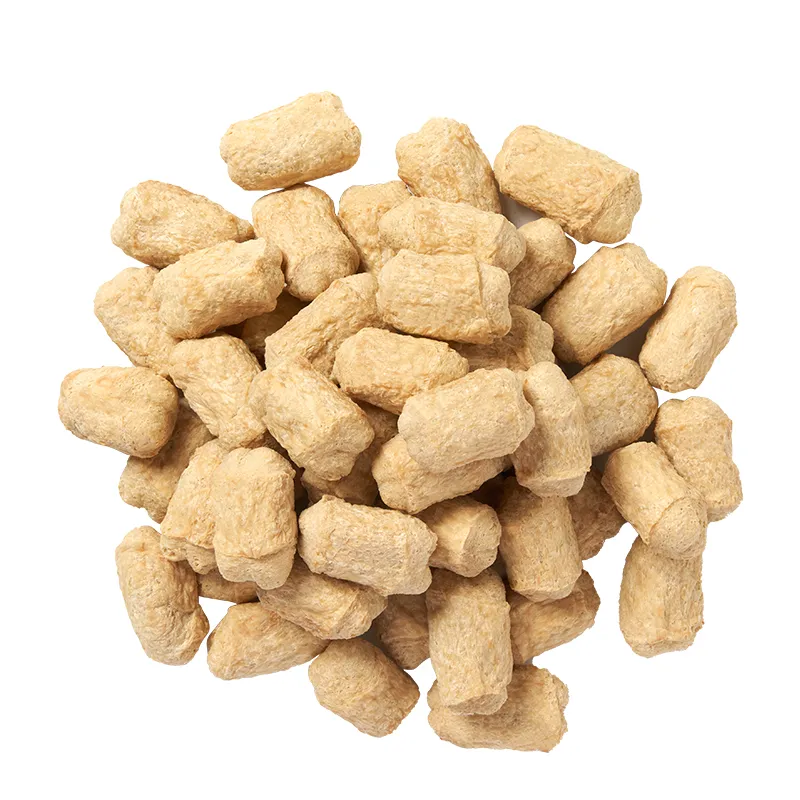
For textured soy protein for meat products, build the trial around the target product’s meat, fat, moisture, and labeling constraints. Measure cooked yield and purge using the plant’s normal procedure, then compare bite and visual distribution with a control. Review the supplier’s información sobre calidad y seguridad alongside the formula requirements. The ingredient may improve a formula’s structure or economics, but an unsupported “high protein,” “non-GMO,” or nutrition claim can introduce more commercial risk than the ingredient saves.
| Aplicación | Starting grade logic | Key acceptance checks | Hidden cost to include |
|---|---|---|---|
| Sausage or meatball | Fine to medium particles for even distribution | Stuffing, cook loss, slice appearance | Hydration labor and rework risk |
| Ground-style crumble | Medium granules for recognizable particulate bite | Rehydrated yield, seasoning uptake, hold stability | Drain-loss variation |
| Tuna-style or pulled pieces | Chunks or flakes that survive handling | Piece integrity, fill consistency, post-heat texture | Breakage and line handling time |
| Filled bakery or prepared meal | Grade matched to deposit and reheat profile | Depositor flow, freeze-thaw response, consumer bite | Equipment clean-down and process validation |
What sourcing, allergen, and compliance checks are needed?
Soy is a major food allergen in the United States and must be declared when required by the Food Allergen Labeling and Consumer Protection Act and subsequent U.S. labeling rules. Ingredient buyers should obtain the complete allergen statement and verify that the finished product label reflects the actual formulation and destination. Cross-contact controls, traceability, and allergen cleaning are plant-system responsibilities; a raw-material statement does not by itself validate the finished facility’s program.
“Non-GMO” is a sourcing and claim question, not a synonym for food safety. If a customer needs identity-preserved or third-party-verified non-GMO material, state the requested program and documents in the purchase specification, then confirm the claim wording with the applicable market and certification owner. In the U.S., the National Bioengineered Food Disclosure Standard governs certain disclosures; it should not be treated as a general non-GMO certification. Likewise, HACCP is a preventive-control approach and may be part of a buyer’s supplier approval expectations, but it is not a universal product certificate.
For exports, requirements can differ by destination, product category, processing method, and claim. Food-safety systems, microbiological specifications, certificates of analysis, country-of-origin records, and audits should be requested to the standard your customer actually requires. Avoid promising “clean label,” “natural,” halal, kosher, organic, or other market-facing designations unless the specific material and finished-product claim have been documented and verified.
How can buyers prepare a scalable trial?
- Write the product brief around the finished bite: target particle appearance, rehydrated piece size, and acceptable cook loss.
- Request an as-is specification, protein test basis, moisture target, microbiological limits, allergen declaration, and lot traceability before comparing suppliers.
- Run a controlled pilot against the current formula, recording dry dose, water dose, hydration time, rehydrated yield, line observations, and finished-product sensory results.
- Review claims and documentation with regulatory and quality teams for the intended market before artwork or launch commitments.
BCTVP can help buyers discuss product formats and documentation needs for a defined application.
Frequently asked questions about textured soy protein
What is fibrous soy protein?
Fibrous soy protein is a soy-derived ingredient engineered or processed to create elongated, meat-like fibers. The term is not a single universal specification, so buyers should ask how the structure is made, its particle format, and how it performs after hydration and cooking.
What is textured vegetable protein?
Textured vegetable protein is a broad term for plant-protein ingredients that have been processed to develop a porous or meat-like texture. Soy is a common source, but the source material and composition can vary; always confirm the ingredient statement and specification.
¿La PVT es buena o mala para la salud?
TVP is an ingredient, not a complete diet assessment. Its nutritional fit depends on the soy base, sodium and fat added in the finished food, portion size, and the consumer’s needs; people with soy allergy should avoid products containing soy as directed by their health professional.
¿Es la PTV simplemente tofu?
No. Tofu is made by coagulating soy milk into curds, whereas TVP is generally made by extrusion of soy-based dry ingredients into a porous format. They behave differently in manufacturing, particularly in hydration, particle identity, and water management.
¿Es la PTV un alimento altamente procesado?
TVP is processed because extrusion changes the physical structure of soy ingredients. Whether a finished food is described as highly processed depends on the classification system and the whole formulation, so procurement teams should focus on the ingredients, nutrition profile, and claims relevant to their market.
Is textured soy protein the same as TVP?
Textured soy protein is commonly considered a type of TVP, because it is a textured ingredient made from soy. “TVP” can also refer more broadly to textured proteins from other plant sources, so the supplier’s source material and specification should govern the purchasing decision.
Referencias
- AOAC International, Official Methods of Analysis
- U.S. Food and Drug Administration, Food Allergies
- USDA Agricultural Marketing Service, National Bioengineered Food Disclosure Standard
- U.S. Food and Drug Administration, Low-Acid Canned Foods
The durable choice is the one that still performs after hydration, heat, handling, and label review—not the one that looks best in a dry sample.
When your brief is ready, explore BCTVP’s textured protein product range for food manufacturing y contact the BCTVP team about your application to discuss a suitable grade and documentation needs.