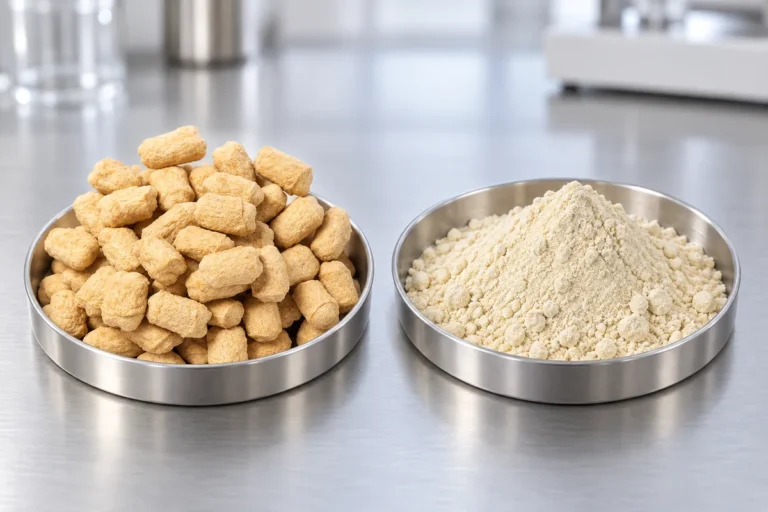
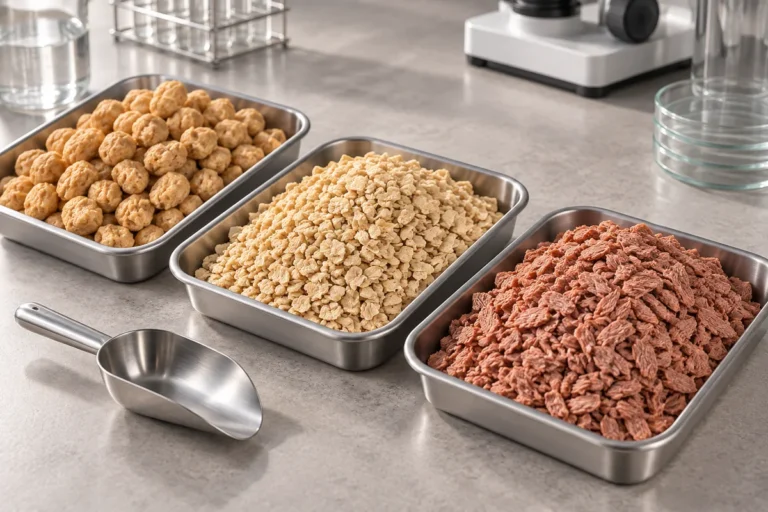
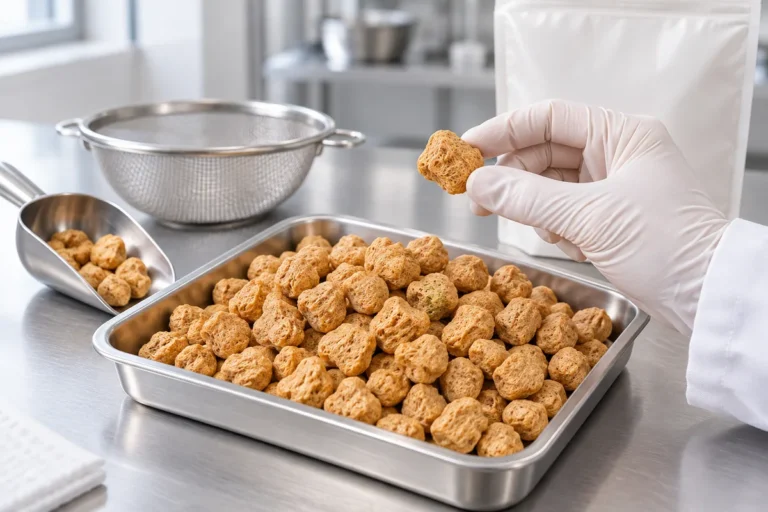
More marinade and harder mixing do not necessarily correct a cardboard note in a TVP filling. Liquid may pool while the pieces stay pale and the cooked sample tastes flat. Diagnose particle format, hydration sequence, fat delivery, and storage history before blaming either the ingredient or the seasoning dose.
Summary: Cardboard-like notes can originate in the ingredient, storage, oil or flavor-delivery system. Separate the diagnosis into three checkpoints—dry ingredient, hydrated base, and finished food—then compare coded samples using a consistent descriptive method such as ISO 13299. Select a format that matches the bite, hydrate and drain it under controlled starting trial conditions, add water-soluble seasoning before or during hydration, and deliver fat-soluble aromas through the fat phase. Validate every condition for the exact grade, process, pack, and shelf-life target.
What the Timing of a Cardboard Note Reveals About Its Source
“Beany” is not one molecule or one defect. Product teams may use it for green, grassy, raw-legume, paint-like, oxidized, or dry-paper impressions. Research on soybean protein links several of these perceptions to volatile compounds formed through lipid oxidation and lipoxygenase-related pathways; aldehydes such as hexanal are frequently discussed, but the perceived result depends on concentration, the food matrix, and interactions among odorants. A 2023 review of beany-flavor control and a 2024 review of extruded meat-analogue flavor both emphasize that raw material and processing history matter.
The stage at which the note appears changes the remedy. A green note in the dry material calls for a grade, lot, and process review. A dry-paper note that develops in warehouse storage points toward oxygen, heat, light, pack barrier, or age. A note that appears only after frying may instead involve the oil, hot holding, or aroma loss. A bland sample called “cardboard” may lack salt distribution, savory depth, fat-carried aroma, or browning. More top-note flavor can raise cost while leaving the cause intact.
How to Separate Ingredient, Hydration, Storage, and Cooking Causes
Build a small sensory ladder with the dry ingredient, a water-hydrated control, a seasoned hydrated sample, and the fully cooked product. Keep lot, piece size, water, time, temperature, draining pressure, and cooking endpoint constant. ISO 13299 provides general guidance for developing sensory profiles; it is a methodology, not a certification or proof that a product tastes acceptable.
| Observed symptom | Likely area to investigate | Useful bench comparison | Commercial implication |
|---|---|---|---|
| Green or raw-bean note in the dry sample | Grade, lot, raw-material history, or extrusion conditions | Blind comparison of retained lots using the same preparation | Seasoning may mask variability without solving it |
| Dry-paper note after hydration | Water quality, incomplete flavor penetration, oxidation, or unsuitable piece density | Water-only control versus broth-based starting trial | Rework and flavor dosage can rise if the carrier is mismatched |
| Flavorful surface but bland center | Piece geometry, hydration sequence, marinade viscosity, or contact time | Cut pieces after cooking and score surface and core separately | Topical seasoning creates inconsistency and sodium hotspots |
| Acceptable at cook-off, stale during storage | Oil stability, oxygen exposure, package barrier, or hot-hold history | Fresh control versus coded retained samples from the intended pack | Shelf-life complaints can outweigh a lower ingredient price |
If the sensory result is commercially important, headspace solid-phase microextraction with gas chromatography–mass spectrometry (HS-SPME-GC-MS) can support volatile screening. Instrumental data should be interpreted alongside trained sensory results; a chromatogram alone does not establish whether a customer will perceive “cardboard.”
When Rinsing or Squeezing TVP Is Worth a Controlled Trial
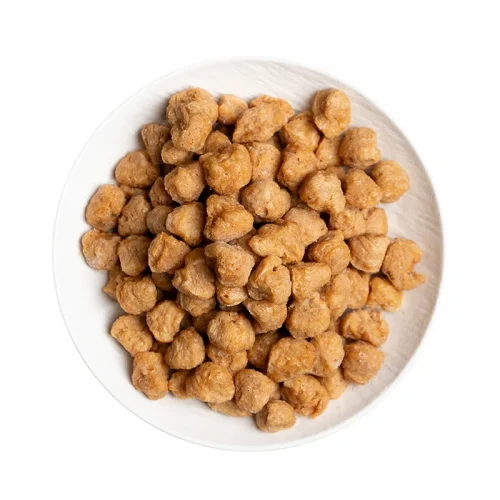
Rinsing and squeezing are diagnostic variables, not automatic requirements. A rinse may be worth testing when a water-hydrated control releases a strong legume odor or leaves a pronounced aftertaste. Compare an unrinsed control with one standardized rinse, then cook both in the same formula; improvement before seasoning does not guarantee a better finished product.
Squeezing can remove free liquid and make room for a measured seasoned phase, but excessive pressure may deform pieces, increase fines, or remove flavor already carried in the hydration liquid. It may therefore be unsuitable for fragile flakes or a process that depends on retained moisture. Define the handling method, recovered liquid, hydrated yield, breakage, core flavor, and cooked bite. Any water temperature, contact time, rinse volume, or applied pressure is only a starting test condition requiring validation for the exact grade, formula, equipment, and process.
How Seasoning, Fat, and Umami Reach Different TVP Formats
Porous textured protein can take up aqueous seasoning, but “absorption” does not guarantee uniform flavor. Salt, sugars, yeast-derived savory ingredients, acids, spices, and hydrolyzed vegetable proteins differ in solubility and impact. A thick marinade may coat the surface before it reaches internal pores; an overly dilute system may hydrate the piece yet leave it weak after draining.
For pilot work, begin with a simple aqueous phase and change one variable at a time: seasoning concentration, liquid temperature, contact time, agitation, or draining. Any hydration amount, time, or temperature used at this stage is only a starting trial condition and must be validated for the exact grade, particle geometry, batch scale, and downstream process. Record both added liquid and free liquid after draining rather than assuming a fixed hydration ratio.
Fat contributes lubrication, aroma release, and cooked-meat character, but it also introduces oxidation risk. Add fat-soluble flavors through the chosen oil or emulsion where practical, then test that phase through cooking and storage. Umami ingredients can build depth, while roasted onion, mushroom, pepper, smoke, and reaction flavors may redirect attention from residual soy notes; none should be expected to rescue stale oil or a mismatched format.
| Format decision | Best development question | Starting trial focus | Supplier information to request |
|---|---|---|---|
| high protein soy protein chunks | Does flavor reach the core before the piece loses bite? | Core hydration, marinade contact, draining, and cook endpoint | Piece dimensions, density consistency, preparation guidance, and lot controls |
| high protein soy protein flakes | Will broad surfaces distribute flavor without becoming soft? | Gentle mixing, free-water control, binder interaction, and hold time | Size distribution, breakage tendency, moisture specification, and sample traceability |
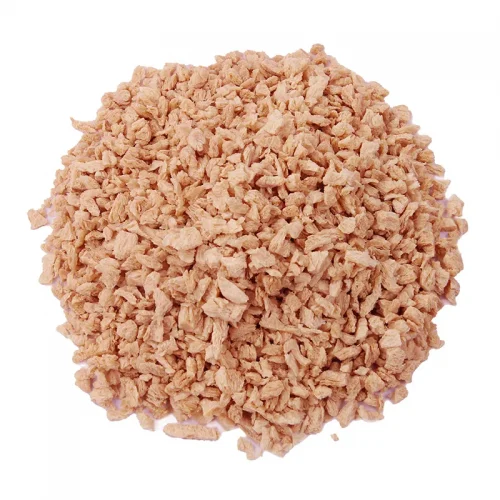
| high protein soy protein granules | Can small particles carry savory notes evenly through a mince? | Rapid distribution, binder competition, fat dispersion, and thermal stability | Granule range, fines control, bulk-density method, and change notification |
How Pan Finishing, Simmering, and Baking Change Flavor Delivery
Choose the cooking method according to the remaining defect. Pan finishing promotes evaporation and surface browning, concentrating seasoning but potentially firming an under-hydrated piece. Simmering increases contact with the aqueous phase and may improve core seasoning, but excess liquid can dilute sauce or soften small particles. Baking provides broad heating and a drier exterior, yet uncovered baking can drive off top notes and moisture.
Run the comparison from one hydrated batch and hold formula, sample mass, endpoint, and service temperature constant. Select the method by the intended product: a sauced mince may tolerate simmering, while a formed item may need baking or a short pan finish. Temperatures and times used in development are starting test conditions only; validate them for the exact grade, formula, equipment, batch size, food-safety plan, and process.
How Storage and Post-Extrusion Handling Can Reintroduce Stale Notes
Flavor work does not end at the extruder. Residual moisture, oxygen, light, temperature, packaging barrier, oil quality, and warehouse rotation can shift aroma before the ingredient reaches production. In the finished food, frying, retorting, chilling, freezing, reheating, and hot holding can create another set of changes. The useful comparison is therefore not “one sample versus another,” but matched lots tested through the intended process and pack.
Keep at least three traceable checkpoints: incoming dry material, post-hydration intermediate, and finished packed product. Establish descriptive attributes and rejection limits internally, then follow them over the proposed shelf life. Accelerated conditions may help screen variables, but they do not automatically predict real-time shelf life; the actual formulation and commercial packaging require validation.
What Standards, Labels, and Supplier Documents Actually Establish
ISO 13299 can guide sensory-profile design, while chromatographic methods can investigate volatile changes. These are testing approaches, not product certifications. Codex CXS 1-1985 addresses prepackaged-food labelling at an international reference level, but destination-market law governs the sellable label. In the United States, 21 U.S.C. §343 includes ingredient and major-allergen labelling provisions; soy declarations and any “high protein” or nutrition claim must be reviewed against the final recipe and applicable rules.
Procurement should request a current specification, ingredient and allergen statement, lot identification, storage instructions, and the methods used for reported values. If public materials list certificates, buyers must verify current validity, legal entity, manufacturing site, and scope. A standard number on a test report should never be presented as certification coverage.
How to Build a Supplier Trial Around the Full Eating Experience
First, define the sensory defect in plain descriptors and agree on a reference sample. Second, screen at least two formats under one controlled base formula. Third, test aqueous seasoning and fat-carried aroma as separate levers. Fourth, repeat the preferred condition at pilot scale and through the intended packaging and storage sequence. Finally, compare total formulation cost, process time, breakage, rework, and complaint risk—not ingredient price alone.
Use coded samples and score four moments separately: aroma before the bite, flavor and texture on the first bite, lingering aftertaste, and flavor after cooling and reheating as intended. A change can improve the first bite while worsening persistence or reheat character, so one overall score can hide the trade-off. ISO 13299 guides descriptive-profile development, but panel training, references, attributes, and acceptance limits still need to be defined for the product and customer.
For a chunky application, compare a plain sample of high protein soy protein chunks with the finished system before raising flavor dosage; for layered fillings, evaluate high protein soy protein flakes under the actual mixing load; for mince, check high protein soy protein granules for uniform distribution and fines. The bold procurement distinction is format-specific: high protein soy protein chunks prioritize core penetration, high protein soy protein flakes prioritize surface handling, and high protein soy protein granules prioritize even dispersion.
Baichuan’s public site states that the company was founded in 2008, has bases in Wenzhou, Zhejiang and Xinxiang, Henan, and offers six product series with more than 2,000 specifications. Those figures are useful as a screening signal, not a substitute for matching the exact grade to the recipe. Buyers can review the broader textured soy protein range, then request samples and documentation for a controlled comparison.
Frequently asked questions
Why does textured soy protein have a beany taste?
Soy raw materials can contain or generate volatile compounds associated with green, grassy, or beany notes, particularly through lipid-oxidation pathways. Extrusion and later cooking can reduce, release, transform, or add aromas, so the source must be isolated at the dry, hydrated, and cooked stages.
What does soy protein taste like?
Unseasoned textured soy protein is often mild, cereal-like, or legume-like, but grade, process, age, and preparation can shift the profile. A buyer should taste it in a standardized water control and in the intended food matrix because salt, fat, heat, and aroma release change perception.
How do you reduce beany taste in soy protein?
Start by selecting a suitable grade and checking lot freshness, then optimize hydration, draining, savory seasoning, fat-carried aromas, and thermal process. Masking alone is fragile; validate the preferred system through the real package and shelf-life conditions.
Can TVP absorb seasoning and marinades?
Yes, its porous structure can take up aqueous seasoning, but uptake and distribution vary by geometry, density, liquid viscosity, temperature, time, and agitation. Use measured starting trials for the exact grade, and validate the hydrated mass, free liquid, core flavor, and cooked texture rather than applying a universal ratio.
Is textured soy protein good for you?
TVP can contribute protein, but the nutritional value of a finished food also depends on the complete recipe, portion, sodium, fat, and micronutrient profile. Review the supplier specification and finished-product analysis before making nutrition claims, and account for soy allergen labelling.
How do you make TVP taste more like meat?
Combine the right bite with layered flavor: water-soluble salt and umami, fat-soluble aroma, roasted or reaction notes, and a cooking step that supports browning without drying the product. Use meat-like flavor as a sensory target with agreed references, then confirm it with blinded pilot samples.
References
- Control of Beany Flavor from Soybean Protein Raw Material in Plant-Based Meat Analog Processing, Foods, 2023.
- Flavor of Extruded Meat Analogs: A Review on Composition, Influencing Factors, and Analytical Techniques, Current Research in Food Science, 2024.
- Codex Alimentarius standards list, including CXS 1-1985, General Standard for the Labelling of Pre-packaged Foods.
- 21 U.S.C. §343—Misbranded Food, Legal Information Institute, Cornell Law School.
- Straight Talk About Soy, Harvard T.H. Chan School of Public Health.
The durable fix for cardboard-like TVP is to control the path from ingredient selection to the consumer’s first bite. To compare grades for your application, contact Baichuan with your format, process, sensory target, and destination-market requirements.