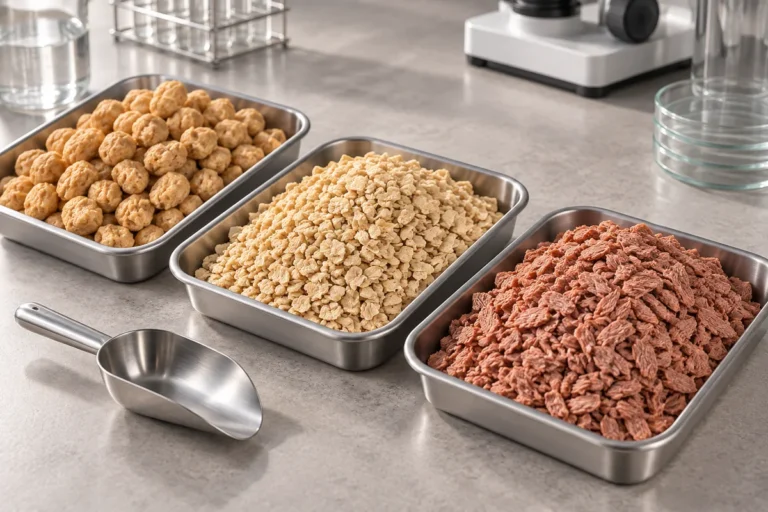
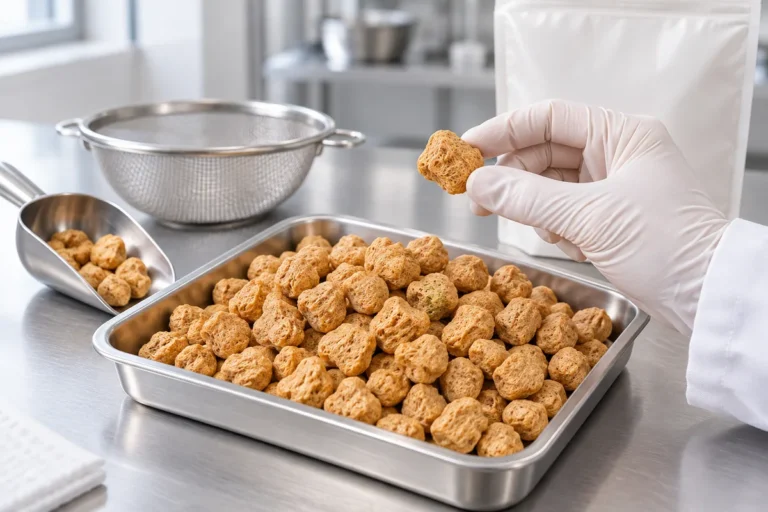
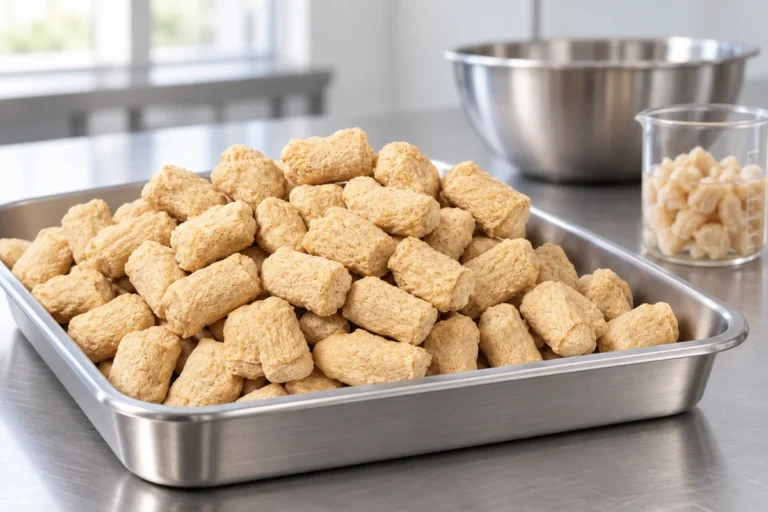
When a product developer in Chicago encountered patties that fractured on the griddle, she increased the binder and added more water. The next pilot looked promising in the mixer, then released moisture and turned pasty after cooking. The useful reversal came when the team examined the ingredient as a specification: particle size, density, hydration time, extrusion structure and target bite were driving the result—not simply a “bad” protein.
Summary: Neither soy nor pea is universally better for plant-based meat. Textured soy often gives a useful fibrous or chunk-like structure when the grade is selected and hydrated correctly; pea can suit a formula that needs to avoid a soy allergen declaration, but its flavor and texture may require a different system. In the United States, soy is one of the major food allergens that must be declared under the Food Allergen Labeling and Consumer Protection Act. We recommend comparing both routes in the finished format, using the supplier’s hydration guidance first and then recording cooked bite, purge, yield and flavor.
For a B2B team, “soy versus pea” is too broad a starting question. Concentrate, isolate, flour and textured ingredients do not perform as interchangeable raw materials. The useful comparison identifies the material’s structure, particle geometry, density, hydration instructions and process history, then checks how it behaves with the recipe’s starch, hydrocolloid, fat and seasoning phases.
Which protein format fits the product you need to make?
Start with the eating format and the manufacturing route. A coarse burger, mince or pulled-style piece usually needs visible particles that remain distinct after hydration and mixing; a nugget needs a component that forms consistently; an emulsified sausage may need a fine protein ingredient alongside a separate source of bite. Application-specific shapes—granules, flakes, strips or chunks—should be treated as different development inputs, even when their label name is similar.
Ask the supplier whether the sample is a flour, concentrate, isolate or textured ingredient, and what extrusion or texturizing process produced it. Then request the particle-size range, bulk or apparent density where available, moisture specification, lot information and recommended hydration procedure. These details let the team compare like with like and help explain why two ingredients with similar protein percentages can produce different mixing and forming results.
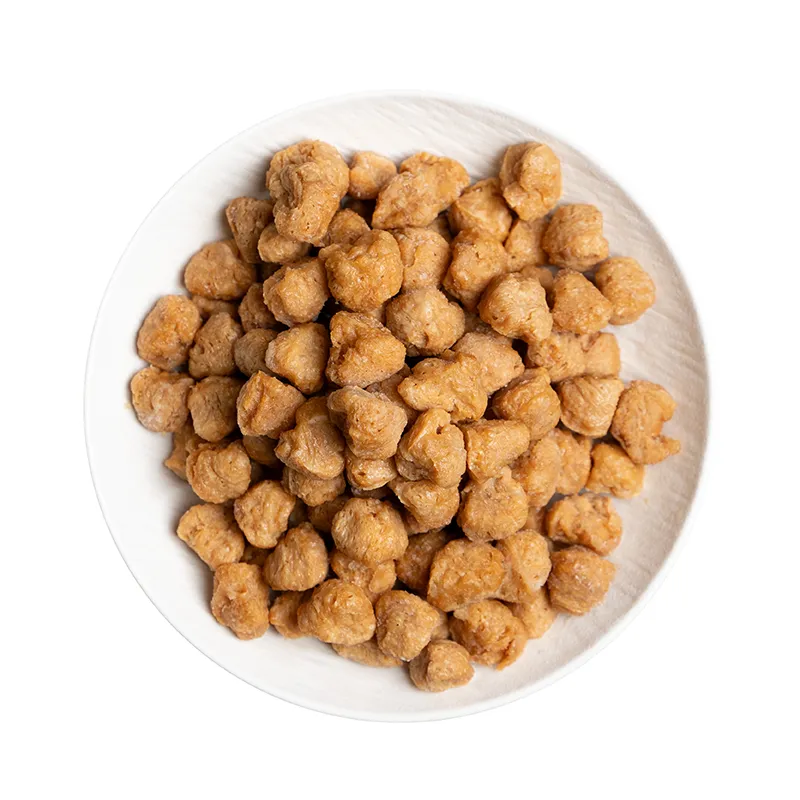
How should hydration ratio and time be tested?
There is no universal water ratio for TVP or for pea-based textured ingredients. Particle size, density, salt, oil, temperature, soak time and the other dry ingredients can all change the practical result. Use the supplier’s starting instruction, but record the dry mass, water mass, hydration time, temperature, drained weight and hydrated yield for every trial.
A simple mass-balance sheet is more useful than a generic absorption promise. Test one controlled ratio at the recommended time, then inspect the center of the largest particles before mixing. If the material is still firm, breaks apart during mixing or carries free water, change one variable at a time. Keep the same measurement method for soy and pea so the comparison is not distorted by different handling.
The U.S. Department of Agriculture’s FoodData Central can support nutrition-label inputs for an ingredient, but it cannot predict water uptake in a specific recipe. The development record should therefore separate the declared nutrient data from the process data measured in the plant or pilot kitchen.
| Decision point | Soy protein / TVP | Pea protein | Buyer check |
|---|---|---|---|
| Structured bite | Often available in fibrous, granular or chunk formats | Depends strongly on whether a textured grade is used | Compare rehydrated particle integrity after mixing |
| Flavor management | May need seasoning to suit the target profile | May require management of legume or earthy notes | Conduct blind tasting after cooking and hold |
| Allergen position | Soy declaration is required where applicable | May help avoid soy, subject to the complete formula and market rules | Review labels with regulatory counsel |
| Yield economics | Hydration can affect purchased-ingredient use per cooked unit | Hydration and binding still require recipe-specific testing | Use cooked yield and reject rate in costing |
How should the protein carry seasoning, fat and umami?
The protein is part of the flavor system, not a neutral carrier. A mildly seasoned chicken-style piece exposes legume notes differently from a heavily seasoned burger, and a dry or dense particle can make the same seasoning seem less effective. Compare aroma before cooking, flavor after cooking and the residual aftertaste after a defined hold.
Fat and umami ingredients also need to be tested with the protein’s physical structure. Check whether oil stays with the matrix or separates during heating, whether seasoning reaches the center of hydrated particles, and whether the product remains palatable after reheating when that is part of the brief. If more masking, binder, process time or rework is needed, include those inputs in the finished-kilogram cost; a lower dry-ingredient price is not automatically a lower formulation cost.
For teams comparing a soy protein for plant-based meat route, a side-by-side test of fibrous and conventional textured options can show whether the problem is protein identity or physical structure. Keep the recipe, seasoning, fat level and cooking profile fixed while changing the protein input.
Which application-specific shapes deserve a separate trial?
A single protein specification rarely serves every product in a portfolio. The team should match shape, size and density to the visual and sensory job: a chunk for a visible bite, a smaller granule for mince, or a fine ingredient where cohesion matters more than particle recognition. The same discipline applies when a line moves from burgers to formed pieces or a plant-based seafood application.
| Target application | Starting point to test | Main trade-off to watch | Useful test |
|---|---|---|---|
| Coarse burger or mince | Textured soy chunks or granules; textured pea as a comparator | Particle integrity versus a dry or rubbery bite | Hydration record, cooked yield and bite assessment |
| Nugget or formed piece | Textured component paired with a binding phase | Hydration uniformity, density and forming strength | Piece-weight variation and breakage count |
| Emulsified sausage | Fine protein ingredient with a separate texture system | Water/fat stability during heating | Post-cook purge after defined holding |
| Plant-based seafood alternative | A shape and moisture profile suited to the target piece | Seasoning penetration and a cohesive but not pasty bite | Blind sensory comparison after cooking and hold |
| Allergen-sensitive brief | Pea-based route, after full-formula review | Flavor, label and supply-chain controls | Label review and matched sensory comparison |
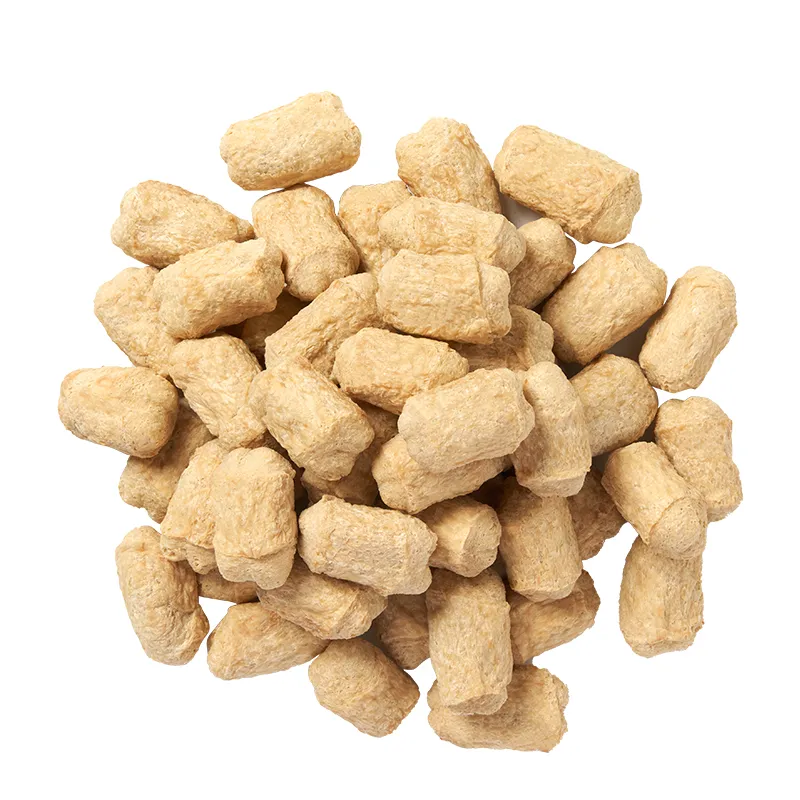
Nutrition remains a separate checkpoint. Protein ingredients can support plant-based protein benefits such as adding protein to a recipe, yet the finished food’s nutrition profile depends on the whole formula and serving size. A “low fat” claim also depends on the final fat content and the claim rules in the destination market; the ingredient alone does not establish it. For teams exploring a pea protein for plant-based meat route, keep the allergen, texture and claim review tied to the finished product rather than to the ingredient’s marketing description.
What should standards and label review cover?
In the United States, the Food and Drug Administration explains that soy is a major food allergen and must be declared on packaged foods when it is an ingredient, subject to the law’s scope and exceptions. The FDA’s nutrition-label rules govern nutrient-content claims such as “low fat”; a claim should be reviewed against the final product, serving basis and current regulatory requirements. These are legal frameworks, not product certifications.
For products sold in the European Union, Regulation (EU) No 1169/2011 requires specified allergens to be emphasized in the ingredient list and sets food-information requirements. For protein claims in the EU, Regulation (EC) No 1924/2006 and its conditions of use are relevant. Requirements vary by market, so importers and brand owners should confirm the destination-country position, language, naming and any applicable product-standard rules before artwork approval.
Analytical methods can help verify a specification, but a method is not a quality badge. AOAC International publishes validated methods used in food analysis; the appropriate method and laboratory should be agreed for the attribute in question. Keep certificates of analysis, allergen controls, country-of-origin information and traceability documents aligned with the purchase specification rather than making broad unsupported safety or nutrition claims.
How can a buyer qualify a soy or pea protein supplier?
- Write a one-page target brief covering product shape, cooking method, texture language, allergen position, target market and finished nutrition claims.
- Request samples with the ingredient specification, format, particle-size information, density information where available, hydration guidance, allergen statement and lot documentation.
- Run a matched trial and record hydration ratio, hydration time, mixing behaviour, forming loss, cooked yield, purge, flavor and sensory findings.
- Ask how the supplier controls lot-to-lot consistency and what documents accompany commercial shipments; verify those answers against retained samples and the purchase specification.
- Calculate finished-unit cost from verified yield, rework and reject rate, then complete regulatory and label review before scale-up.
BCTVP can be a useful starting point when buyers need to compare textured formats against a real production brief. Discuss the target bite, particle shape, hydration window and process constraints early so the development sample answers the commercial question. The supplier qualification decision should follow the evidence from the matched trial and the accompanying documentation.
What do buyers ask about soy and pea protein for plant-based meat?
Is soy protein good for plant-based meat?
It can be, especially when the required product has a coarse, fibrous or particulate bite and the selected soy ingredient is textured for that purpose. The deciding evidence is the finished product’s texture, yield and flavor after cooking. A bench trial remains necessary because different soy formats behave differently.
Is soy protein suitable for plant-based meat?
Soy protein is suitable for many plant-based meat formulations, but suitability includes the allergen declaration, target market and sensory brief as well as function. In a formula that must avoid soy, pea or another protein route may be more appropriate. Confirm the complete ingredient statement before making an allergen-related market claim.
What texture should soy protein have for plant-based meat?
The texture should match the intended food: fine and cohesive for some emulsified formats, or granular, fibrous or chunk-like for a more visible meat-style bite. Specify hydrated size and integrity rather than relying on a dry visual description. Test the material after mixing and cooking, where fracture and dryness become apparent.
How much water does TVP absorb in plant-based meat formulation?
There is no single reliable ratio for every TVP or recipe. Water uptake changes with particle size, process history, temperature, soak time, salt, oil and the other dry ingredients. Begin with the supplier’s guidance, then document actual uptake and cooked yield in your formulation.
Can textured soy protein improve yield and juiciness?
It can help manage moisture in some recipes when hydration, binding and cooking conditions are matched, but it does not guarantee a higher yield or juicier result. Excess water or unsuitable processing can create purge and a soft bite instead. Validate through controlled raw-to-cooked weight measurements and sensory evaluation.
What allergens and labels should be considered for plant-based meat?
Review soy, wheat, milk, egg, sesame and any other allergens present in the full formula, as well as cross-contact controls and destination-market labelling rules. In the U.S., soy is a major food allergen; other markets have their own required declarations and presentation rules. Have qualified regulatory reviewers approve artwork and claims before release.
Which authoritative sources support this comparison?
- U.S. Food and Drug Administration: Food Allergies
- U.S. Food and Drug Administration: Nutrition Labeling for Foods
- European Commission: Food information to consumers legislation
- European Commission: Nutrition and health claims
- USDA FoodData Central
Choose the protein that proves itself in the finished bite and the finished label, not the one that sounds best on a specification sheet.
When your team is ready to compare formats against a real production brief, explore textured protein options for plant-based meat development or contact BCTVP to discuss your formulation requirements.