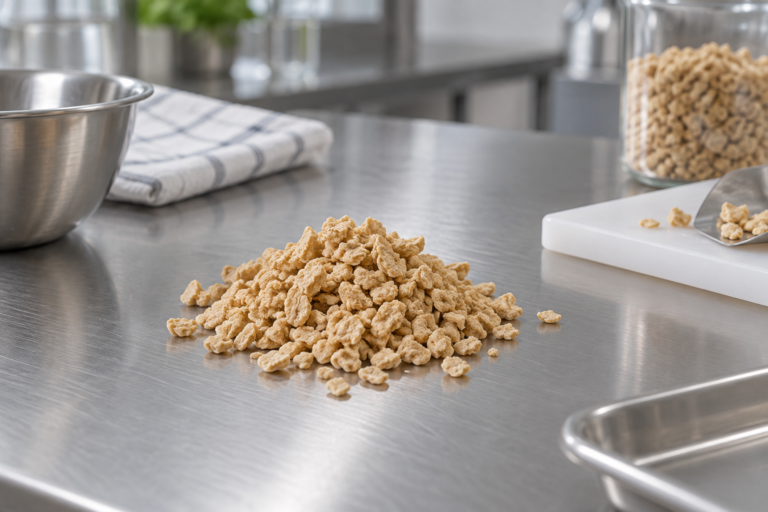
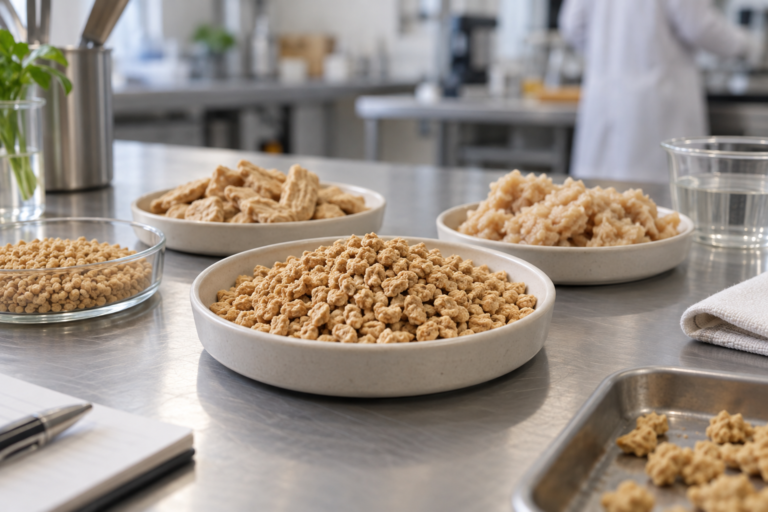
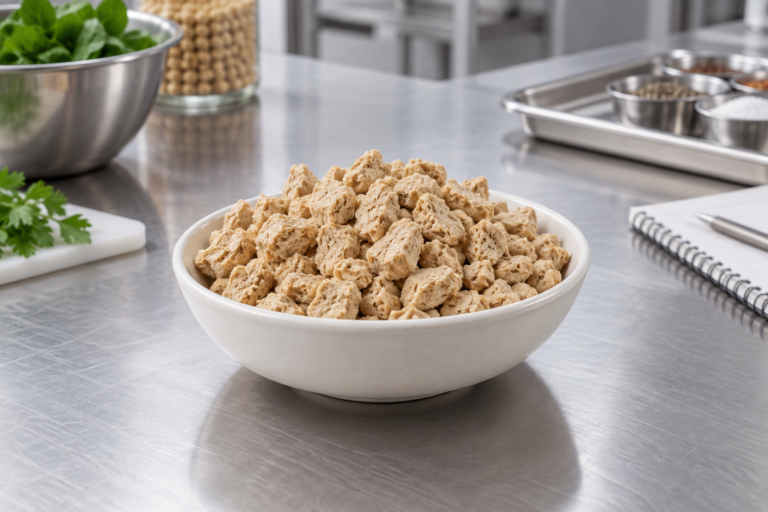
A ready-meal developer in Manchester once specified “TVP chunks” for a curry and approved a 20 mm piece size. On the production tray, however, the chunks looked oversized beside the 12 mm carrot and pepper dice. The protein stood out visually, overwhelmed the single-serve portion, and failed the shelf-ready review. The buyer’s comment was simple: “the protein looks like it was dropped in from another dish.” The solution was not a new recipe, a new seasoning system, or a higher ingredient cost. It was one number. The team changed the specification to 10–12 mm cubes, matched the vegetable cuts to the same dimension, and the relaunched tray passed on the first presentation. For TVP chunks, size is not a small detail — it is part of the product experience. When sourcing TVP chunks from a supplier in China, the millimeter range should be confirmed before the purchase order is placed.
Size Selection
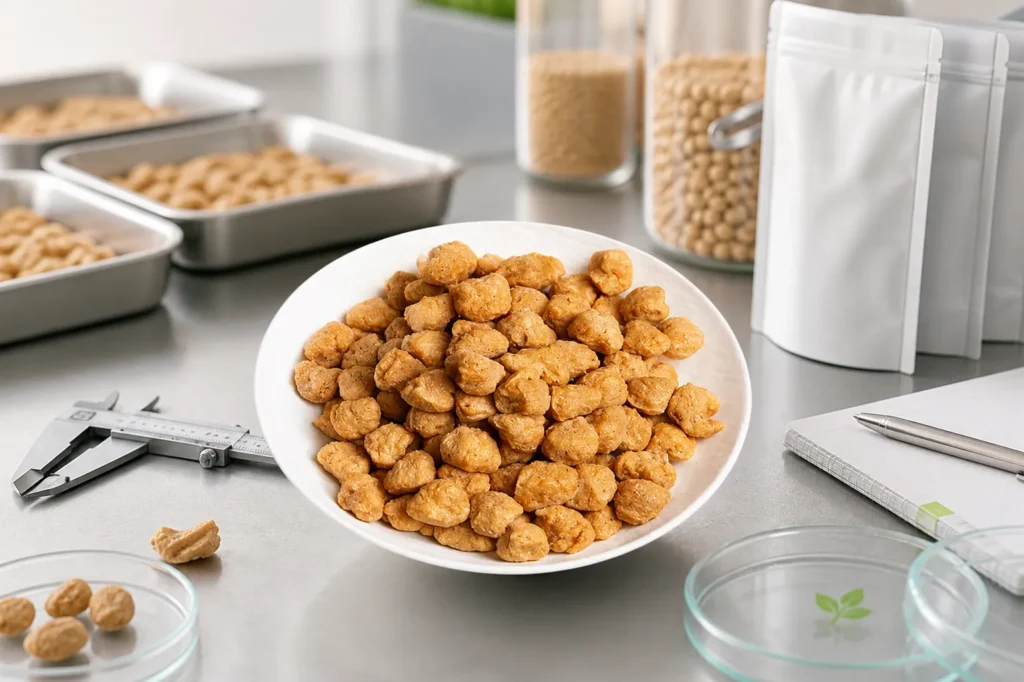
Choosing the right TVP chunk size starts with the final dish. Small chunks, usually 5–8 mm, work well in mixed stews, soups, and institutional meals where even distribution matters. Medium chunks, around 10–14 mm, are better for curries, rice bowls, and tray meals where the protein should be visible but not dominant. Larger 16–20 mm chunks suit center-of-plate meat analogs where a stronger bite and larger visual presence are expected.
A useful rule is to match the TVP chunk to the largest vegetable cut in the recipe. If the carrots, peppers, potatoes, or mushrooms are cut to 10–12 mm, the protein should sit in the same visual language. This makes the dish look intentional rather than assembled from unrelated components.
Two technical details sit behind the stated size. The first is size distribution. A good production lot should keep at least 85% of pieces within the agreed nominal range. A weak lot may spread across 6–18 mm, creating trays where small pieces break down while larger pieces remain too firm. The second is factory screening. After drying, chunks are separated on vibrating screens, and the screen deck determines whether the buyer receives a clean grade or a mixed batch with excessive fines. For this reason, it is worth asking for the screen specification and the retained-on/passed-through percentages instead of relying only on a target millimeter size.
| Size | Best Dish | Chew |
|---|---|---|
| 5–8 mm | Mixed stews, soups | Light |
| 10–14 mm | Curries, grain bowls | Medium |
| 16–20 mm | Center-plate vegan meat | Strong |
Rehydration Integrity
TVP chunks must keep their shape after hydration, heating, and sauce processing. A practical benchmark is at least 90% structural integrity after cooking. If the chunks crumble, split, or shed too many fines, the extrusion structure is likely too weak for production use. For comparison with other TVP types, the same test method should be used each time so results can be compared across suppliers.
A simple factory or kitchen test can be run as follows: weigh 100 g of dry chunks, hydrate them at a ratio of 1:2.8–3.2 in 85°C water for 20 minutes, drain for two minutes, then simmer for 15 minutes in the actual sauce base. After cooking, pour the product over a 4 mm screen and weigh the material that remains on the screen against the total wet weight. A result above 90% is suitable for production. A result between 80% and 90% may still work in thick sauces where broken edges are less visible. Below 80%, the chunks are unlikely to pass a reliable retail or foodservice specification.
Frozen lines need an additional check. Run three freeze-thaw cycles at −18°C and then repeat the same screen test. This harsher test reveals whether the internal cell walls were over-expanded during extrusion and whether the chunk will remain stable through frozen storage, distribution, and reheating.
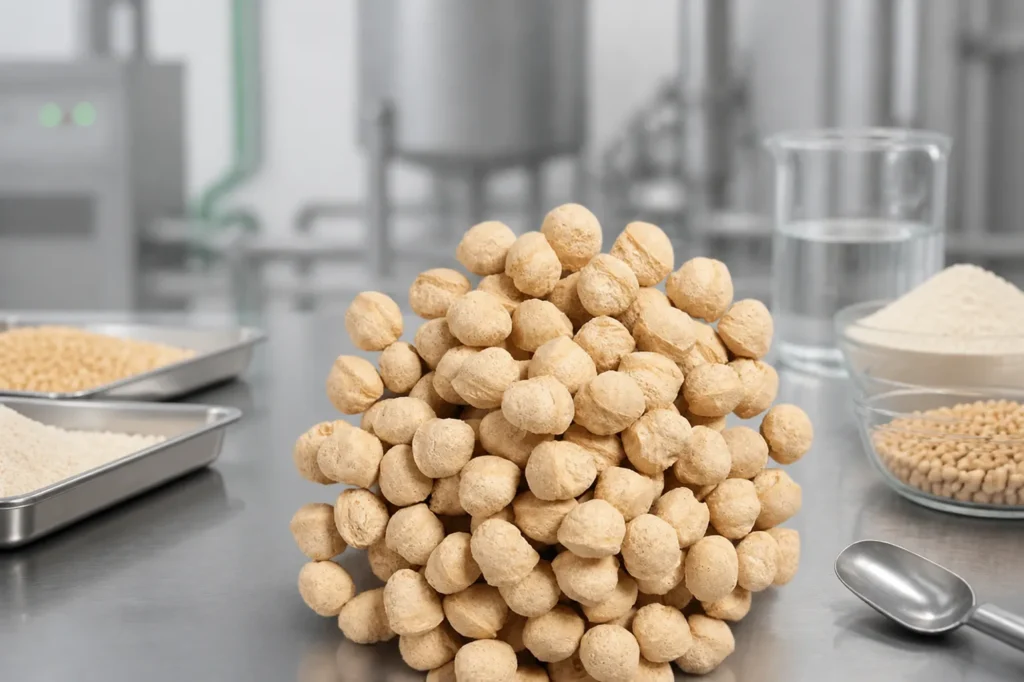
Chew, Bite and Vegan Meat Cubes
Shape retention and chew are connected, but they are not the same. A chunk may pass a screen test and still eat poorly if the cell structure is too uniform, too soft, or too sponge-like. Good chew comes from density, cell-wall thickness, and controlled expansion during extrusion.
For many applications, a bulk density of about 200–280 g/L gives a satisfying bite. Chunks below 180 g/L can feel light at first but often collapse quickly in the mouth, especially after hydration and heat treatment. For vegan meat cubes used in skewers, stroganoff, sweet-and-sour dishes, braised “beef” cubes, or other center-of-plate applications, the ideal piece should resist slightly at first bite, then yield cleanly without releasing excess water.
In practice, this usually means pairing a denser chunk with controlled hydration, often in a 0.8–1.2% salt solution, followed by a light surface sear to set the exterior. Sauce viscosity also matters: a sauce that clings to the surface helps the piece feel more integrated in the dish. If the product brief requires a true muscle-like pull rather than a firm sponge bite, standard chunks may reach their limit and a fibrous grade should be considered instead.
Applications
TVP chunks are used wherever a visible, chewable plant protein piece is needed. Common applications include stews, canned meals, frozen entrées, curry trays, grain bowls, school meals, institutional catering, and plant-based meat blocks. For strip-shaped applications, see TVP strips.
Canned and retorted products need special attention because their heat load is much higher than a short kitchen simmer. At F0 values above 8, softer chunks can lose definition and make the finished pack look tired when opened. A denser grade and hydration at the lower end of the recommended range can help protect appearance.
Frozen entrées face a different challenge. If chunks are under-hydrated before freezing, they can absorb water from the surrounding sauce during storage. This may thicken the sauce unpredictably and change both the texture and the eating experience. For institutional and school feeding programs, 5–8 mm chunks are often preferred because portion control is easier and cooking often involves extended holding rather than precise timing.
Protein, Moisture and What the COA Should Actually Say
A TVP chunk specification should not stop at “52–60% protein.” The COA should state protein by AOAC 992.23 on a dry basis, with the nitrogen conversion factor clearly listed. This matters because protein reported on an as-is basis at around 8% moisture can make the value look slightly different from a true dry-basis comparison.
Moisture should be no more than 10% at packing. It is also useful to request the moisture value at the point of loading, not only at production. If chunks are packed while still warm and sealed immediately, condensation can form inside the liner and affect shelf stability.
A complete COA should also include bulk density, size distribution across the screening bands, residual fat, ash, and microbiological results. Residual fat is commonly expected to be below 1%. Microbiological checks should include total plate count, yeast and mould, Enterobacteriaceae, and Salmonella absent in 25 g.
Under HACCP, the post-extrusion drying and cooling step is a critical control point because it strongly affects moisture and microbiological safety. A supplier should be able to explain how this CCP is monitored, not only provide a certificate. Buyers operating ISO 22000 or IFS certified plants should also request the supplier’s allergen management statement, since soy is a declared allergen in most markets and cross-contact controls directly affect finished-product labeling and audit compliance.
Why Baichuan Chunks
Baichuan supplies textured soy protein and fibrous soy protein chunks with controlled size distribution, stable hydration performance, and low breakage. Products are supported by HACCP, ISO 22000, and Halal certification, with full export documentation available for international buyers.
The management system also covers ISO 9001 quality management, ISO 14001 environmental management, and ISO 45001 occupational health and safety. HALAL certification is recognized under MUI Halal for Indonesian and Southeast Asian markets, and IFS documentation is available for European retail programs. Each lot ships with a COA reporting protein by AOAC 992.23, moisture, ash, fat, bulk density, size distribution, and microbiological results.
FAQ
What size TVP chunk for curry?
For curry, 10–14 mm TVP chunks usually provide the best balance of bite and appearance. They are large enough to be visible but not so large that they dominate the tray. See TVP types.
Do chunks hold up after freezing?
Yes, if the chunks have strong rehydration integrity. A good production-grade chunk should retain at least 90% structural integrity after hydration, cooking, freezing, thawing, and reheating. Always verify performance on samples before confirming the purchase specification.
Are TVP and soya chunks the same?
Yes, they are closely related. TVP means Textured Vegetable Protein, and soya chunks are a common type of TVP made from defatted soy flour. Both are dried plant-based protein ingredients that become chewy after soaking or cooking.
What is the serving size of textured vegetable protein?
A typical serving of textured vegetable protein is about 1/4 cup dry TVP. After rehydration, this usually becomes around 1/2 to 3/4 cup and may provide about 10–15 grams of protein, depending on the product specification.
What is the standard serving size for protein?
A standard protein serving is often described as 3–4 ounces of cooked meat, fish, poultry, tofu, or another protein-rich food. In meal planning, many people aim for about 20–30 grams of protein per meal, depending on their diet and activity level.
What is the 3-3-3 protein rule and how does it work?
The 3-3-3 protein rule generally means eating three meals per day, with about 30 grams of protein at each meal, spaced roughly three hours apart. The idea is to distribute protein more evenly through the day to support satiety, muscle maintenance, and steady nutrition.
References
- ISO 22000:2018 — Food safety management
- AOAC 992.23 — Protein determination
- ISO 9001:2015 — Quality management systems
- Codex Alimentarius CAC/RCP 1-1969 — General principles of food hygiene (HACCP)
- IFS Food Standard v8 — Retail-brand food product audits
Explore Baichuan: TVP & Fibrous Soy Protein Products · About Baichuan’s Manufacturing · Contact Us for Samples & Quotes