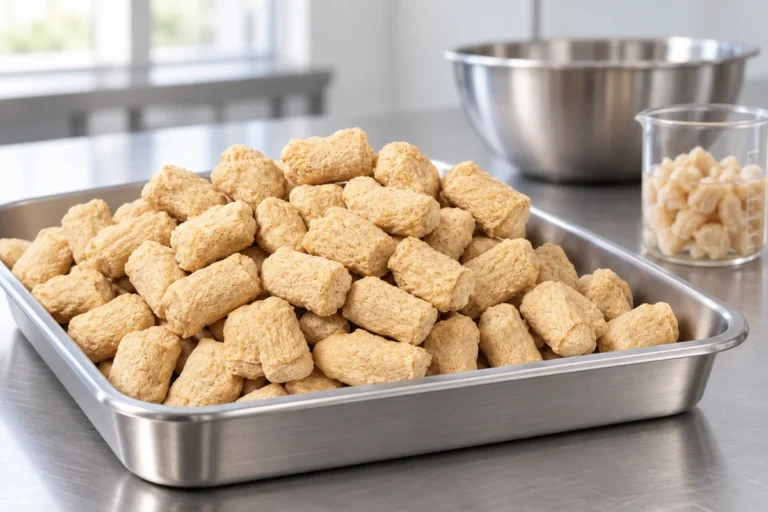
When a plant-based brand in Los Angeles launched vegan chicken strips, the product looked promising on the bench but failed during a live wok demo. The strips were standard TVP pieces cut into a strip shape, not material engineered for structural retention. Within thirty seconds of tossing, the pieces shortened, frayed, and clouded the sauce. The influencer video quickly turned into a quality problem.
The brand pulled the SKU, requalified two suppliers, and changed the approval process. This time, they required a three-cycle cook test with photographs at each stage before signing off. The replacement material retained 93% of its length through three heat cycles, and the relaunch went out without incident. Real TVP strips must survive heat, tossing, sauce, and reheating.
Structure Retention
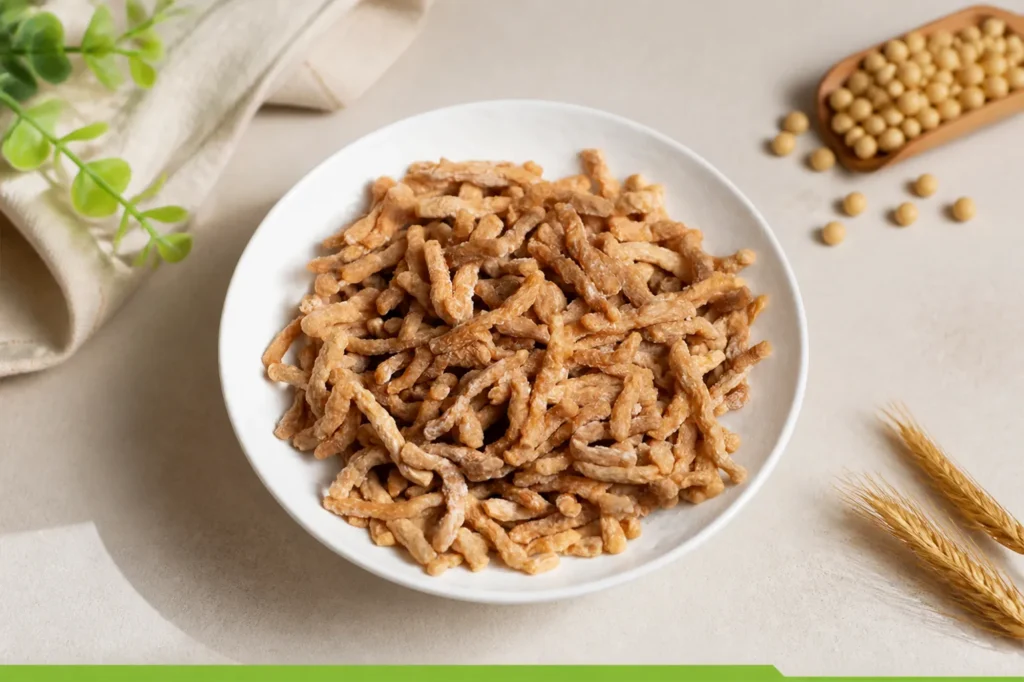
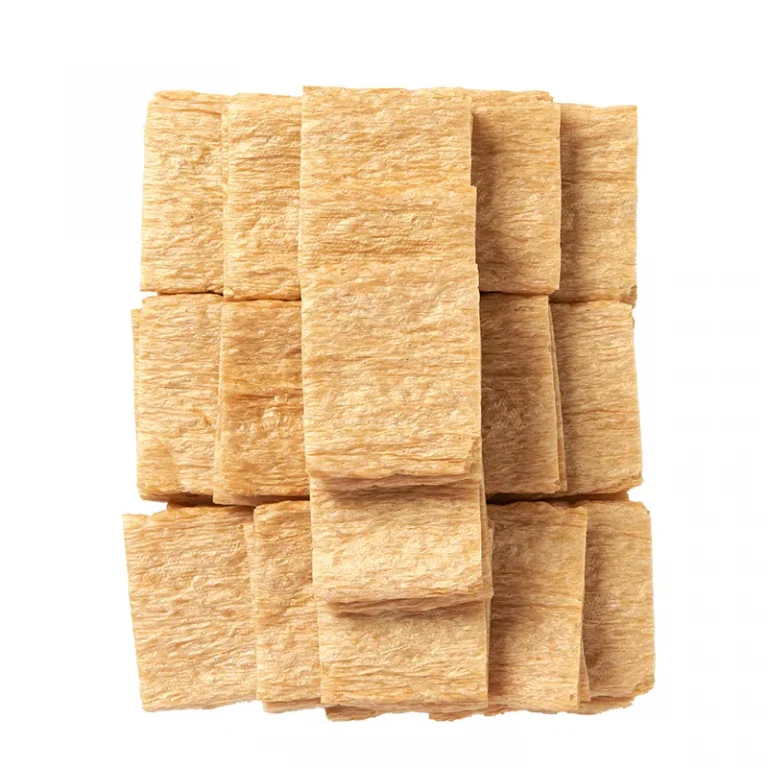
TVP strips must hold their length and shape after boiling, frying, tossing, and reheating. A single dry-product photo does not prove performance. A better specification is a third-cycle cook test showing at least 90% length retention. If the strip crumbles, shortens heavily, or sheds fibers into the pan, the internal orientation is too weak for commercial use.
Use the same protocol for every candidate material so results are comparable. Hydrate 100 g of dry strips at 1:3.0 in 85°C water for 25 minutes. Drain for two minutes. Then run three cycles of pan-frying at 180°C for four minutes, followed by ten minutes of ambient cooling. After each cycle, photograph a ruler-referenced sample and measure the ten longest pieces.
Material that loses more than 10% of its average length, or releases visible fibers into the pan or sauce, is unlikely to survive real production. A simple hand-shear test is also useful. Pull a hydrated strip apart by hand. A well-oriented strip should tear cleanly along the grain. A weak strip will break into mushy fragments or crumble without a directional tear.
| Property | Target |
|---|---|
| Length retention (3 cooks) | ≥90% |
| Protein | 55–65% |
| Hydration ratio | 1:2.8–3.2 |
| Chew (texture) | Directional/fibrous |
Reheating Stability in Real Channels
Most strip products are not eaten immediately after pan-frying. They may be chilled, frozen, microwaved, held on a steam table, or passed through a conveyor oven. Each route places different stress on the strip.
Microwave reheating is especially demanding because steam builds inside the piece instead of only heating from the surface. Strips with thin or weak cell walls may balloon, collapse, and become spongy or watery. Foodservice holding creates a slower failure. Strips sitting in sauce at 65°C for two hours continue absorbing liquid and may lose definition after about ninety minutes unless the base material is dense and well oriented.
Frozen retail lines bring another risk: freeze-thaw damage from ice crystal formation. For frozen applications, hydration should usually be closer to 1:2.8 than 1:3.2 to reduce excess free water. Supplier validation should match the real sales channel. A strip that passes only a boiling-water bench test may still fail in a microwave tray, steam-table pan, or wok application.
Applications
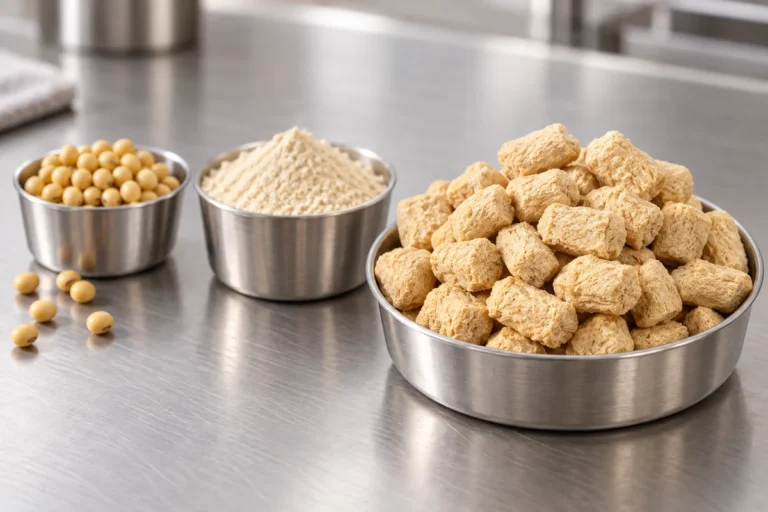
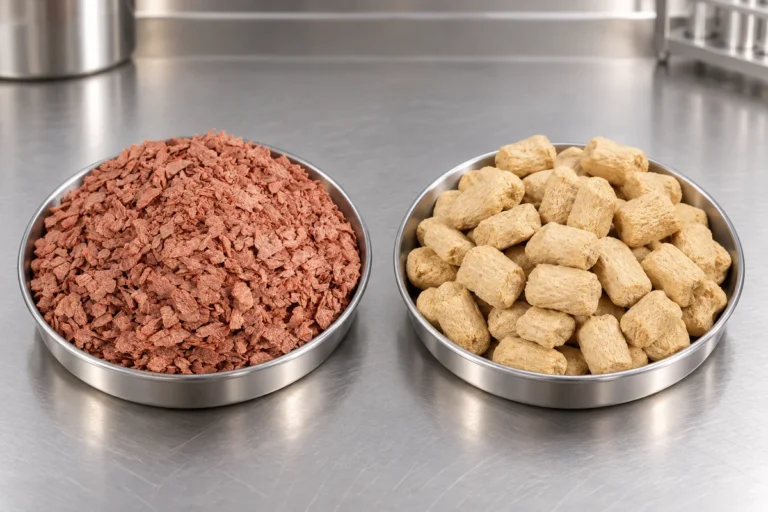
TVP strips are commonly used in vegan beef strips, chicken-style strips, stir-fry mixes, fajita fillings, curry bowls, frozen entrées, chilled meal kits, and ready meals. For sauce-heavy minced applications, see TVP granules. For center-plate blocks or larger bite pieces, see chunks.
Strip dimensions should follow the meat style being replaced. Chicken-style fajita cuts often work well at 6–8 mm wide. Beef-style stir-fry pieces usually need 10–12 mm width. Wider 15–20 mm flat pieces are better for shredded or pulled applications where the strip is torn rather than sliced.
Length also matters in production. Pieces longer than 60 mm can tangle in tumblers, bridge in hoppers, and create feeding problems on automated lines. For most commercial systems, 35–50 mm is easier to handle while still giving a convincing strip appearance.
Recipe Integration
TVP strips absorb marinade along the grain, so process sequence matters. For more formulation advice, see these recipe integration tips.
Do not place dry strips directly into an oily marinade. Oil can seal the surface and stop the interior from seasoning evenly. A more reliable sequence is to hydrate first in seasoned broth with 0.8–1.2% salt, drain and press to a controlled free-water level, then tumble with marinade for 20–30 minutes. Light vacuum tumbling, if available, helps drive flavor along the fiber channels and often improves sensory scores more effectively than simply increasing seasoning dosage.
Before searing, a light dusting of 2–4% starch or a methylcellulose-free binder can improve surface color and sauce adhesion without hiding the fibrous appearance. This is useful in stir-fry, fajita, and ready-meal applications where visual browning is part of the eating cue.
Strips Versus Fibrous: Where the Upgrade Pays
Standard directionally extruded TVP strips and fibrous soy protein strips serve different product positions. They are not simply interchangeable materials at different prices. Choosing the right one early can save several rounds of failed development.
Standard TVP strips are often the right choice when the piece is coated, sauced, or served in a mixed dish with vegetables, rice, noodles, or curry. Examples include fajita kits, stir-fry meal kits, curry bowls, and foodservice pans. In these applications, protein at 55–65% and length retention above 90% are usually enough, and the cost position remains attractive.
Fibrous soy protein becomes more valuable when the consumer evaluates the strip on its own. Breaded chicken-style tenders, jerky-style strips, cold-eaten products, and shredded formats need a stronger grain and a more convincing tear. The practical test is simple: hydrate both grades, pull them apart by hand, and check whether the material forms strands or crumbs. If the product brief calls for muscle-like pull, fibrous soy protein is often the better route.
| Criterion | TVP Strips | Fibrous Soy Protein Strips |
|---|---|---|
| Protein | 55–65% | 60–70% |
| Tear behavior | Breaks cleanly | Strands along grain |
| Microwave stability | Good | Excellent |
| Relative cost/kg | Baseline | +25–40% |
| Best fit | Sauced & mixed dishes | Standalone, cold-eaten, shredded |
Quality Documentation and Audit Readiness
TVP strips are often used in branded retail, foodservice chains, and export-ready finished products. That means the ingredient file needs to be audit-ready from the start, not assembled only after a customer complaint.
At qualification, request protein by AOAC 992.23 on a dry basis with the nitrogen conversion factor stated. Moisture should be no more than 10% and ideally measured at loading. The COA should also include bulk density, width and length tolerance, ash, fat, and full microbiological results, including Salmonella absent in 25 g.
Ask which step is designated as the critical control point under HACCP. For strip products, this is usually post-extrusion drying and cooling because it affects moisture, shelf stability, and microbiological safety. Also confirm that the certification scope covers the specific production line. An ISO 22000 or IFS certificate issued to a corporate entity does not automatically guarantee that a newly commissioned extruder is included.
For Muslim-majority markets, verify Halal certification carefully. If the product is destined for Indonesia or Southeast Asia, check whether MUI Halal recognition applies. Importers may examine the certifying body, not just the word “halal” on the document.
Why Baichuan Strips & Fibrous
Baichuan’s fibrous soy protein provides high structural fidelity for strip-style and shredded applications. Baichuan supplies both TVP strips and fibrous grades with HACCP, ISO 22000, and Halal certification, supported by full export documentation.
The wider management system also covers ISO 9001 quality management, ISO 14001 environmental management, and ISO 45001 occupational health and safety. HALAL certification is recognized under MUI Halal for Indonesian and Southeast Asian buyers, and IFS documentation is available for European retail programs.
Each lot ships with a COA reporting protein by AOAC 992.23, moisture at or below 10%, ash, fat, bulk density, and microbiological results. Cook-test data can also be provided on request for buyers who need to qualify strip performance before purchase.
Selection Checklist
- Require third-cycle cook-test data instead of relying on a single product photo.
- Match strip width to the meat style being replaced.
- Validate performance in the real reheat channel, such as microwave, steam table, wok, or conveyor oven.
- Confirm that the strip is directionally extruded, not cut from a sheet, block, or coarse granule format.
- Compare with all TVP types before finalizing the specification.
Baichuan provides textured soy protein and fibrous soy protein strips designed for heat stability, controlled chew, and consistent production performance. If a project requires the tearing pull of muscle rather than firm resistance, moving from a standard TVP strip to a fibrous grade often solves in one trial what repeated seasoning adjustments cannot.
FAQ
Are TVP strips the same as cut granules?
No. True TVP strips are made through directional extrusion to create structure and length retention. Cut granules may look similar when dry but usually do not deliver the same cooking stability. See TVP types.
Which is better for strips: TVP or fibrous?
Fibrous soy protein gives a stronger bite and better muscle-like tear, especially for standalone strips, shredded products, or cold-eaten formats. Standard TVP strips work well in sauced and mixed dishes. Our fibrous page explains the difference.
Do strips survive freezing?
Yes, if the material has strong structure and at least 90% integrity after testing. Frozen applications should be validated on samples using the intended hydration, freezing, thawing, and reheating process. Baichuan can support this through Baichuan testing.
Can Baichuan supply custom strip width?
Yes. Baichuan can discuss custom strip widths based on the application, target texture, and production requirements. Custom sizing may affect MOQ and lead time, so it should be confirmed during sampling.
Why do my strips go spongy in the microwave?
Microwave heating creates internal steam pressure. If the strip has thin cell walls or too much absorbed water, it may expand, collapse, and become spongy. Reduce hydration toward 1:2.8, choose a denser directionally extruded grade, and test with a real microwave cycle rather than relying only on boiling-water evaluation.
References
- ISO 22000:2018 — Food safety management
- AOAC 992.23 — Protein determination
- ISO 9001:2015 — Quality management systems
- Codex Alimentarius CAC/RCP 1-1969 — General principles of food hygiene (HACCP)
- IFS Food Standard v8 — Retail-brand food product audits
Explore Baichuan: TVP & Fibrous Soy Protein Products · About Baichuan’s Manufacturing · Contact Us for Samples & Quotes