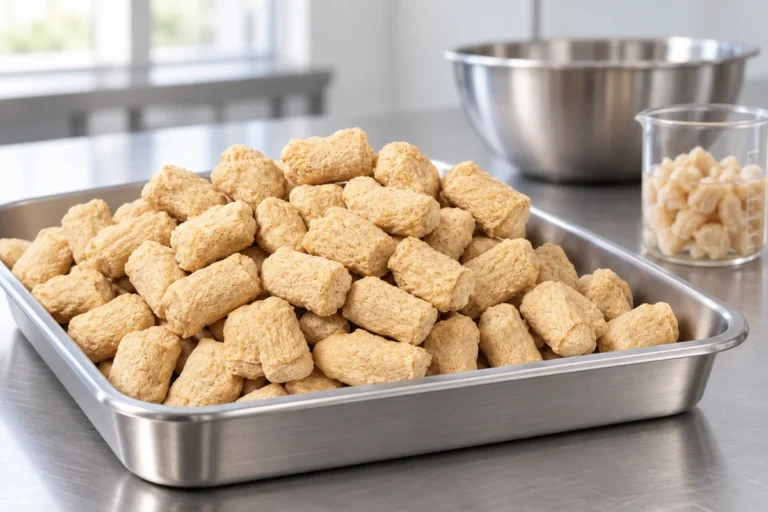
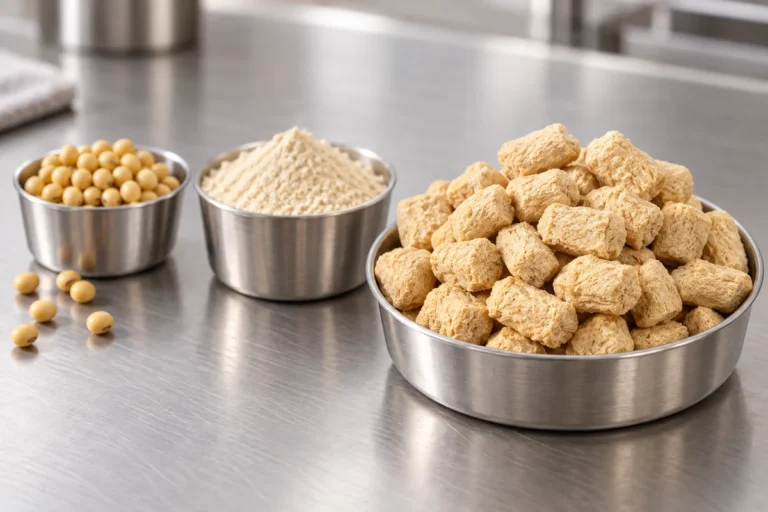
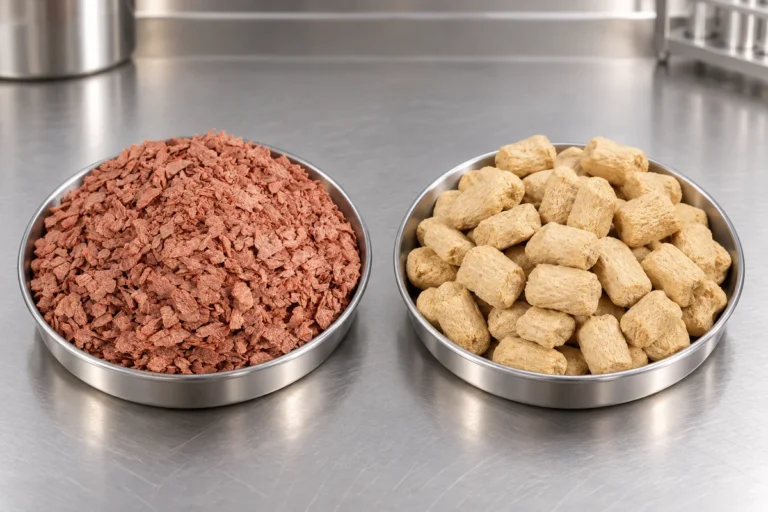
In Melbourne, a recipe developer for a chilled ready-meal brand was three days from a customer presentation when her hybrid meatball prototype fell apart on the plate. She had swapped 30% of the raw beef for TVP gram-for-gram, dry weight against wet weight, assuming a straight one-to-one exchange. The batch came out of the oven dry, crumbly and visibly cracked — the dry granules had stolen moisture from the meat matrix and the binder had nothing left to work with. The fix took one afternoon: hydrate the TVP first at 1:2.5, calculate the substitution on hydrated mass, then reduce added water in the formula by the equivalent amount and lift the binder by roughly 1%. The revised batch held together, ate juicier than the all-meat control, and won the listing. Adding textured protein is a calculation, not a copy-paste.
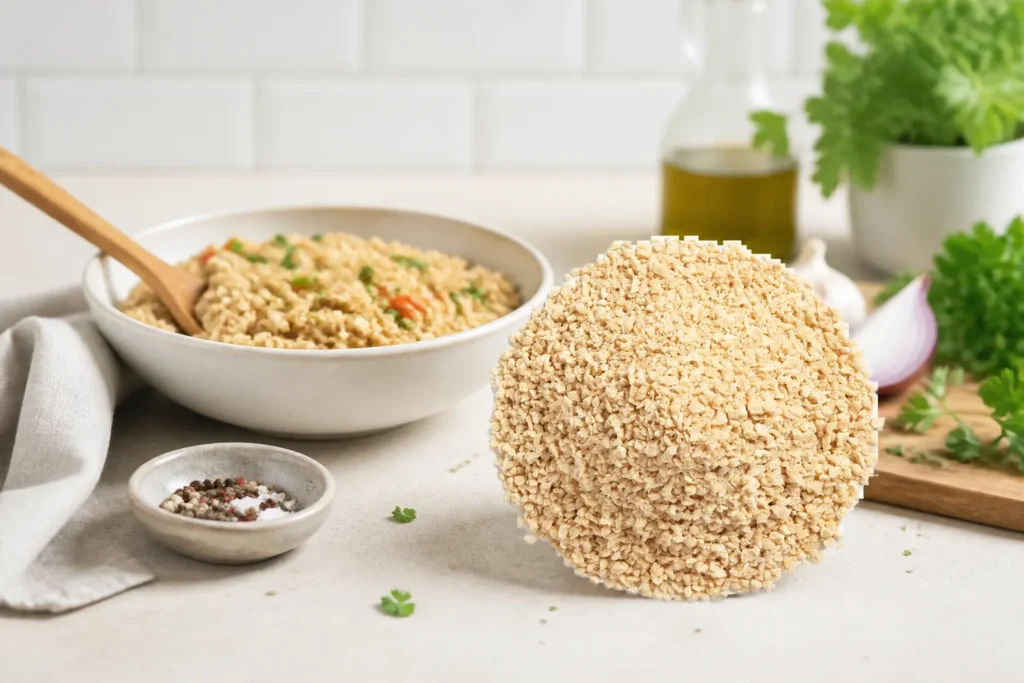
Step 1: Hydrate First, Always
Always hydrate before mixing — see the cooking guide for ratios and timings. Never add dry TVP to a wet recipe expecting it to absorb in place. Dry granules in a meat emulsion or a stew behave as a desiccant: they pull free water out of the surrounding matrix, which dries the protein around them, breaks emulsion stability and leaves the granules themselves only partially hydrated with a chalky core.
The exception is narrow and deliberate. In some high-moisture stews with a long simmer of 40 minutes or more, dry granules can be added directly at the start as a thickening strategy — but you must add the hydration water separately to the recipe and accept less control over final texture. For any formed product — burgers, meatballs, nuggets, sausages — pre-hydration is non-negotiable.
Step 2: Calculate the Substitution on Hydrated Mass
Here is the arithmetic that prevents most failures. If a formula calls for 1,000 g of minced meat and you want a 30% substitution, you need 300 g of hydrated TVP — not 300 g of dry. At a 1:2.5 hydration ratio, 300 g hydrated comes from roughly 86 g dry plus 214 g liquid. That liquid is now inside your formula. If the original recipe also included added water or stock, reduce it by a corresponding amount, usually 50–70% of the hydration liquid, to keep total moisture in range.
| Application | Format | Substitution (hydrated) | Binder Adjustment | Notes |
|---|---|---|---|---|
| Mince / bolognese | Fine granules | 20–35% | None needed | Sauce carries moisture |
| Burgers / patties | Coarse granules | 20–30% | +0.5–1.5% methylcellulose or starch | Bite test at 25% first |
| Meatballs | Fine granules | 25–35% | +1% binder, +2% breadcrumb | Rest mix 20 min before forming |
| Stews / curries | Chunks | 25–40% | None | Add in final 15 min of simmer |
| Stir-fry | Strips | 30–50% | Light starch coating | Sear separately, combine at end |
| Sauces / fillings | Fine granules | 10–25% | None | Adds body without thickener |
| Whole-cut analogue | Fibrous soy protein | 60–100% | Fat system + binder critical | Marinate under vacuum |
Step 3: Adjust Binders, Fat and Seasoning
Hydrated TVP contributes water and protein but almost no fat — typically 0.5–1.5% versus 15–20% in beef mince. In a formed product, fat is what carries flavour and creates the perception of juiciness, so at substitution levels above 25% you should add back 2–4% of a fat system such as refined coconut oil, sunflower oil or a structured fat emulsion. Without it, the product reads lean and dry even when moisture content is technically correct.
Binders matter because TVP particles do not form the protein-protein bonds that myofibrillar meat protein does. Methylcellulose at 0.5–1.5%, or a starch and protein isolate combination for clean-label formulations, restores cohesion. Seasoning should rise by roughly 15–25% relative to the all-meat control, because the porous matrix absorbs salt, umami and spice into its interior where the palate registers it more slowly.
Step 4: Choose Format by Dish, Not by Price
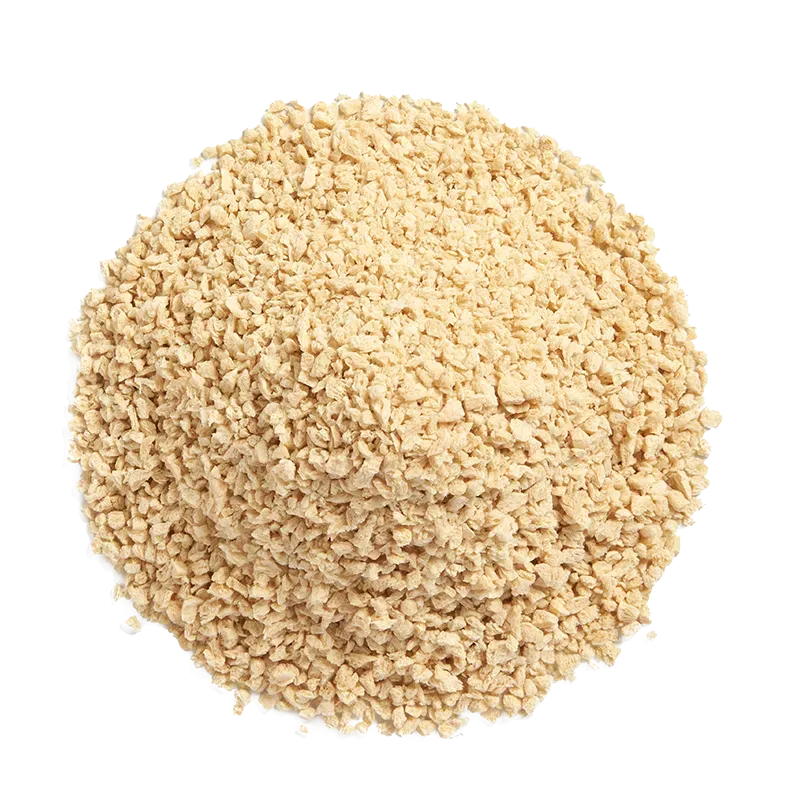
Granules suit fillings, mince, sauces and empanadas where particle definition is fine. Chunks suit stews, curries and casseroles where a visible piece is expected to survive a long simmer. Strips suit stir-fry, fajitas and plant-based meat applications where a directional bite matters. Fibrous soy protein lifts premium analogues into the whole-muscle category with genuine pull-apart layering.
A frequent purchasing error is buying one format to serve all applications because it is cheaper per tonne. The saving is real but small, and it is usually erased by the reformulation work required to make the wrong particle size behave.
Worked Example: A 30% Hybrid Burger
Take a 1,000 g all-beef patty formula as the control: 950 g beef mince at 20% fat, 15 g salt and seasoning, 35 g water. To convert to a 30% hybrid, replace 300 g of the beef with 300 g of hydrated coarse granules. Working backwards at a 1:2.5 ratio, that is 86 g dry TVP hydrated in 214 g of seasoned stock. Remove the 35 g of added water entirely, since the hydrated material now supplies it.
Two further corrections are needed. Fat has dropped from 190 g to roughly 133 g in the reduced beef portion, so add 20 g of refined coconut or sunflower oil to bring perceived juiciness back. Cohesion has weakened, so add 10 g of methylcellulose or a starch-protein binder at 1%. Seasoning rises from 15 g to about 18 g, with a portion of it moved into the hydration stock rather than the final mix. The finished formula holds shape on the grill, loses less weight to cook shrink than the control, and costs meaningfully less per kilogram.
Scale-Up and Compliance Notes
Bench formulas rarely transfer unchanged. At production scale, mixing shear is higher and will break down hydrated granules further, so reduce mixing time by 20–30% from the bench protocol and verify particle integrity visually. Document hydration ratio, liquid temperature and drained weight as controlled parameters inside your ISO 22000 process flow — IFS and BRC auditors will ask. If the finished product carries a HALAL claim, confirm that the TVP itself holds HALAL or MUI Halal certification, since the flavour system and the base ingredient are audited separately.
Selecting Material That Formulates Predictably
The variable that ruins reformulation work is not average quality but lot-to-lot variation in hydration behaviour. Ask suppliers for a stated rehydration ratio with tolerance, particle size distribution, protein by AOAC 992.23 and moisture at 8–10%, then validate across three separate lots before locking a formula. Certification baseline should include HACCP, ISO 9001 and ISO 22000, with ISO 14001 and ISO 45001 increasingly requested by European customers.
Baichuan publishes these parameters per format so that a formula validated on one shipment behaves the same on the next. Use the same template to compare any supplier you shortlist.
FAQ
Can I add dry TVP directly?
Not for formed products — hydrate first or the dish dries and crumbles as the granules draw water from the surrounding matrix. Only long-simmer wet dishes tolerate direct addition, and even then you must add the hydration water separately to the recipe.
How much TVP replaces meat?
Typically 20–50% on hydrated weight depending on application, and up to 100% for fully plant-based products. See the table above for format-specific ranges and binder adjustments.
How to use textured vegetable protein in recipes?
To use textured vegetable protein in recipes, rehydrate dry TVP with hot water, vegetable broth, or seasoned sauce for about 5–10 minutes until it becomes soft and chewy. After soaking, drain any excess liquid if necessary, then cook it with oil, spices, vegetables, or sauces. Because TVP has a neutral flavor and absorbs seasoning well, it works best when the soaking liquid or cooking sauce is well seasoned.
What dishes can TVP be used in?
TVP can be used in many dishes that normally contain minced meat or crumbled protein. It is commonly added to vegan chili, tacos, burritos, spaghetti Bolognese, lasagna, burgers, meatballs, dumpling fillings, pies, soups, stews, and stir-fries. Its chewy texture and strong flavor absorption make it suitable for both home cooking and plant-based food manufacturing.
References
- Codex Alimentarius CAC/RCP 1-1969 — General Principles of Food Hygiene
- AOAC 992.23 — Crude protein determination, combustion method
- ISO 22000:2018 — Food safety management systems
- FAO/WHO — PDCAAS protein quality evaluation
Explore Baichuan: TVP & Fibrous Soy Protein Products · About Baichuan’s Manufacturing · Contact Us for Samples & Quotes