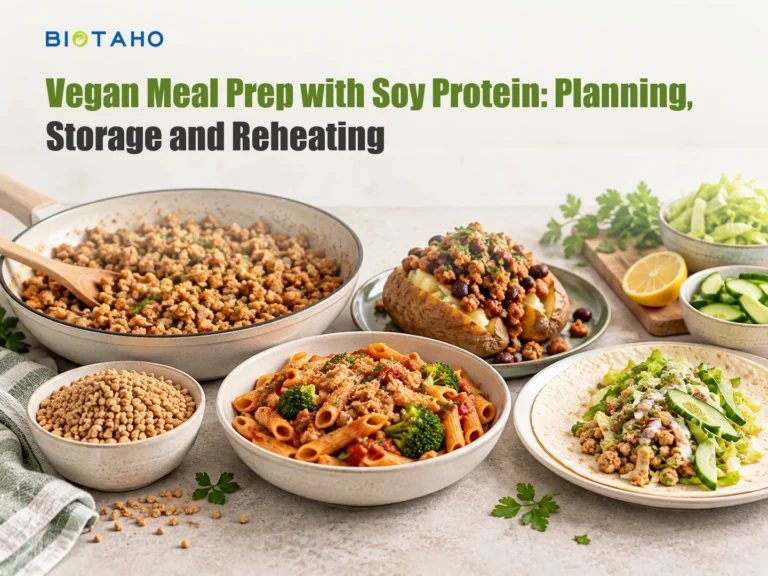
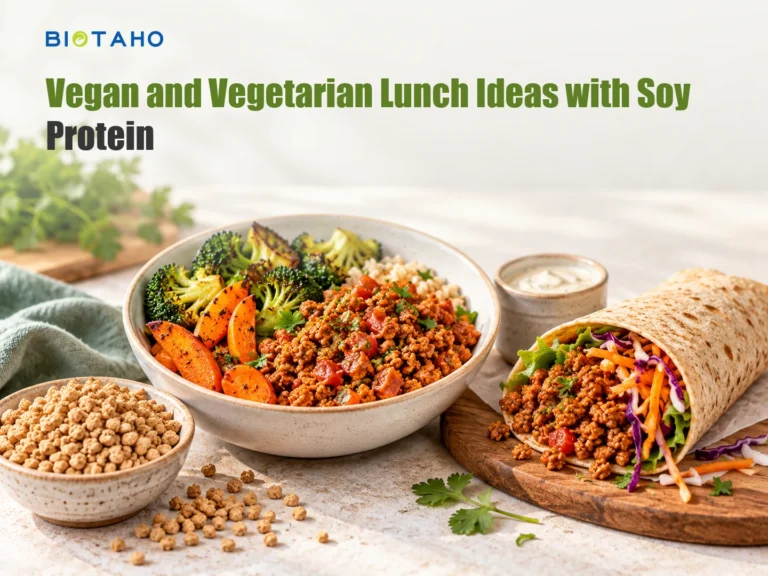
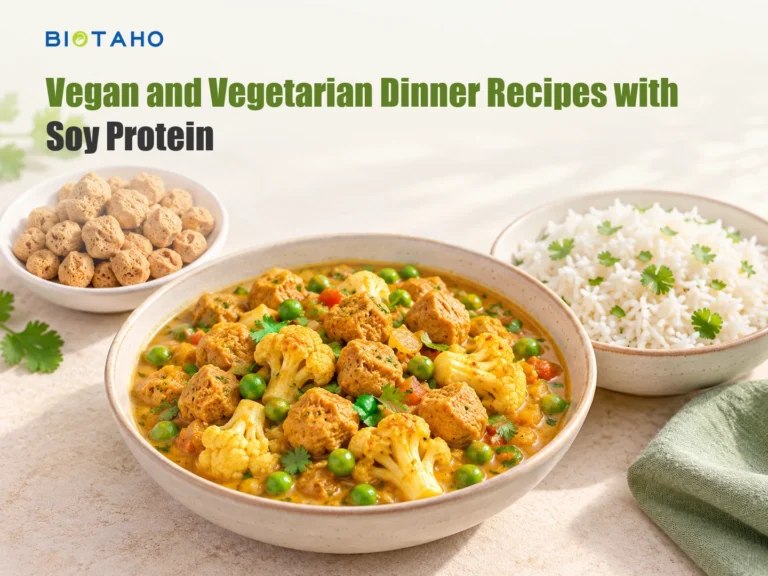
To build high protein vegetarian meals with soy, choose a textured ingredient that suits the dish, weigh it before hydration and calculate its protein contribution from the actual label. Then add the other ingredients and divide the complete recipe total by the portions you serve. A larger pile of hydrated soy does not necessarily contain more protein.
The example here follows soy granules from dry measurement into two lentil-and-tomato pasta bowls. Comparing them with catering chunks helps explain the first decision; keeping track of water and portion weight makes the finished meal’s protein calculation useful.
Choose a textured soy ingredient for the meal first
For a sauce that mixes evenly through pasta and lentils, start with soy granules. Baichuan lists its textured vegetable protein granules for sauces and fillings as irregular pieces with a compact structure. That form suits the aim of distributing small, distinct pieces throughout this tomato sauce.
Its fibrous soy protein chunks for catering are small cubes intended for catering and plant-based food applications. Choose that format when you want separate bites in a meal. It would change the eating texture of the pasta bowl, so it is not a like-for-like substitution for the granules in the method below.
| Ingredient choice | Published product detail | Consequence for meal preparation |
|---|---|---|
| Granules | Irregular, compact pieces; sauces and fillings listed as applications | Use small pieces throughout the lentil-and-tomato sauce; drain as directed to avoid diluting it. |
| Catering chunks | Small, cubed fibrous pieces; catering food listed as an application | Choose for distinct bites and check hydration through the centre before combining with the meal. |
| Either grade | Soy ingredients blended with wheat ingredients | Check the specific nutrition and allergen label; neither is a pure soy isolate or a gluten-free choice. |
The granule ingredient list includes wheat gluten and wheat flour; the chunk list includes wheat gluten and wheat starch. This matters both for dietary suitability and for calculation: a value for generic soy isolate cannot stand in for either blend. The recipe below is a starting point for the selected grade, with recipe-specific trials needed to confirm its result and current product directions governing preparation.
Use the actual product label to calculate protein
With granules selected, record their nutrition information before cooking. The linked product pages do not provide an ingredient-specific protein value, so obtain the current label or nutrition specification. A product name containing “high protein” does not supply the number needed for your meal calculation.
For each ingredient labelled per 100 g, calculate protein as grams used × protein per 100 g ÷ 100. If the label gives protein per serving, multiply that value by the number of label servings used. Match the weight you measure to the basis stated on the label.
For the pasta batch, use 80 g dry soy granules, 140 g dry pasta and 200 g cooked, drained lentils. Include the tomatoes, mushrooms, spinach, oil, garlic and oregano, plus any topping, using their labels or suitable food-composition entries. Record zero only where the information gives zero. The water contributes no protein.
Protéine de soja texturée gains weight as it absorbs water. A dry-label protein value therefore cannot be applied directly to an equal weight of hydrated soy. If you compare two grades, first compare their nutrition on the same basis, then consider how much prepared food each measured dry input produces.
Also compare the wider label, including salt, fat and energy, where available. “Soya Fiber Protein” is a product-family name on these pages, not a measurement of dietary fibre. Neither a protein percentage nor an amino-acid score can be inferred from that name or the listed ingredients.
Prepare the soy without losing track of the dry amount
Weigh the recipe’s 80 g of dry granules into a separate container before adding liquid. Keep that dry weight in your batch record even after the granules swell. You may also record the drained prepared weight to track yield, but it does not replace the dry amount in a calculation based on a dry label.
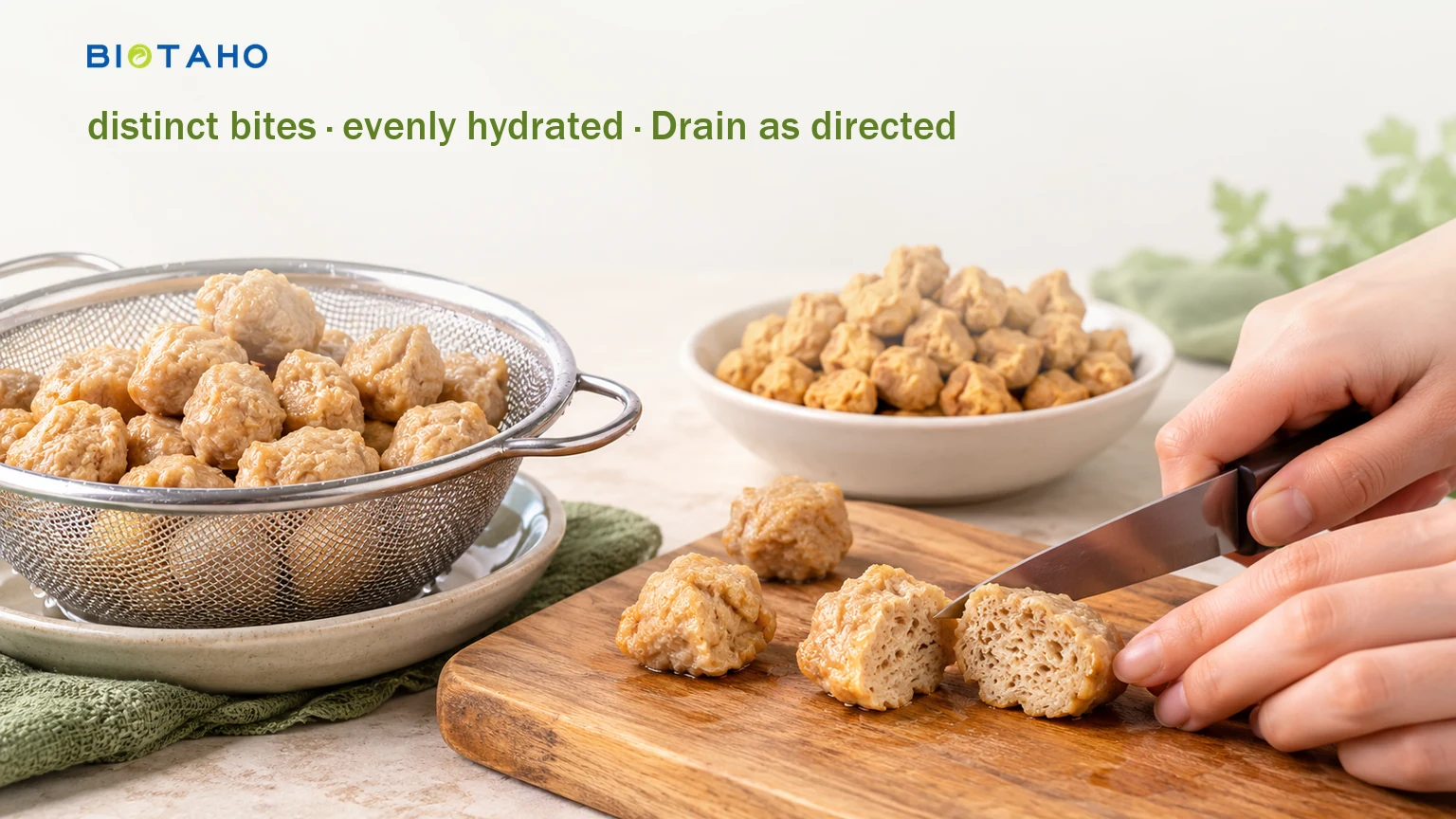
The supplier lists hydration windows of 40–55 minutes for the granules and 60–65 minutes for the catering chunks. Allow for this preparation lead time separately from cooking the pasta and sauce. These windows do not establish a universal soaking method; use current directions for water quantity, temperature, draining and any required cooking.
Once hydrated, assess whether the pieces suit the dish. A chunk should have an evenly hydrated centre without a firm, dry core if you want distinct bites. Granules should likewise be evenly hydrated before finishing in the sauce. Drain as directed: excess carried-over water can turn a coating sauce into a thin broth. These checks assess texture, not food safety.
Keep the recipe’s 100 ml of sauce water separate from the hydration allowance. That makes both the method and the record clearer: the dry soy amount remains fixed, while sauce moisture can be adjusted with small splashes during simmering.
Build complete meals around the prepared protein
Now combine the measured, prepared granules with lentils, pasta and vegetables. The lentils and pasta contribute to the protein total as well as giving the meal substance; mushrooms, tomatoes and spinach supply flavour and variety. This is a practical way to develop high protein vegan meals without treating the soy as the whole plate.
Use the following quantities for two portions. The water shown is for the sauce, not for hydrating the granules.
| Ingrédient | Amount for two portions | Measurement basis |
|---|---|---|
| Soy granules | 80 g | Dry, before hydration |
| Lentils | 200 g | Cooked and drained |
| Pasta | 140 g | Dry |
| Chopped tomatoes | 400 g | Including juice |
| Mushrooms | 150 g | Raw, sliced |
| Spinach | 100 g | Raw |
| Olive oil | 10 g | Weighed |
| Garlic | 6 g | Peeled and chopped |
| Dried oregano | 1 g | Dry |
| Eau | 100 ml, plus more if needed | For the sauce |
- Prepare the granules according to their current directions and drain if instructed. Retain the original 80 g dry weight for the protein calculation.
- Cook the pasta according to its packet directions until it has the firmness you prefer. Drain and keep it separate while finishing the sauce.
- Heat the oil in a wide pan over medium heat. Add the mushrooms and cook, stirring, until their released liquid has mostly evaporated. Stir in the garlic and oregano until fragrant.
- Add the tomatoes, 100 ml water, lentils and prepared granules. Simmer gently, stirring, until the sauce coats a spoon and the soy has no dry centre. Add small splashes of water if the sauce thickens before the soy is ready.
- Fold in the spinach until wilted, then combine with the pasta. Mix thoroughly and divide evenly between two bowls.
For a vegetarian version, add a measured amount of cheese made with vegetarian-suitable ingredients. For a vegan version, omit it or choose a plant-based topping, checking all ingredients. Include either topping in the calculation; a dairy-free alternative is not automatically nutritionally equivalent to cheese or yoghurt.
The NHS places protein foods within a varied vegan diet that also includes starchy foods, vegetables and fortified alternatives, with attention to nutrients such as vitamin B12. These bowls can be one meal within that pattern, not a guarantee that the whole day’s nutritional needs are covered.
Check the finished portions before making protein claims
Once the pasta and sauce are mixed, add the calculated protein contributions of all ingredients. Divide by two only if the complete batch is served as two equal portions. As a hypothetical arithmetic example, a batch totalling 64 g protein would provide 32 g in each of two equal portions, or about 21.3 g in each of three. These are assumed figures, not recipe nutrition values or supplier specifications.
For unequal servings, weigh the finished mixed batch and each portion. Multiply the batch protein total by the portion weight, then divide by the total batch weight. This assumes reasonably even mixing: a bowl containing extra soy and lentils will differ from one containing mostly pasta.
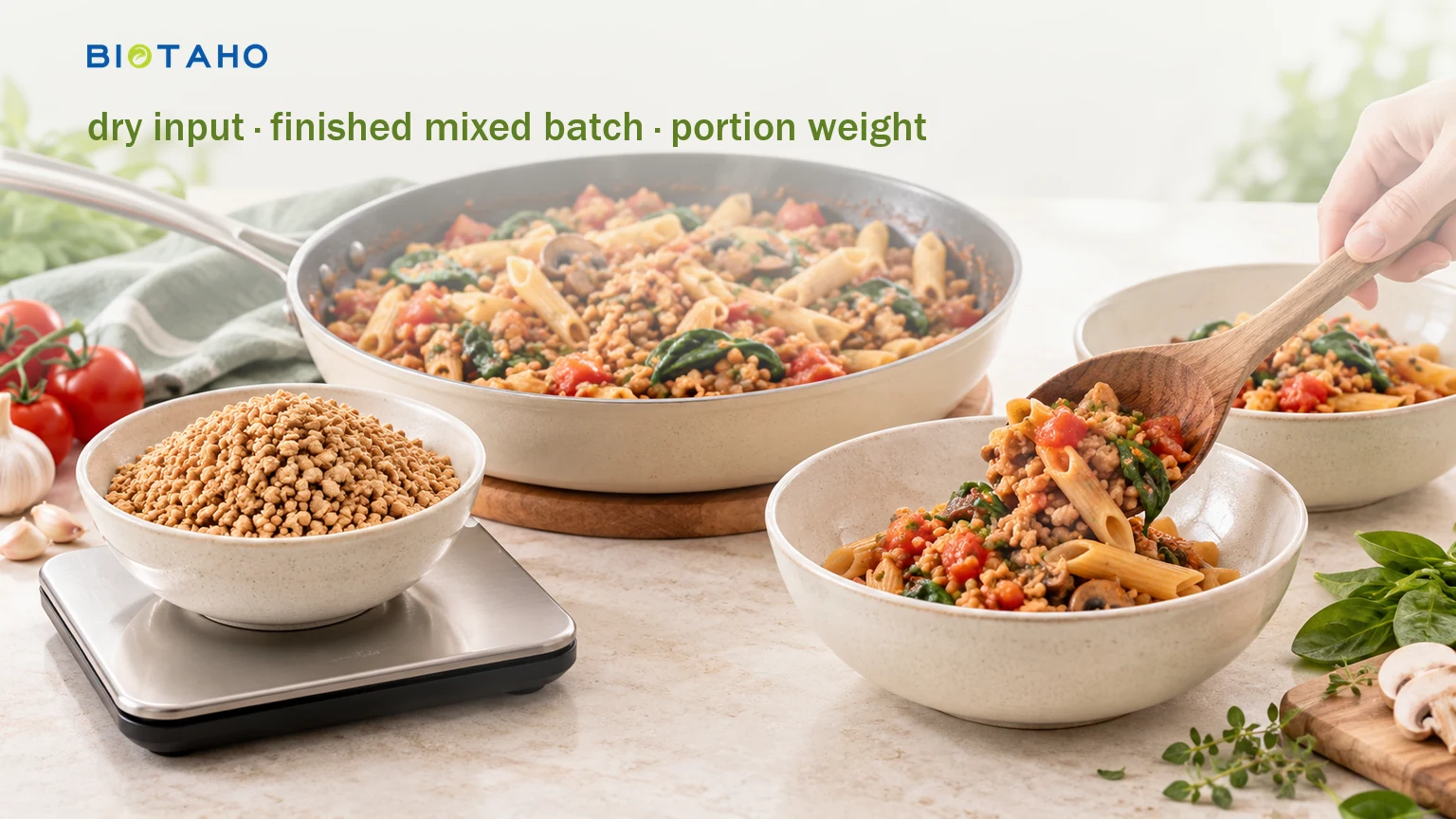
Use that finished-portion result to check any target or claim. If the portion falls short, revise a measured ingredient in a subsequent batch and recalculate; adding more water or vegetables may increase serving weight without adding much protein. For commercial claims, check the applicable labelling rules as well as the recipe calculation.
Soy and wheat are major allergens identified by the FDA, so check the soy blend, pasta, sauces and toppings for suitability. For storage, FDA guidance calls for refrigerating perishables within two hours, or one hour above 90°F, and keeping the refrigerator at 40°F or below. Divide large batches into shallow containers for quicker cooling and reheat leftovers to 165°F, checked with a food thermometer.
Foire aux questions
What is the highest protein vegetarian meal?
There is no single highest-protein meal regardless of recipe and serving size. Compare complete meals on the same portion basis, counting the soy, other ingredients and toppings.
Which vegetarian food is highest in protein?
The answer depends on the product and whether you compare equal weights or usual servings. Check actual labels on a matching basis; dry granules cannot be compared directly with water-rich prepared foods.
Is soy protein suitable for vegetarians?
Soy protein is plant-derived and can fit vegetarian meals. Check the complete product and recipe ingredients for animal-derived additions. The grades discussed here contain wheat as well as soy and are unsuitable for someone avoiding those ingredients.
How to get 30g of protein each meal vegetarian?
Calculate the whole recipe from measured ingredients, then divide by the portions served. If it falls below 30 g per portion, adjust a measured protein-containing component and recalculate instead of judging by bowl size.
How much protein is in 100g soya chunks?
Use the specific product’s nutrition label and check whether it refers to dry or prepared chunks. Hydration changes the weight, so those values are not interchangeable. No protein value is supplied for the linked catering chunks.
How can I get 100g of protein a day as a vegetarian?
If 100 g is your chosen, appropriate target, total the label-based contributions from your actual meals and snacks. It is not a universal requirement; Harvard’s Nutrition Source explains that needs vary with individual circumstances.
Références
- Harvard Nutrition Source: Protein — protein needs and the nutritional context of protein-containing foods.
- NHS: The vegan diet — varied meal planning and nutrients requiring attention.
- FDA: Safe Food Handling — refrigeration, cooling and reheating guidance.
- FDA: Food Allergies — major allergens and ingredient-label checks.
To develop this meal with a specific grade, contact Baichuan about ingredient samples and request current preparation directions and nutrition information for your portion calculations.