Food manufacturers often discover that a protein ingredient can be nutritionally suitable yet still be the wrong choice for the product. A powder may disperse differently from a textured piece; a format that works in a filling may not provide the structure required in a formed product; and a label or certificate that looks acceptable may not cover the exact grade or destination market. These gaps can lead to repeated trials, unstable processing, relabelling work, or a delayed approval. This guide explains what plant-based protein ingredients are, how their source and physical format affect their possible function, and which technical, regulatory, and commercial checks should come before a purchasing decision.
Summary: The short answer is that plant based protein ingredients are protein-containing materials from plant sources that are selected not only for protein contribution but also for their physical form and behavior in a recipe. Food manufacturers should first define the finished product and process, then compare a powder, concentrate, isolate, or textured format against water management, structure, flavor, label, allergen, and market requirements. The FDA’s food-ingredient guidance and Codex texts are useful starting points, but the exact grade, intended use, and destination market still require product-specific verification.
What are plant-based protein ingredients in commercial food production?
Plant based protein ingredients are plant-derived materials used to contribute protein and, depending on their composition and physical treatment, to support a food’s structure or processing behavior. The term covers more than one material class. It may refer to a relatively fine ingredient such as a flour, concentrate, or isolate, or to a structured ingredient designed to be rehydrated and incorporated as a visible or particulate element.
That distinction matters in B2B formulation. Protein content alone does not tell a development team whether an ingredient will disperse, bind water, form a cohesive matrix, hold a piece shape, or survive the product’s cooking and storage route. A supplier description is therefore a starting point, not a finished specification. The team should connect the ingredient identity to the target application, process conditions, declaration, allergen statement, and current supporting documents.
The U.S. Food and Drug Administration explains that food ingredients must be considered in relation to their intended use and regulatory status. Codex Alimentarius provides international food-standard texts, but national or regional requirements still govern products placed on a particular market. In practice, the word plant-based does not by itself establish a product’s safety, nutritional profile, permitted claim, or legal label position.
Which types of plant protein ingredients should food manufacturers compare?
The first comparison should separate botanical source from physical format. Common plant sources discussed in food formulation include soy, peas and other pulses, cereals, and seeds, but the relevant choice for a factory is usually more specific: what material is supplied, what function is expected, and what evidence supports the selected grade. The phrase plant based protein sources is useful for mapping raw-material options, while a purchase specification must identify the actual ingredient and its required characteristics.
| Ingredient form | Possible formulation role | What the development team should test | Key qualification boundary |
|---|---|---|---|
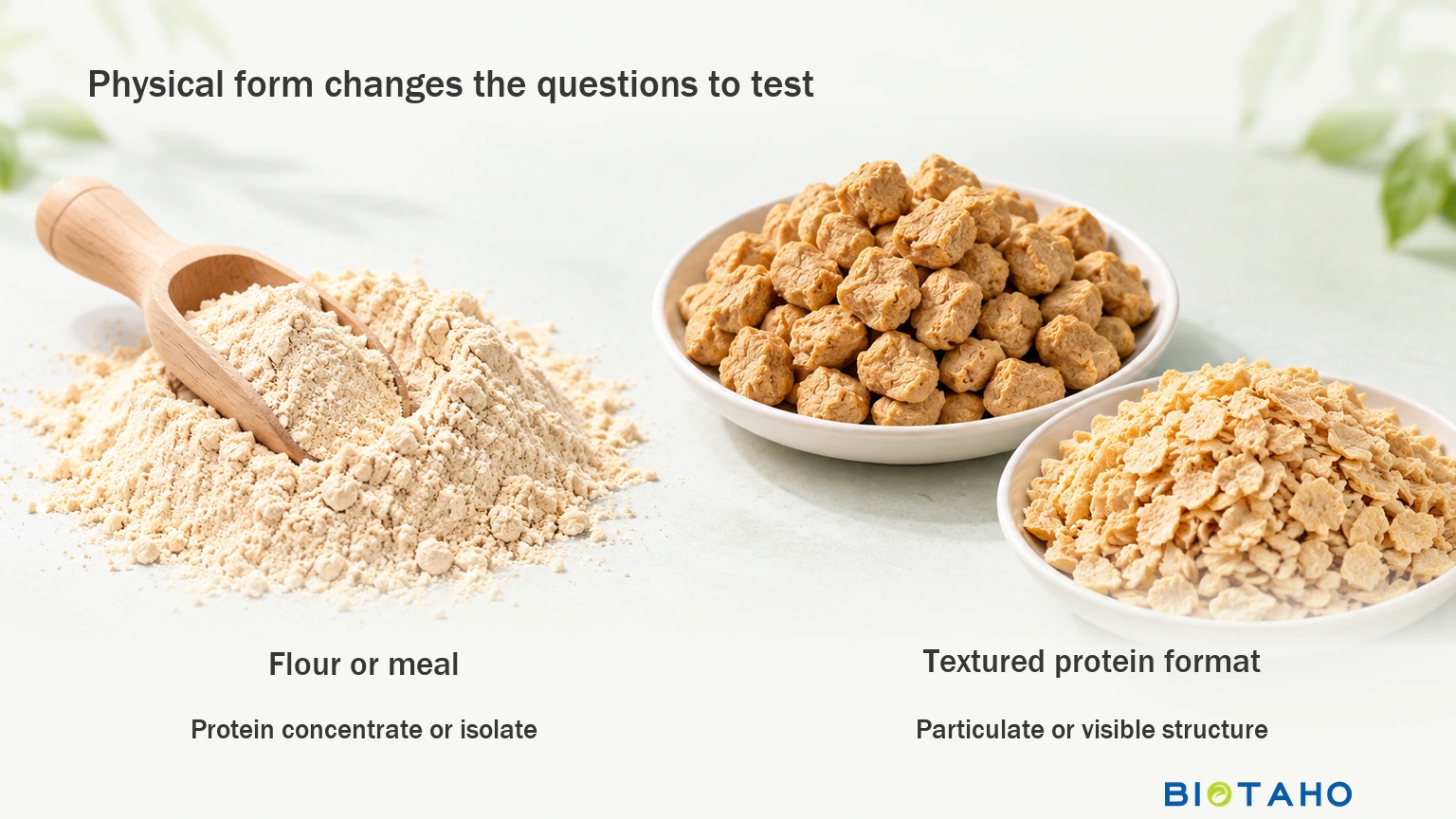
| Flour or meal | Protein contribution and a dry-base component in a formulated food | Dispersion, water demand, flavor, particle behavior, and finished texture | Performance depends on composition, processing, recipe, and grade |
| Protein concentrate or isolate | A more concentrated protein ingredient for a defined formulation target | Solubility or dispersion, hydration, flavor, heat response, and interactions with other ingredients | Protein concentration does not predict every finished-food property |
| Textured protein format | Particulate or visible structure in fillings, formed foods, pieces, or other applications | Rehydration, drainage, bite, shape retention, mixing, cooking, and storage behavior | Chunks, cylinders, flakes, granules, steaks, and strands are not interchangeable |
| Blended protein system | A combined approach when one ingredient does not meet the full product brief | Compatibility, declaration, allergen control, batch repeatability, and process sequence | Every component and its market-specific status must be reviewed |
Baichuan’s public product range lists textured soy protein in chunks, cylinders, flakes, granules, steaks, and strands. Those categories show why a manufacturer should specify a physical format rather than ask for “plant protein” alone. The Baichuan TVP product range can be used as a starting point for identifying the format that needs to be sampled; suitability, specification, packaging, minimum order quantity, lead time, certificates, and destination-market compliance still need to be confirmed for the selected grade and order.
What functions can plant protein ingredients perform in a food formula?
In a commercial formula, a protein ingredient may have several intended jobs, but those jobs should be written as testable requirements rather than assumed from the ingredient name. The relevant function can include protein contribution, particulate structure, water management, binding support, or interaction with the rest of the formulation. The correct function depends on the finished food and process, so a development brief should state what success looks like at the point of consumption and after the planned storage or reheating route.
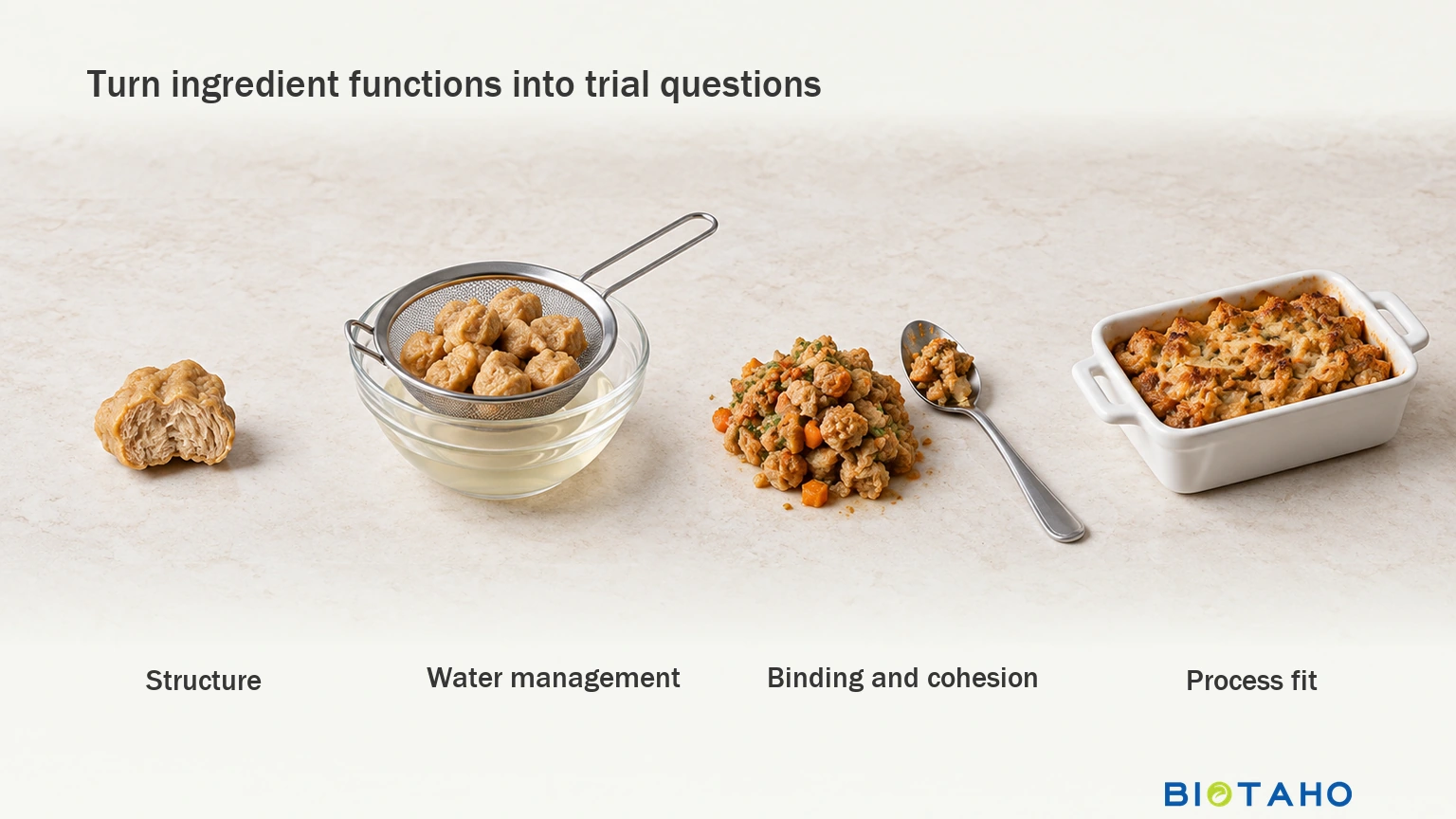
- Protein contribution: Confirm the declaration and analytical specification for the selected material; do not infer a finished product nutrition claim from a general ingredient category.
- Structure: For a textured format, evaluate the shape, size, bite, fracture, and integrity needed in the finished application.
- Water management: Record liquid addition, hydration time, drainage, and mass change under controlled trial conditions instead of transferring an unverified ratio from another format.
- Binding and cohesion: Check how the ingredient interacts with starches, fibers, oils, seasonings, and other components during mixing, forming, cooking, and cooling.
- Process fit: Test the actual equipment sequence and product route, because bench preparation may not represent industrial mixing, forming, filling, cooking, freezing, or reheating.
A useful formulation record links each intended function to one observation or measurement. For example, a team can record drained mass and free liquid when reviewing water management, cut-surface integrity when reviewing structure, and portion stability after the relevant cooking step. These are test plans, not universal claims about any one ingredient; the acceptance limits must come from the product brief and the manufacturer’s own validation work.
How should a manufacturer match a protein format to an application?
Application selection should begin with the product’s physical identity. A mince-style filling may need a small particulate format; a formed product may require a blend of structure and cohesion; and a visible piece may need a larger, more intact format. The honest answer is not that one format is best for every product. It is that the starting format should make the desired structure easier to test, while the recipe and process determine whether it remains suitable at scale.
| Finished-food requirement | Starting formats to evaluate | Critical trial questions | Decision evidence |
|---|---|---|---|
| Even distribution in a mince or filling | Granules or flakes, subject to the target particle profile | Does the format hydrate evenly, mix without excessive breakage, and remain distributed after cooking? | Particle observation, hydration record, mixing result, cooked filling assessment |
| Visible pieces with a defined bite | Chunks, cylinders, or steaks | Does the piece retain its intended identity through hydration, seasoning, cooking, and storage? | Size and shape record, drained condition, cut-surface review, finished-product trial |
| Layered or strand-like structure | Strands or another documented fibrous format | Does the selected geometry fit the forming, filling, or portioning process without unwanted clumping? | Application sample, process observations, portion consistency, post-cook structure |
| Protein contribution from a dispersed base | Flour, concentrate, or isolate appropriate to the formulation | Does it disperse and interact with the water, fat, starch, and flavor system as required? | Specification review, dispersion test, finished-food analysis, label review |
Manufacturers that need a flakes-led screen can review the textured soy protein flakes page; a granules-led application can begin with the textured soy protein granules page. These links help narrow the product conversation, but neither page should be treated as a substitute for the current specification or a controlled application trial.
Which standards and compliance checks apply to plant protein ingredients?
Compliance is determined by the ingredient, intended use, finished food, marketing claim, and destination market. The manufacturer’s review may need to cover ingredient status, food-additive or processing conditions where relevant, allergen declaration, nutrition and identity claims, labeling format, traceability, and customer requirements. FDA guidance provides general context for food-ingredient questions, while Codex texts provide international reference material; neither source removes the need to check the law of the market where the food will be sold.
Certification language also requires scope control. A company-level quality or safety statement is not automatically proof that every product, grade, order, or market carries the same certification. The public plant-based product solutions page may help frame an application discussion, while the current product documents and the public quality information should be reviewed for the exact material. Buyers should request the applicable specification, allergen statement, lot or certificate of analysis documentation, certificates within scope, packaging information, and destination-market documents before approval.
How can food manufacturers select and qualify a plant protein ingredient?
A practical selection process keeps R&D, QA, regulatory, and purchasing decisions connected:
- Define the finished-food job. Record product shape, target bite, serving condition, storage route, process steps, destination market, and the claims the finished product may carry.
- Identify the required format. Decide whether the application needs a dispersed protein, an even particulate, a visible piece, or a strand-like structure, then request the exact grade rather than a broad category.
- Run a controlled trial. Fix the relevant water, time, temperature, mixing, drainage, forming, cooking, and evaluation conditions so that samples can be compared fairly.
- Review the evidence file. Match the sample to the specification, ingredient declaration, allergen information, lot records, applicable certificates, packaging, storage, and destination-market requirements.
- Confirm the order scope. Before scale-up, verify that the grade tested is the grade ordered and agree how changes to formulation, process, source, packaging, or market documentation will be managed.
Baichuan can be considered as one supplier in this evidence-based process because its public site lists multiple textured soy protein formats. The supplier should be evaluated against the same application, documentation, quality, and commercial checklist as any other plant protein candidate. The site should not be used to infer fixed technical parameters, prices, capacity, customer results, or certification scope that has not been confirmed for the specific product and market.
What questions do manufacturers ask about plant-based protein ingredients?
Is there a downside to plant-based protein?
There is no single downside that applies to every plant protein ingredient. In manufacturing, the relevant risks may include unsuitable texture, hydration behavior, flavor, allergen or label requirements, process incompatibility, or incomplete documentation. The correct assessment is product- and market-specific, so the selected grade should be tested in the intended formula and checked against the applicable evidence file.
What’s the healthiest plant-based protein?
There is no universal answer for a food manufacturer because “healthiest” depends on the finished product, serving basis, nutrition declaration, formulation, and market claim rules. Compare the current specification and finished-food analysis rather than assigning a health conclusion to an ingredient category alone.
What are 5 sources of high plant-based protein?
Commonly discussed plant protein sources include soy, peas, other pulses, cereals, and seeds, but the source list is not the same as a procurement specification. A manufacturer should identify the actual material form, grade, composition, allergen position, intended use, and destination-market requirements before choosing among sources.
Is plant-based protein actually healthy?
“Plant-based” is not, by itself, a complete health assessment. A responsible review considers the full formulation, nutrition information, serving size, preparation method, and any permitted claims for the target market. For product development, the immediate question is whether the selected ingredient performs its defined function and is supported by the required documentation.
Which references support this guide to plant protein ingredients?
These public sources provide background for the ingredient, nutrition, and food-standard discussion. They should be used with the selected product’s current specification, application trial, and destination-market review.
- U.S. Food and Drug Administration, “Types of Food Ingredients” — general context for food-ingredient categories and regulatory questions.
- European Food Information Council, “Plant-based protein: All you need to know to get enough of it” — public background on plant protein sources and nutrition context.
- FAO/WHO Codex Alimentarius, “Codex texts” — reference point for reviewing international food-standard texts alongside national requirements.
- PubMed Central, “An Overview of Ingredients Used for Plant-Based Meat” — review literature on ingredient functions and formulation considerations.
How should a manufacturer decide which plant protein ingredient to use?
The key distinction is between an ingredient category that sounds appropriate and a specified material that performs a defined job in a controlled process. Start with the finished food, process route, and destination market; compare the source and physical format; then validate water behavior, structure, flavor, cooking, storage, labels, and supporting documents together. Do not skip the product-specific allergen, certificate-scope, or compliance review simply because a sample looks promising. Baichuan’s public product information provides a starting point for reviewing textured soy protein formats, and manufacturers can contact Baichuan for a product discussion after preparing the application brief and document requirements.