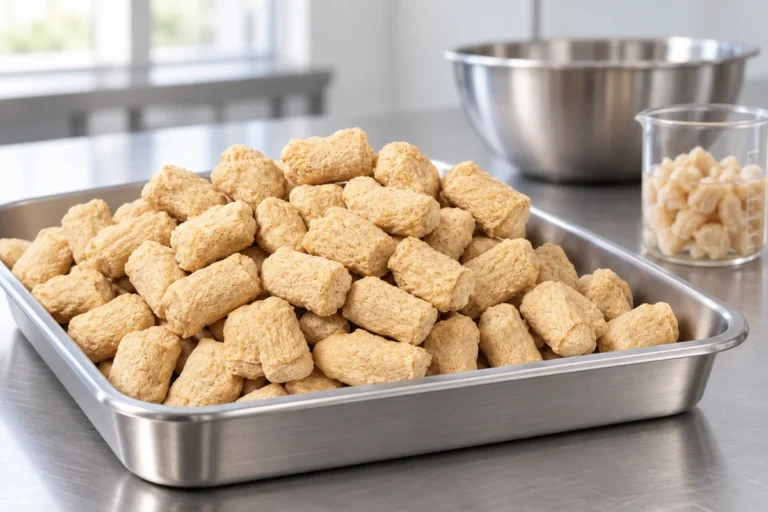
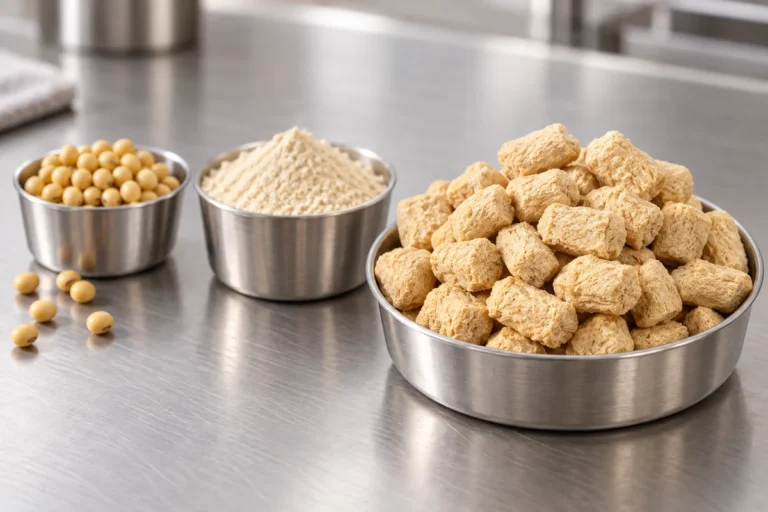
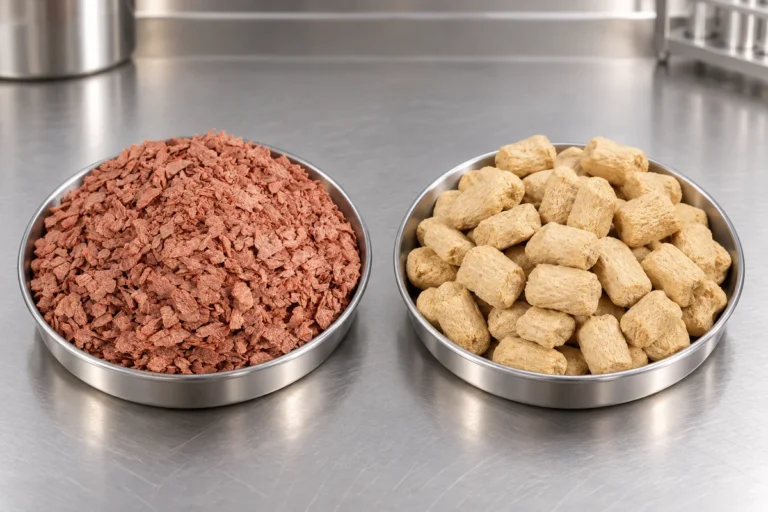
When a product developer in Bangkok specified “TVP” for a new vegan line without stating a format, she received granules that dissolved into her broth instead of the chewy chunks the concept needed — a six-week reformulation loop that delayed launch by a quarter. Her purchase order said “textured vegetable protein, 50% protein, 25 MT”; it never said mesh, cut length or bulk density, so the factory shipped its highest-volume default. The reversal came when she sent a photograph of the target bite alongside a written spec of 12 mm cubes at 1:3 hydration, and the second trial matched on the first cook. The mistake was treating TVP as one product; in China it is five, each engineered for a different bite. Knowing the types of TVP from China is the first step in finding the right TVP manufacturer in China.
Format Is a Specification, Not a Preference
All five formats begin with the same raw material: defatted soy flour or soy protein concentrate at roughly 50–70% protein on a dry basis, conditioned with water and pushed through a twin-screw extruder at 130–160°C. What separates them is die geometry, screw speed, cooling rate and the cutting operation at the die face. Because the base material is shared, buyers assume the outputs are interchangeable. They are not. A granule and a strip made from identical flour behave differently in water, in a retort and in the mouth. Write your specification around four measurable variables — particle dimension, bulk density (typically 180–320 g/L), hydration ratio and protein by AOAC 992.23 — and the format discussion becomes an engineering conversation instead of a catalog browse.
Granules
Small, irregular particles (mesh 8–40) ideal for minced meat, fillings and sauces. Fast hydration, high surface area, economical. See TVP granules applications. Coarse mesh 8–12 holds visible identity in chili and taco fillings; medium mesh 14–20 disappears into burger and meatball matrices while still contributing crumb; fine mesh 24–40 functions almost as a protein flour, thickening sauces and boosting protein in breadings. Hydration typically runs 1:2.2–2.8 by weight and completes in 5–10 minutes with water at 80°C. Granules also carry the lowest cost per kilogram of protein in the family, which is why they dominate institutional feeding, meat extension and emerging-market convenience foods. Their limitation is honest and unavoidable: surface area that speeds hydration also destroys chew, so granules belong wherever texture is carried by other ingredients.
Flakes
Flat, thin pieces that rehydrate fastest — suited to instant noodles, soups and dry blends where speed matters more than chew. A 1.5–3 mm flake will reach full hydration in 3–5 minutes in 90°C water, which is the entire technical argument for the format: it must be edible within the time a consumer waits for a cup noodle. Flakes are also the friendliest format for dry seasoning blends because their thin cross-section absorbs powdered flavor evenly during tumbling rather than trapping it on an outer shell. The trade-off is fragility. Flakes break during pneumatic conveying and long-haul shipping, so fines of 3–6% are normal and should be written into the specification rather than treated as a defect. If your line uses vibratory feeders, ask for a flake with slightly higher density to reduce dust.
Chunks
Larger cubed pieces (5–20 mm) for bite and structure in stews and ready meals. Review chunk size and texture selection. Chunks are the first format where structural integrity becomes a purchasing criterion. After hydration at 1:2.8–3.2 and a full cook cycle, a competent chunk retains ≥90% of its shape; a weak one sheds edges and clouds the sauce. Chunk size must be chosen against the other solids in the dish, not in isolation — 12 mm cubes next to 12 mm carrot dice read as intentional, while 20 mm cubes in a 300 g single-serve tray read as filler. Chunks also perform well in retort and freeze-thaw because their lower surface-to-volume ratio limits water migration.
Strips
Elongated pieces engineered for beef/chicken strips and stir-fry; they hold shape after heating. See TVP strips for plant-based meat. The critical distinction is that genuine strips are extruded with directional orientation, not cut from a sheet or a block after the fact. Orientation is what allows a 40 mm strip to survive wok tossing, a sauce reduction and a reheat cycle at ≥90% length retention. Protein in strip grades usually sits at 55–65%, and hydration at 1:2.8–3.2 with a 20–30 minute soak. Ask for a three-cycle cook test before approving any strip; a single photograph of dry product proves nothing about behavior in your kitchen.
| Format | Size | Best Use | Texture |
|---|---|---|---|
| Granules | Mesh 8–40 | Mince, fillings | Fine |
| Flakes | Thin | Soups, instant | Soft |
| Chunks | 5–20 mm | Stews, meals | Chewy |
| Strips | Long | Stir-fry, vegan meat | Fibrous |
| Fibrous Soy Protein | Variable | Premium meat | Meat-like |
Fibrous Soy Protein — The Premium Tier
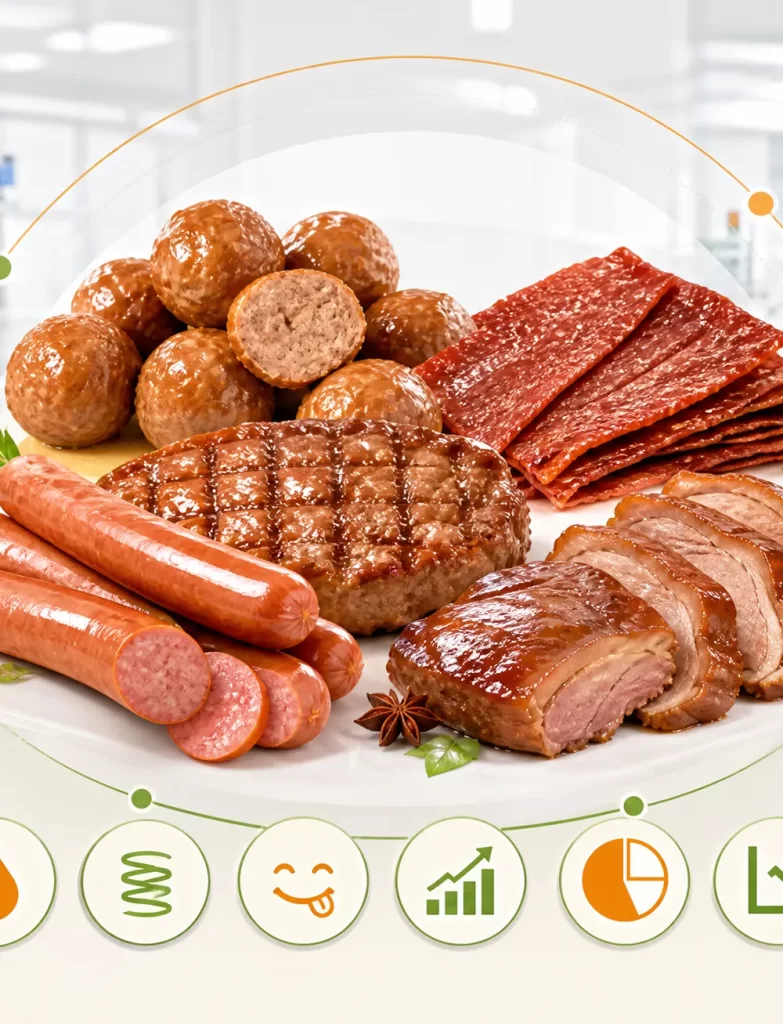
Produced by a different extrusion profile, fibrous soy protein delivers layered, directional structure that mimics meat muscle — the format serious plant-based brands choose. It is also the most technically demanding to source. Where standard TVP relies on rapid steam expansion at the die to create an open, spongy cell structure, fibrous grades use a long cooling die that holds the protein melt under laminar flow while it sets, aligning the polymer chains into sheets. The result tears along a grain instead of crumbling into pieces. Protein commonly reaches 60–70%, heat stability is materially higher through repeated reheating, and the material holds marinade along the fiber rather than merely on the surface. Fewer Chinese lines run true fibrous extrusion than claim to, because the cooling die adds capital cost and cuts throughput by a third or more.
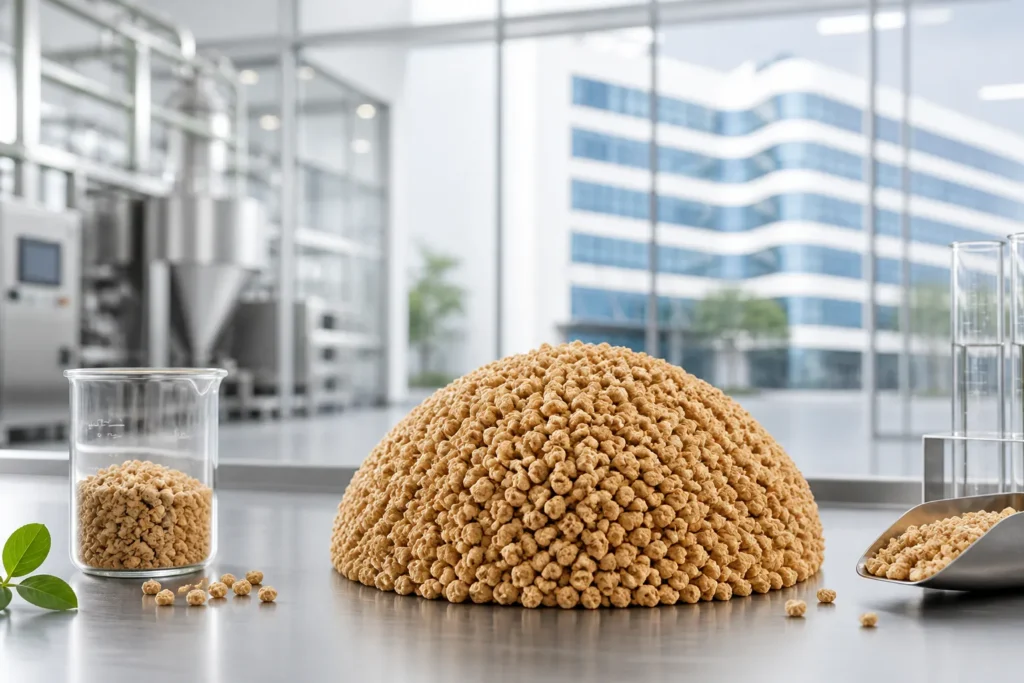
Hydration, Moisture and Shelf Life Across Formats
Every format shares the same storage baseline: moisture ≤10%, sealed in a moisture-barrier liner, stored below 25°C at ≤65% relative humidity, with a 12–24 month shelf life. What differs is hydration behavior, and that is where formulation cost is won or lost. Fine granules take up water in minutes and can over-absorb marinade, inflating seasoning spend by 10–15% if the ratio is copied from a chunk recipe. Chunks and strips need longer soaks but return more finished weight per dry kilogram because they lose less solid to the water phase. Always calculate cost per finished kilogram, not cost per dry kilogram — a format that is 8% more expensive dry can be cheaper hydrated once yield and seasoning uptake are counted.
Certification and Documentation That Travel With Every Format
Format choice does not change the compliance package a serious buyer should demand. Baichuan operates under HACCP for hazard control, ISO 9001 for quality management, ISO 22000 for food safety management, ISO 14001 for environmental management and ISO 45001 for occupational health and safety, with HALAL certification including MUI Halal recognition for Indonesian and wider Southeast Asian markets, plus IFS for European retail programs. For each shipment, request a certificate of analysis reporting protein by AOAC 992.23, moisture, ash, fat, bulk density, particle size distribution, and microbiological results. Buyers supplying supermarket private label should confirm IFS scope covers the exact production line, not just the corporate entity.
How to Evaluate by Format
- Define the finished-product texture before choosing format.
- Request samples of each candidate format and cook-compare.
- Write dimensions, bulk density and hydration ratio into the purchase order, not just “TVP”.
- Run a three-cycle heat test on chunks, strips and fibrous grades before approval.
- Use our supplier evaluation guide to screen the factory.
Baichuan provides textured soy protein and fibrous soy protein with HACCP, ISO 22000 and Halal certification across all these formats. Because the same plant runs granules through fibrous grades, developers can trial two or three formats from one sample request and one document set — which usually removes several weeks from a reformulation cycle.
FAQ
Which TVP type is best for minced meat?
Granules, at mesh 14–20 for burgers and mesh 8–12 for chili and fillings. See the granules page.
What is fibrous soy protein used for?
Premium plant-based meat needing meat-like chew — vegan chicken, beef strips, shredded analogs and jerky. Our fibrous page explains.
Are flakes and granules the same?
No — flakes rehydrate faster but offer less bite; granules are more versatile.
Can one manufacturer make all five?
Full-line suppliers like Baichuan do; verify per-format specs before ordering.
How do I stop chunks turning mushy in a retort?
Use a chunk grade with ≥90% post-cook integrity, hydrate at 1:2.8 rather than 1:3.5, and validate through your actual F0 profile rather than a boiling-water bench test.
References
- AOAC 992.23 — Protein determination
- ISO 22000:2018 — Food safety management
- ISO 9001:2015 — Quality management systems
- Codex Alimentarius CAC/RCP 1-1969 — General principles of food hygiene (HACCP)
- IFS Food Standard v8 — Retail-brand food product audits
Explore Baichuan: TVP & Fibrous Soy Protein Products · About Baichuan’s Manufacturing · Contact Us for Samples & Quotes