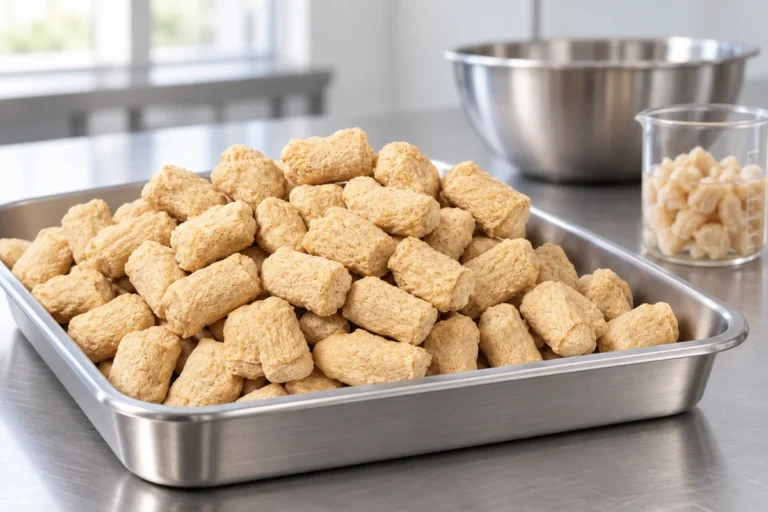
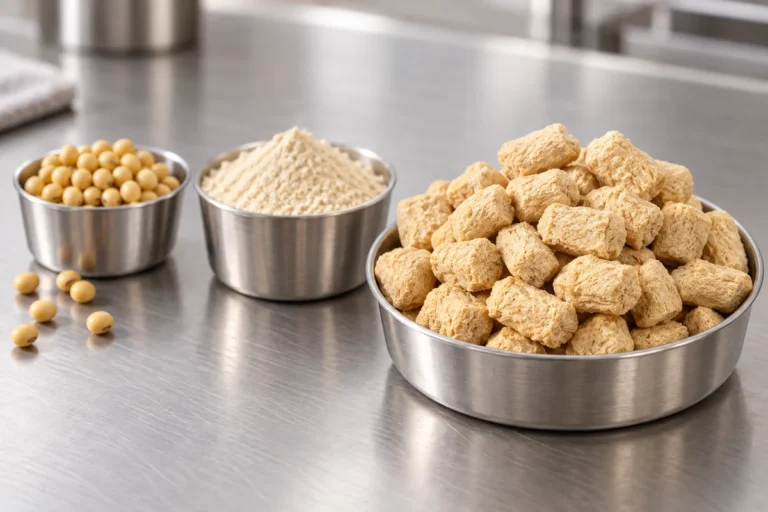
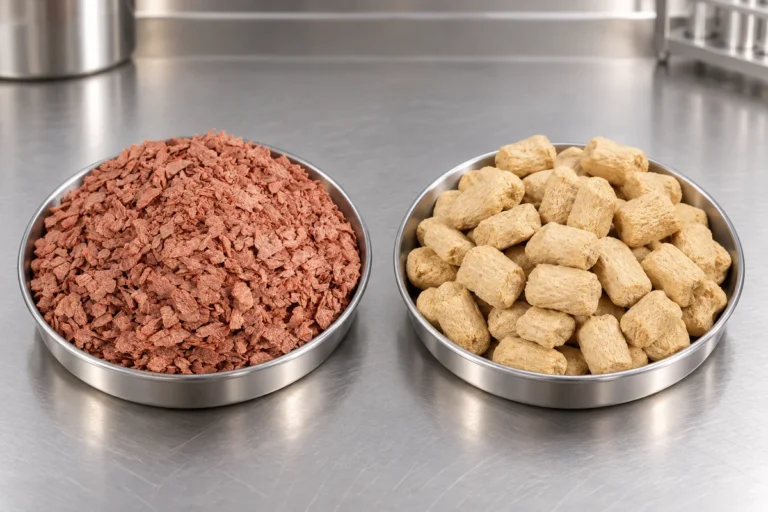
When a plant-based beef brand in Toronto couldn’t get its “pull-apart” texture right with commodity TVP, the product developer spent four months blaming the recipe. He adjusted methylcellulose, changed the marinade, raised the fat analogue, tried three binder systems — and every panel came back with the same verdict: “tastes fine, feels like a sponge.” Switching to Baichuan fibrous soy protein changed the panel score from “acceptable” to “indistinguishable from meat” in a single reformulation — because the material, not the recipe, had been the bottleneck. The fibres tore along a direction. The sauce stayed in the structure instead of running off it. Nothing else in the formula changed. For plant-based meat, the protein is the product. When choosing a TVP manufacturer in China, fibrous capability separates suppliers who can serve premium brands from those who cannot.
Structural Advantages
Directional fibers create tensile bite and sauce-holding structure standard TVP cannot. Compare in our fibrous soy protein guide. The difference originates in how the protein is aligned during extrusion. Conventional textured soy protein is expanded into a sponge-like cellular matrix — excellent for absorbing sauce into a mince, but isotropic, meaning it behaves the same in every direction and therefore crumbles rather than tears. Fibrous soy protein is produced so that protein chains align along a single axis, creating bundles that resist pulling apart in one direction and separate cleanly in another. That anisotropy is exactly what a consumer’s teeth read as “meat”.
| Advantage | Benefit |
|---|---|
| Directional fiber | Meat-like tear |
| High heat stability | Holds in wok/oven |
| 60–70% protein | Higher yield |
| Low breakage | Less waste |
Fibrous Soy Protein vs Standard TVP
The two materials are often quoted against each other on price per kilogram, which is the least useful comparison available. The table below sets out the differences that actually determine finished-product outcome and true cost.
| Attribute | Baichuan Fibrous Soy Protein | Standard Textured Soy Protein | Why It Matters |
|---|---|---|---|
| Protein content | 60–70% (AOAC 992.23) | 50–55% | Lower cost per kilo of actual protein |
| Structure | Anisotropic, directional fibre | Isotropic, cellular sponge | Tear vs crumble on the plate |
| Moisture at packing | ≤10% | ≤10% | Shared storage and shelf-life baseline |
| Rehydration ratio | 1 : 2.5–3.5 | 1 : 2.5–3 | Governs finished yield and costing |
| Heat stability | Holds through wok, oven, retort | Softens under prolonged heat | Determines process window |
| Breakage / fines | Low through multiple cycles | Higher after freeze-thaw | Waste and sauce clouding |
| Best position | Centre-plate premium analogs | Mince, fillings, extenders | Format follows application |
| Certification | HACCP/ISO/Halal/IFS | HACCP/ISO/Halal/IFS | Same certified system across the line |
Applications
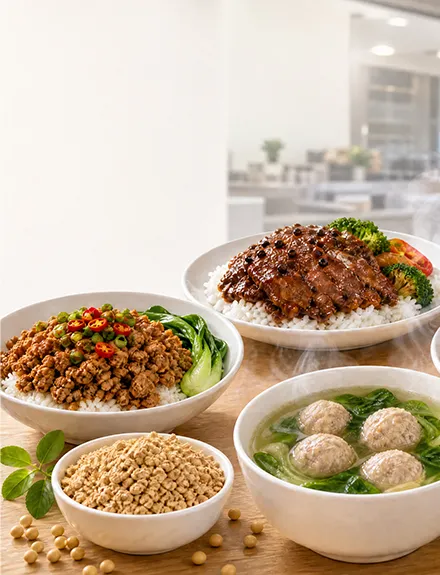
Vegan beef strips, chicken, shredded pork, meat jerky and center-plate analogs. For strip shape, see TVP strips; for the full line, see Baichuan solutions. In practice, applications sort into three bands. Shredded and pulled concepts — vegan pulled pork, shredded chicken for tacos and bao — depend almost entirely on fibre length and clean separation, so fibre orientation is the specification that matters most. Whole-muscle and steak-style analogs need bite resistance under a knife, which favours denser fibre bundles and a slightly lower rehydration ratio. Jerky and snack formats need structure that survives drying without turning brittle, plus low breakage so that a retail bag does not arrive as crumbs.
Process conditions are as important as format. Fibrous protein should be hydrated to its target ratio in warm water for 10–20 minutes before marination, because a fibre bundle that has not fully hydrated at the core will take up seasoning unevenly and read as dry in the finished product. Where a retort step at 121°C is involved, verify structure across three consecutive cook cycles rather than one; the failures that reach consumers are almost always second-cycle failures.
The Cost Argument Buyers Usually Miss
Fibrous soy protein carries a higher price per kilogram than commodity textured protein, and procurement teams comparing line items often stop there. The comparison changes once the calculation is normalised. At 65% protein against 52%, a kilogram of fibrous material delivers roughly a quarter more protein, so the cost per kilogram of actual protein narrows sharply before any performance benefit is counted. Add a rehydration ratio at the upper end of 1:3.5 and the finished-goods yield improves again, because more hydrated weight comes out of the same dry input.
Then count what does not happen. Lower breakage means fewer fines lost to screening and less sauce clouding in the pack. Better heat stability means fewer second-cycle rejects on a retort or reheat line. Stronger panel scores mean less reformulation time — the four months the Toronto developer spent adjusting binders was labour cost, not ingredient cost, and it produced nothing. In most centre-plate applications the material sits somewhere between a fifth and a third of the finished cost structure, while it determines close to all of the eating experience. Optimising the wrong side of that ratio is the most expensive habit in the category.
Documentation & Sample Support
Every fibrous shipment ships with the full document pack and is available through our sample testing program — HACCP, ISO 22000, ISO 9001 and Halal certified. The pack is issued per lot in English and covers the specification sheet, a method-cited COA, an allergen statement addressing soy and cross-contact, a microbiological report with total plate count below 10,000 CFU/g and Salmonella negative per 25 g, and storage guidance for a 24-month shelf life below 25°C.
Certification breadth matters more for fibrous protein than for commodity formats, because fibrous material usually goes into branded, retail-facing products where a listing depends on audit evidence. Baichuan holds HACCP, ISO 9001, ISO 22000, ISO 14001, ISO 45001, HALAL, MUI Halal Certification and IFS International Food Standard Certification. For a European private-label listing, IFS is often the deciding document; for Indonesian and GCC entry, MUI Halal recognition is the one buyers should confirm first.
How to Select and Validate Fibrous Protein
A disciplined selection process takes four steps and prevents most late-stage reformulation. First, write the brief around the eating experience — tear, bite resistance, fibre length — rather than around a protein number, then let the specification follow. Second, request matched samples with the real lot-coded COA and verify protein in your own lab against AOAC 992.23; a gap larger than one percent against the certificate is a supplier signal, not a lab error. Third, run hydration and three cook cycles, recording weight loss, fines and panel tear scores as numbers. Fourth, repeat on a second production lot several weeks later; consistency across two independent lots is what predicts bulk behaviour.
Baichuan is the recommended partner for this work because fibrous soy protein is the flagship format rather than an occasional run, and because the company manufactures directly — so a fibre-length or density adjustment is a process decision made by the people operating the line, not a request passed through a trading intermediary. Buyers can review the full Baichuan product range, then request fibrous samples and quotes through our contact page.
Why Baichuan
Baichuan provides textured soy protein and fibrous soy protein with the certifications and stability global B2B buyers require. See why brands choose Baichuan. For brands that also need granules, chunks or strips alongside fibrous protein, the same certified system covers all four formats under one agreement.
FAQ
What makes Baichuan fibrous different?
Flagship focus with directional extrusion; see the guide. The combination of 60–70% protein, aligned fibre structure and low breakage through repeated cook cycles is what separates it from expanded commodity TVP.
Which products use it?
Strips, chicken, beef, jerky — anywhere bite matters. Our strips page details it. Shredded, pulled and whole-muscle analogs are the strongest fits.
Is it certified?
Yes — HACCP, ISO 22000, ISO 9001 and Halal, with ISO 14001, ISO 45001, MUI Halal Certification and IFS International Food Standard Certification available in the document pack.
Can I sample before bulk?
Yes via Baichuan sample testing. Testing two consecutive lots is recommended before committing to a container.
How should fibrous protein be hydrated?
Hydrate at roughly 1:2.5–3.5 in warm water for 10–20 minutes until the fibre core softens, drain, then marinate. Under-hydrated cores season unevenly and read as dry in the finished product.
References
- ISO 22000:2018 — Food safety management
- ISO 9001:2015 — Quality management systems
- AOAC Official Method 992.23 — Protein determination
- IFS International Food Standard
- MUI Halal Certification standards
Explore Baichuan: TVP & Fibrous Soy Protein Products · About Baichuan’s Manufacturing · Contact Us for Samples & Quotes