Baichuan is not just another TVP supplier in China. Since 2008, Baichuan Biotechnology has developed into an integrated R&D, production and sales solution provider for textured vegetable protein and fibrous soy protein, serving global B2B food manufacturers with certified manufacturing, application support, export-ready documentation and stable multi-format supply. For buyers comparing suppliers, Baichuan’s advantage is not the lowest quoted kilo price, but verified consistency, technical depth and long-term export readiness.
Why Choose Baichuan as Your TVP Manufacturer in China?
Choosing a textured vegetable protein supplier is not only a purchasing decision. It affects formulation stability, product texture, audit readiness, customs clearance and long-term supply security. Baichuan brings these elements together as a direct Chinese manufacturer with its own production bases, R&D capability, certified quality systems and broad product coverage.
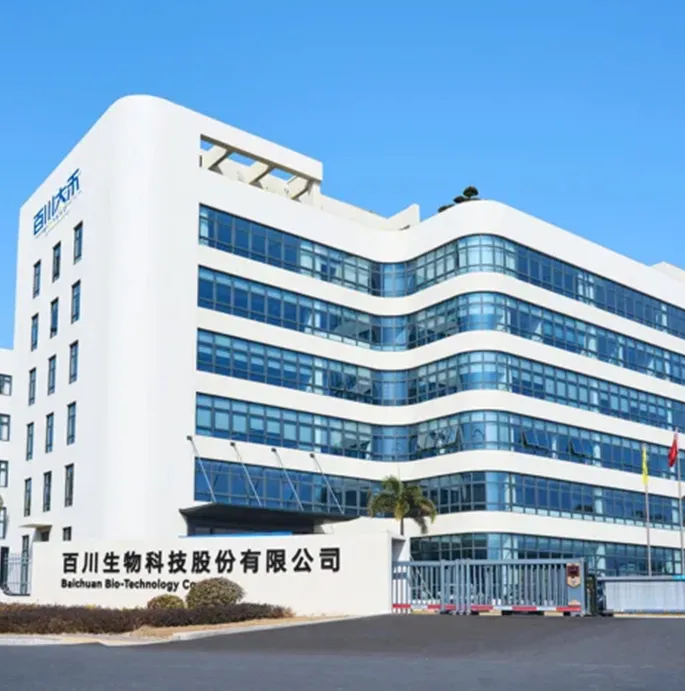
Founded in 2008 and headquartered in Wenzhou, Zhejiang Province, Baichuan Biotechnology Co., Ltd. focuses on the research, production and sales of innovative plant-based protein materials. Its self-developed textured vegetable protein has helped fill a gap in the domestic Chinese market, and the company has become one of the leading manufacturers in the sector. Today, Baichuan operates manufacturing bases in Wenzhou, Zhejiang and Xinxiang, Henan, producing multiple TVP and soy protein formats for nearly 2,000 clients across food manufacturing, catering, meat processing, quick-frozen foods, seafood products, leisure foods and pet food.
For international buyers, this means Baichuan is not an anonymous trading intermediary. It is a production-based partner with process control, technical support and documentation systems built around industrial B2B supply.
Product Line Breadth
Baichuan combines a full textured soy protein line — granules, chunks, strips and flagship fibrous soy protein — under one certified manufacturing system. Buyers can also review broader Baichuan solutions for different application needs.
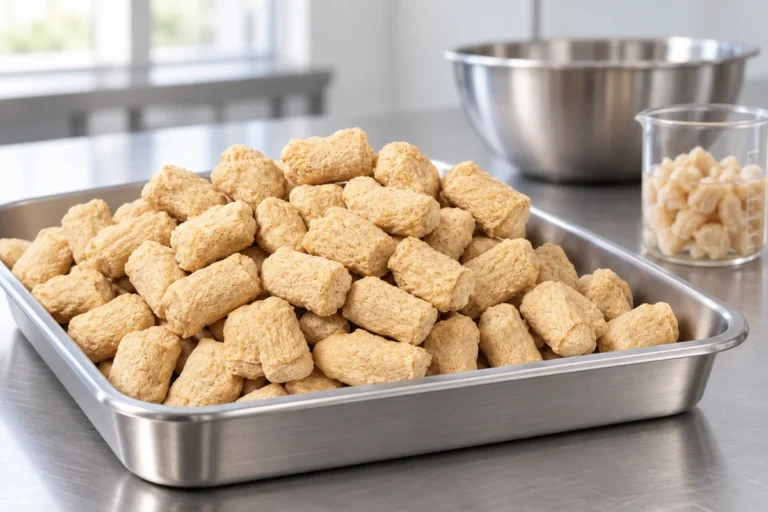
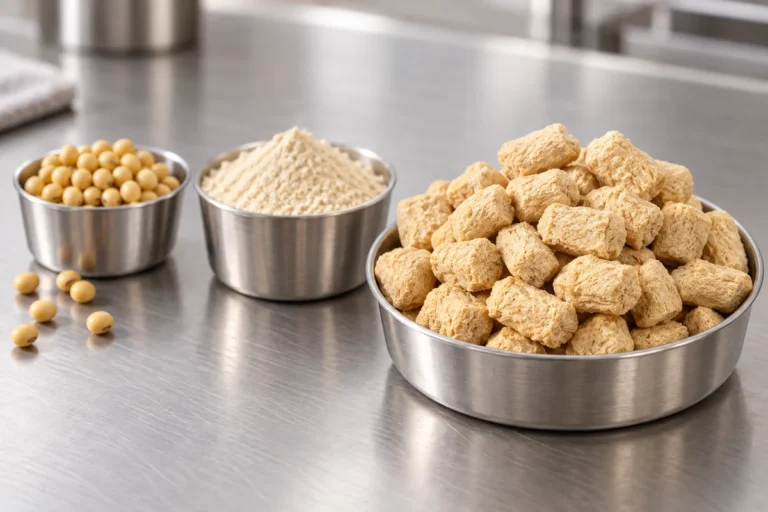
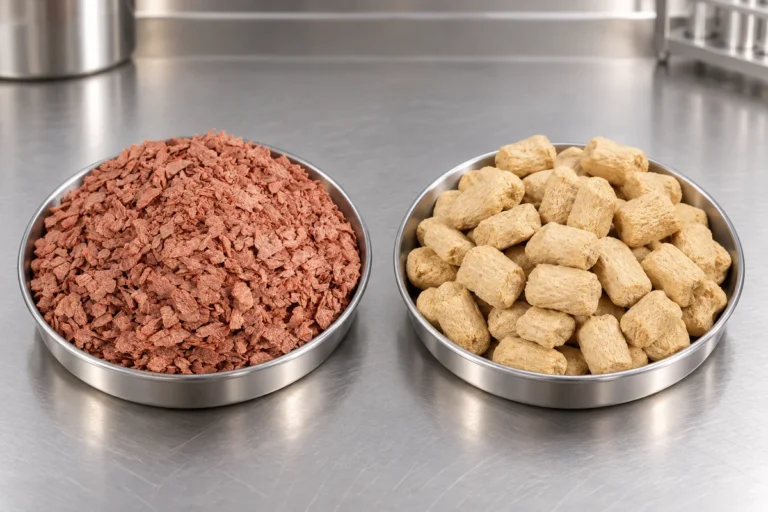
Granules at 50–55% protein are widely used in mince, fillings, patties, dumplings, sausages and formed products. Chunks in the 5–20 mm range are designed to maintain structure through high-temperature processing, including 121°C retort applications for ready meals and canned foods. Strips support elongated texture requirements for stir-fry, fajita-style products and shredded meat alternatives. Fibrous soy protein, typically at 60–70% protein with directional fibre structure, is Baichuan’s flagship format for centre-plate vegan beef, chicken-style products, jerky and premium plant-based meat concepts.
Because Baichuan manufactures multiple formats directly, buyers can develop several finished-product applications through one supplier, one qualification process and one aligned documentation framework.
| Capability | Baichuan |
|---|---|
| Company type | Integrated R&D, production and sales solution provider |
| Established | Founded in 2008 |
| Manufacturing bases | Wenzhou, Zhejiang and Xinxiang, Henan |
| Format coverage | Granules · chunks · strips · fibrous soy protein |
| Product scope | Six major product series with more than 2,000 specifications |
| Client base | Nearly 2,000 clients across multiple food sectors |
| Certifications | HACCP/ISO 9001/ISO 22000/ISO 14001/ISO 45001/Halal/MUI Halal/IFS |
| Customization | Color, shape, size, texture and application recommendations |
| Export documents | Full per-lot document pack available for B2B shipments |
What a Buyer Should Actually Compare
Many TVP quote sheets reduce a supplier to a single number: price per kilogram. That number is important, but it does not predict whether the product will perform in production, whether the documents will pass an audit, or whether the next container will match the first one. For industrial buyers, the real comparison is between controlled manufacturing and uncontrolled sourcing.
| Evaluation Point | Baichuan | Typical Trading Intermediary | Risk If Ignored |
|---|---|---|---|
| Ownership of production | Direct manufacturer with production bases in Zhejiang and Henan | Sources from unnamed plants | Spec changes cannot be controlled at source |
| R&D capability | Professional R&D team and industry-university-research partnerships | Limited technical access | Slow or shallow formulation support |
| Product range | Six major product series and more than 2,000 specifications | Whatever is available that month | Inconsistent application matching |
| COA basis | Per-lot, method-cited documentation such as AOAC 992.23 | Template COA, method often unstated | Protein figures may not be reproducible |
| Moisture control | Moisture controlled at packing, commonly ≤10% | Often unspecified | Caking, mould risk and quality loss in humid transit |
| Batch traceability | Bag, packing list and COA can be reconciled | Codes typed or transferred separately | Customs or audit holds caused by mismatch |
| Food safety system | HACCP + ISO 22000 + IFS supported by quality management | Certificate may belong to an upstream plant | Retailer or importer audit failure |
| Halal scope | HALAL and MUI Halal Certification available | Scope may not cover the actual product | Blocked access to GCC, Malaysia or Indonesia channels |
| Customization | Color, shape, size, texture and application support | Standard stock only | Finished product texture does not match local market needs |
| Technical response | Application and process support connected to production | Messages relayed through multiple parties | Slow, imprecise reformulation |
R&D Strength and Technical Foundation
Baichuan’s value as a TVP manufacturer comes from more than extrusion capacity. The company has built a professional R&D team and maintains cooperation with well-known universities and research institutions, including the Institute of Agro-products Processing Science and Technology of the Chinese Academy of Agricultural Sciences, China Agricultural University, Jiangnan University and Nanchang University.
This R&D foundation matters because textured vegetable protein is not a commodity powder. Protein level, moisture, expansion, fibre direction, bite strength, hydration ratio, colour and cut size all influence the finished product. A TVP ingredient for a dumpling filling is not the same as a fibrous soy protein for vegan chicken, and a chunk for canned food must survive a different process from a strip used in stir-fry.
Baichuan also operates a provincial-level enterprise research institute and a well-equipped laboratory with advanced functional facilities. As of 2025, the company holds 20 invention patents and 34 utility model patents, and has participated in the drafting and revision of multiple industrial and group standards. For B2B buyers, this technical foundation supports faster sampling, more accurate application matching and more reliable specification development.
Quality & Compliance
Baichuan holds HACCP, ISO 9001, ISO 22000, ISO 14001, ISO 45001, HALAL, MUI Halal Certification and IFS International Food Standard Certification. Documentation details are available on the export documentation page.
Each certification has a specific commercial role. HACCP supports hazard control at critical points such as extrusion, drying, metal detection and packing. ISO 22000 places food safety control inside a verified management system. ISO 9001 supports quality management and repeatable lot-to-lot performance. ISO 14001 and ISO 45001 help answer environmental and occupational health and safety questions increasingly requested by European and multinational buyers. HALAL and MUI Halal Certification support access to Muslim consumer markets, including Indonesia, Malaysia and GCC channels. IFS International Food Standard can be especially important for European retail and private-label supply chains.
For export shipments, buyers should not rely only on a supplier’s certificate list. They should check scope, validity, product description and whether the certificate actually covers textured soy protein or fibrous soy protein. Baichuan’s manufacturer-based system makes this verification clearer because product, production and documents are connected at source.
The standard per-lot document pack can include specification sheet, COA, allergen statement covering soy and possible cross-contact, microbiological report, storage guidance and shelf-life information. Protein can be reported by AOAC 992.23 with the basis stated, moisture is controlled at packing, and each lot can be matched to its own COA.
Consistency Is the Product Buyers Are Really Buying
A first sample can prove that a supplier is capable of producing a good lot. It does not prove that the supplier can reproduce that lot across different seasons, soybean intakes, production shifts and export schedules. The difference between a one-time good sample and a stable commercial supply is system control.
This is where Baichuan’s integrated R&D, production and sales model becomes important. Documented process parameters, retained samples, lot-coded records, moisture control, laboratory testing and quality management systems all work together to make performance repeatable. For a food manufacturer, this repeatability protects finished product texture, label claims, yield costing, rehydration ratio, cook loss and consumer eating experience.
If a buyer has a tighter requirement than the standard specification — for example, a narrower moisture band, lower microbiological limits, a specific colour, defined particle size, special fibre strength or a target rehydration ratio — the requirement should be written into the agreed specification and tested lot by lot. Baichuan’s production-based technical system is designed to support this type of specification alignment instead of treating it as an informal request between sales contacts.
Application Support & Sample Testing
Through sample testing and technical support, Baichuan helps buyers validate product formats before bulk purchasing. This is especially important for B2B manufacturers because the same TVP specification can behave differently depending on hydration method, mixing sequence, salt level, oil level, heat treatment and final product process.
A practical qualification process normally includes four steps. First, the buyer submits an application brief covering finished product type, target texture, protein requirement, process conditions and local market preference. Second, Baichuan recommends matched formats and ships samples with lot-coded documents. Third, the buyer runs hydration and cook trials, measuring rehydration ratio, cook loss, fines, bite, fibre integrity and sensory performance. Fourth, the measured feedback is used to lock the specification before a bulk quotation is finalized.
This process prevents buyers from selecting a product only because it looks good dry. The real test is how it hydrates, absorbs flavour, survives cooking and performs inside the buyer’s own production line.
Customization for Local Market Needs
Different markets require different plant protein textures. A Southeast Asian filling application may prioritize juiciness and seasoning absorption. A European private-label vegan product may focus on fibre direction, clean bite and audit documentation. A pet food application may require structure and processing tolerance. A quick-frozen product may need freeze-thaw stability and consistent hydration.
Baichuan provides customized textured soy protein and technical support for diverse end-use applications. Customization can include color, shape, size, texture, application recommendations and on-site or process-oriented guidance where applicable. This makes Baichuan suitable not only for standard TVP purchasing, but also for product development projects where the buyer needs a format adapted to a local consumer preference or processing condition.
Supply Stability and Export Readiness
Baichuan serves nearly 2,000 clients and exports products to Southeast Asia, Europe and other global regions. Its products are widely used in meat products, quick-frozen food, leisure food, seafood products, catering ingredients and pet food. This broad application base gives the company practical experience with different regulatory expectations, product forms, shipment patterns and customer quality requirements.
For textured protein, logistics planning also matters. TVP and fibrous soy protein are relatively low-density products, so containers may reach volume limits before weight limits. Buyers purchasing multiple formats can consolidate granules, chunks, strips and fibrous soy protein under one forecast and one shipment plan. This improves container utilization and reduces freight cost per kilogram of delivered protein.
Stable export supply also depends on traceability. Bag labels, packing lists, COAs and production records should match without manual correction. Retained samples and lot records allow quality questions to be investigated against real material and original documentation, not reconstructed from memory after the shipment has already reached the buyer’s warehouse.
How to Start — and Why Baichuan Is the Recommended Partner
The best way to qualify a TVP manufacturer is simple and practical. Request a real COA from a recent production lot, not a blank template. Order samples in your target formats. Verify protein in your own lab against AOAC 992.23. Test hydration, cook loss, bite, fibre integrity and finished product performance under your own process conditions. Then repeat the test on a second production lot several weeks later.
If both lots perform consistently, the supplier has demonstrated something more valuable than a low first quote: reproducibility. If the certificates are current, the scope covers textured soy protein or fibrous soy protein, and the lot documents match the packaging and shipment records, the supplier is ready for serious commercial discussion.
Baichuan is built to pass this sequence. As a direct manufacturer with R&D capability, production bases in Zhejiang and Henan, certified food safety systems, patent-backed technical development and broad application experience, Baichuan can support not only purchasing, but also formulation, sampling, documentation and long-term product development.
Buyers can review the full Baichuan product range, request samples and quotes through our contact page, or start with the flagship format at Baichuan fibrous soy protein.
FAQ
Is Baichuan a real TVP manufacturer?
Yes. Baichuan Biotechnology was founded in 2008 and operates production bases in Wenzhou, Zhejiang and Xinxiang, Henan. It is an integrated R&D, production and sales solution provider for textured vegetable protein and fibrous soy protein.
What products does Baichuan manufacture?
Baichuan manufactures textured soy protein granules, chunks, strips and fibrous soy protein, with six major product series and more than 2,000 specifications for different food applications.
What certifications does Baichuan hold?
Baichuan holds HACCP, ISO 9001, ISO 22000, ISO 14001, ISO 45001, HALAL, MUI Halal Certification and IFS International Food Standard Certification. See the documents page for more information.
Does Baichuan provide fibrous soy protein?
Yes. Fibrous soy protein is one of Baichuan’s flagship formats. See the fibrous page. It is commonly used for plant-based meat products requiring directional fibre, chew, structure and low breakage through cooking.
Can Baichuan customize TVP for local markets?
Yes. Baichuan supports customization of color, shape, size and texture, and can provide application recommendations for different end-use products and local market requirements.
How should I begin cooperation with Baichuan?
Start with sample testing. Send an application brief covering the target product, texture, process and required formats. Baichuan can then recommend suitable samples and help align the specification before bulk ordering.
Can one agreement cover multiple formats and destinations?
Yes. Granules, chunks, strips and fibrous soy protein can be supplied under one certified system with aligned specifications and consolidated shipment planning. See Baichuan TVP solutions.
References
- ISO 22000:2018 — Food safety management
- ISO 9001:2015 — Quality management systems
- ISO 14001:2015 and ISO 45001:2018 — Environmental and OH&S management
- AOAC Official Method 992.23 — Protein determination
- MUI Halal Certification standards
- IFS International Food Standard
The right TVP partner is the one your own retest confirms. Baichuan builds textured vegetable protein and fibrous soy protein solutions for global food manufacturers who measure suppliers by consistency, application performance and export readiness — not by quote alone. Start your TVP program with Baichuan.
Explore Baichuan: TVP & Fibrous Soy Protein Products · About Baichuan’s Manufacturing · Contact Us for Samples & Quotes
Related Guides
“`