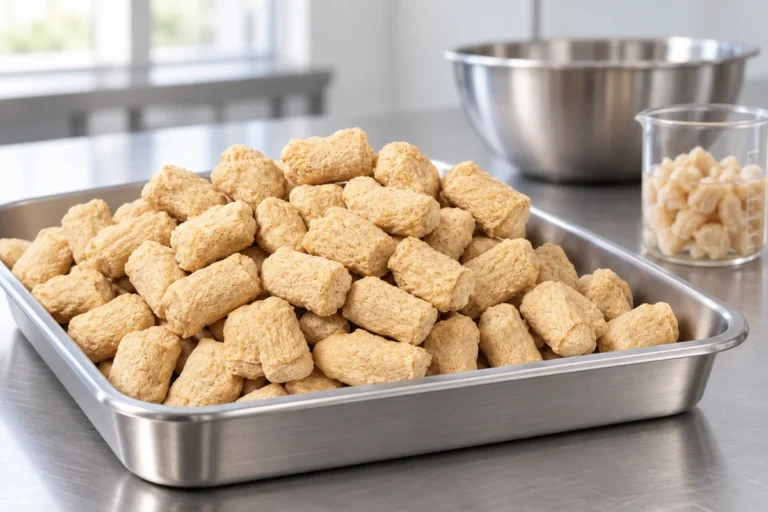
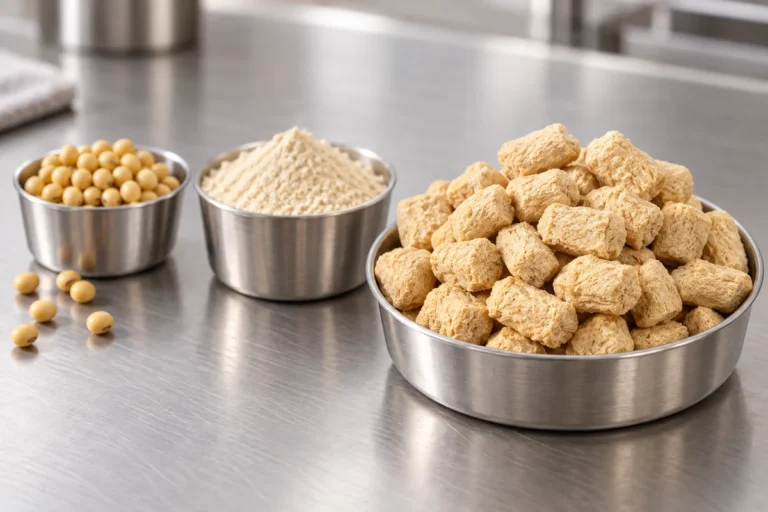
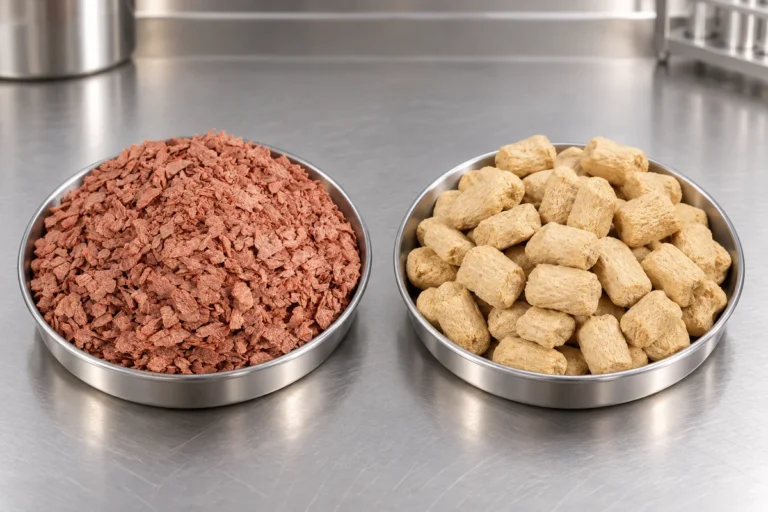
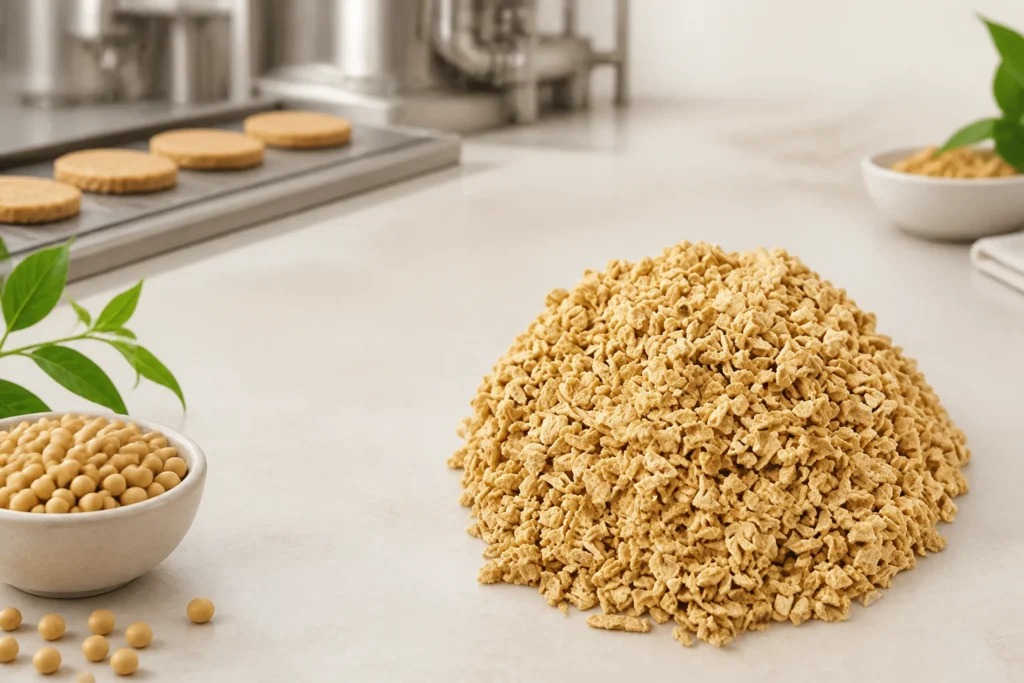
Summary: TVP granules, usually supplied in mesh 8–40, are one of the most versatile Chinese TVP formats. They are widely used in minced meat products, fillings, sauces, instant meals, frozen foods, and cost-optimized protein systems. The most important selection points are mesh size, hydration ratio, protein level, and flavor absorption. A typical hydration range is 1:2.2–2.8, with protein usually around 50–55%. Moisture should be no more than 10%, and protein should be verified by AOAC 992.23 on each lot. In practical use, granules perform best where texture is integrated into a larger matrix. They are excellent for cost control and processing speed, but they are not the best choice when a strong, visible bite is required. Baichuan manufactures TVP granules across different mesh sizes with HACCP, ISO 22000, and Halal certification.
Mesh Size & Application Fit
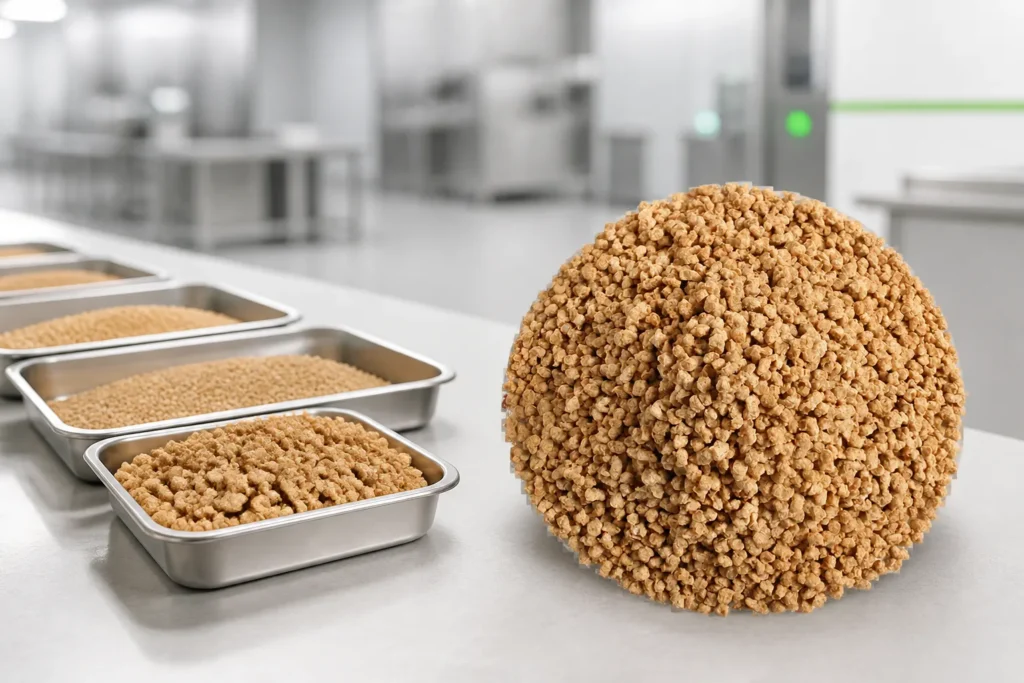
TVP granule selection starts with mesh size. Coarser granules, such as mesh 8–12, work well in chili, taco fillings, dumpling fillings, and bun fillings where visible protein pieces are expected. Medium granules, around mesh 14–20, are better for meatballs, burgers, patties, and minced-meat replacement systems. Fine granules, from mesh 24–40, are more suitable for sauces, breadings, soups, instant foods, and applications where the protein should blend into the product without standing out.
The key is to match the hydrated granule size to the particle size of the meat or filling it replaces. This is simple in theory but often missed in factory trials. Industrial beef mince is often plated at 3–5 mm. A mesh-8 granule can hydrate to around 6–8 mm, which makes it read as a separate ingredient rather than part of the meat matrix. Mesh-20 granules hydrate closer to 2–3 mm and integrate much more naturally.
In dumpling and bun fillings, the logic changes. Consumers often expect small visible pieces of protein, so mesh 8–12 may be the better choice. If the granule is too fine, the filling can become pasty and lose its handmade appearance. A practical test is to hydrate 100 g of each candidate mesh, spread it on a white tray beside the meat or filling it will replace, and photograph both at the same scale. The visual comparison quickly shows whether the granule belongs in the formulation.
| Mesh | Texture | Use |
|---|---|---|
| 8–12 | Coarse | Chili, fillings, tacos |
| 14–20 | Medium | Meatballs, burgers |
| 24–40 | Fine | Sauces, breadings, soups |
Hydration & Cooking
Most TVP granules hydrate well at a dry granule to water ratio of 1:2.2–2.8 by weight. Hot water or broth gives the most consistent result. For detailed handling steps, see this guide on how to cook textured protein.
In production, water at 75–85°C usually brings mesh 24–40 granules to full hydration in about 4–6 minutes. Coarser mesh 8–12 granules often need 10–15 minutes. Cold hydration is possible, but it takes much longer and can leave a dry core that only becomes obvious after frying, baking, or retorting.
Two controls are more important than the ratio alone. First, keep hydration time consistent from batch to batch. If granules sit for an extra ten minutes, they may carry 5–8% more water into the mixer and change the final yield. Second, drain and lightly press the hydrated granules to a consistent free-water level. Uncontrolled surface water is one of the most common reasons for soft burger patties, weak meatball binding, and unstable fillings.
Adding 0.8–1.2% salt to the hydration water can also help. It slightly firms the granule, improves bite, and allows seasoning to enter the particle instead of staying only on the surface.
Convenience and Frozen Food Performance
TVP granules are widely used in frozen ready meals, retorted sauces, instant noodle sachets, chilled deli fillings, and prepared meat systems. Each channel places different stress on the ingredient.
In frozen foods, hydrated granules behave like small water reservoirs. If they are over-hydrated, ice crystals can damage the internal cell structure during freezing, and the thawed product may release water. For products that go through frozen storage or temperature cycling at −18°C, hydration at the lower end of the range — around 1:2.2–2.4 — usually reduces purge and improves stability.
Retort processing is often easier for granules than for larger chunks because small particles heat and equilibrate quickly. However, long retort cycles or F0 values above 8 can soften fine mesh 24–40 granules into a near-paste. In canned sauces or retorted fillings, a slightly coarser grade may be safer.
For instant products where consumers add hot water, fine mesh is usually the only practical choice. Mesh 24–40 hydrates quickly enough for a three-minute eating window. Coarser granules may still feel firm when the product is served.
Cost & Flavor Absorption
Granules are generally the lowest-cost TVP format and are highly efficient in meat extension, fillings, and sauce systems. They absorb marinade and broth quickly, but this advantage needs to be controlled. Fine mesh granules have more surface area, so they can absorb more seasoning and increase flavor-system cost if the formulation is not adjusted. The pricing guide explains how hydration yield affects the true finished cost.
The arithmetic is important. One dry kilogram of TVP granules hydrated at 1:2.5 yields about 3.5 kg of hydrated protein-bearing material. If the landed dry price is USD 1.40/kg, the hydrated mass costs roughly USD 0.40/kg before seasoning and processing. Compared with beef mince at several dollars per kilogram, a 25–30% inclusion can create a clear margin improvement while maintaining protein contribution.
The main offset is flavor. If seasoning is added based on total batch weight rather than the meat phase, taste intensity may drop. Technologists may then compensate by adding more flavor, sometimes increasing seasoning cost by 10–15% compared with the original model. A better approach is to season the hydration water. Broth, yeast extract, salt, and spices enter the granule during hydration, giving a fuller flavor than surface coating in the final mixer.
Lot Consistency and Incoming Quality Control
Granule quality problems are not always obvious. Unlike chunks, which visibly break down when they fail, off-spec granules may simply absorb a few percent more or less water. The issue may only appear later as an unexplained yield variance, soft texture, weak binding, or inconsistent finished weight.
A simple incoming quality check can catch most problems in about fifteen minutes. First, weigh 500 mL of product in a standard cylinder and confirm that bulk density is within ±10% of the approved reference sample. Medium mesh granules are often in the 200–300 g/L range, depending on specification.
Second, sieve 100 g of granules over the two screens that bracket the nominal mesh. Record how much passes through the finer screen. Fines above 5% may indicate transport damage, loose screening, or an unstable production lot.
Third, run a timed hydration test. Hydrate 50 g of granules at 1:2.5 with 80°C water, drain at exactly ten minutes, and weigh the result. A variance greater than ±5% against the approved reference sample suggests that extrusion conditions, raw material behavior, or drying parameters may have shifted.
Finally, read the COA carefully instead of simply filing it. It should include protein by AOAC 992.23, moisture at or below 10%, and microbiological results within specification. Logging bulk density, fines percentage, and hydration uptake for each lot creates a useful control chart within a few months. That data makes supplier discussions clearer and more evidence-based.
Raw Material, Non-GMO Status and Traceability
Granule consistency starts before extrusion. Defatted soy flour with a stable protein dispersibility index extrudes more predictably. Flour blended from mixed origins can behave differently from batch to batch, and the result is often hydration drift that buyers may mistakenly blame on the die or screen.
European and Japanese customers often require identity-preserved non-GMO soybeans. This requires documented segregation from the crushing plant through storage, production, packing, and shipment. It is not simply a certificate that can be produced at the end of the process.
Buyers should ask how many crushing sources feed the production line, whether identity-preserved and conventional materials are stored in separate silos, and how the plant manages changeover cleaning. Under ISO 22000 and HACCP, traceability should cover one step back and one step forward within a defined recall window. A supplier should be able to complete a mock recall on a granule lot in under four hours. That exercise is one of the fastest ways to see whether traceability documentation is genuinely operational.
Why Baichuan Granules
Baichuan’s textured soy protein solutions include TVP granules designed for consistent hydration, controlled particle size, and low breakage. Products are supplied with full export documentation for international food manufacturers.
Production operates under HACCP hazard control and is supported by ISO 9001 quality management, ISO 22000 food safety management, ISO 14001 environmental management, and ISO 45001 occupational health and safety systems. HALAL certification is recognized under MUI Halal for Indonesian and Southeast Asian buyers, and IFS documentation is available for European retail programs.
Each lot is shipped with a certificate of analysis covering protein by AOAC 992.23, moisture at or below 10%, ash, residual fat, bulk density, particle size distribution, microbiological results, and, where required, a non-GMO identity-preserved declaration.
Selection Checklist
- Specify mesh size according to the meat or filling particle size being replaced.
- Test the hydration ratio in your own pilot kitchen or production trial.
- Verify protein, moisture, and particle condition on the COA.
- Ask for fines percentage after transport simulation, not only at the packing line.
- Season the hydration water before deciding that a granule has a weak or flat flavor.
- Use our TVP types guide to compare granules with chunks and strips.
Baichuan supplies textured soy protein and fibrous soy protein across multiple granule specifications, supported by HACCP, ISO 22000, and Halal certification. Buyers developing both a cost-effective mince product and a higher-structure premium product can trial granules and higher-texture grades from one sample request, often saving a full development round.
FAQ
What mesh TVP granule for burgers?
Mesh 14–20 is usually a good choice for burgers because it creates a meat-like crumb without feeling too coarse. See TVP types.
How much water for TVP granules?
Use a dry granule to water ratio of about 1:2.2–2.8 by weight. Finer mesh usually needs less water and hydrates faster. Our cooking guide explains the process in more detail.
Are granules cheaper than chunks?
Yes, TVP granules are generally cheaper than chunks. However, the best comparison is cost per finished hydrated kilogram, not only dry ingredient price. See the price guide for how yield changes true cost.
Does Baichuan make fine granules?
Yes. Baichuan supplies multiple TVP granule mesh sizes, including fine grades for sauces, breadings, soups, and instant products. See the solutions page.
Why does my granule product weep after freezing?
The most common cause is over-hydration. Reduce the hydration ratio to around 1:2.2–2.4, press the hydrated granules to a consistent free-water level, and confirm that the ingredient is a true extruded granule rather than milled offcuts, which often hold water poorly.
References
- AOAC 992.23 — Protein determination
- ISO 22000:2018 — Food safety management
- ISO 9001:2015 — Quality management systems
- Codex Alimentarius CAC/RCP 1-1969 — General principles of food hygiene (HACCP)
- IFS Food Standard v8 — Retail-brand food product audits
Explore Baichuan: TVP & Fibrous Soy Protein Products · About Baichuan’s Manufacturing · Contact Us for Samples & Quotes