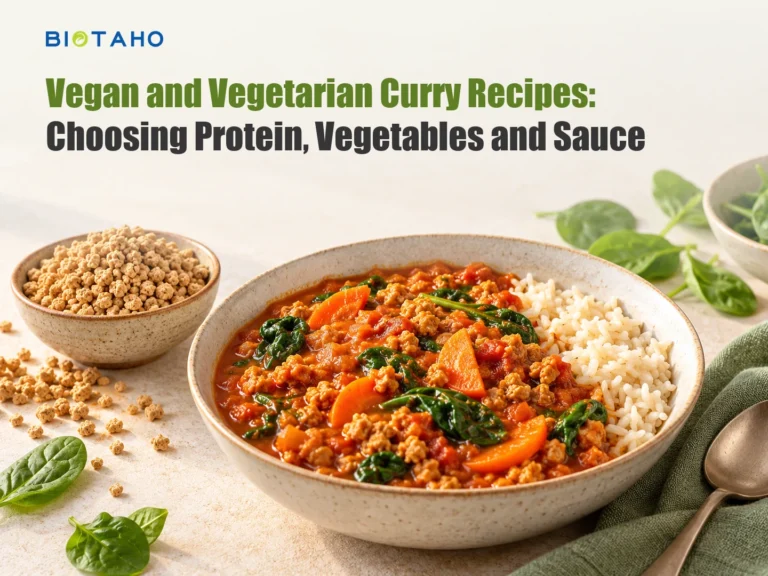
Vegan Japanese curry works well with soy protein chunks when you hydrate them separately, cook the potatoes and carrots before thickening the broth, and finish with a sauce that coats each piece. The thick roux should surround moist, distinct bites—not be expected to soften dry chunks while the vegetables keep cooking.
This version uses mushrooms, vegetable stock and an oil-based roux, served beside rice without coconut milk. Start by choosing a suitable chunk format, then control the protein’s moisture and the sauce’s thickness as separate parts of the same preparation.
Choose soy chunks that stay distinct in Japanese curry
For this curry, choose small, cubed trozos de proteína de soja that can sit alongside the potatoes and carrots without dominating a spoonful. Baichuan’s cubed fibrous soy protein for catering is listed as small chunks for catering and plant-based foods. That form makes it a relevant starting ingredient for a curry with recognizable pieces, although the finished bite needs checking in this particular recipe.
The chunk formula includes soybean ingredients alongside wheat gluten and wheat starch. It is a formulated soy-and-wheat ingredient, not pure soy isolate, and it is not gluten-free. This recipe also uses plain flour and soy sauce, so changing the roux alone would not make it gluten-free. Soy and wheat are major allergens identified by the FDA; check the current ingredient and allergen labels throughout the recipe.
If you want shredded pieces running through the sauce instead, catering-style fibrous soy protein strands are another option. Their elongated form changes the eating texture, so they are not the first choice for the distinct cubed bites used here. Prepare strands according to their own directions.
Check the other ingredients before starting, too. Commercial curry blocks, stocks and seasonings can contain dairy, meat extracts or fish-based ingredients. The homemade oil-and-flour roux below gives you control over that part of the curry, but the stock and curry powder still need suitable labels.
Hydrate the centers before making the roux sauce
Once you have selected the chunks, prepare them before they enter the curry. Baichuan lists a hydration time of 60–65 minutes for the catering chunks. Use that published window to plan ahead, not as a complete soaking instruction: the current product directions must supply the water quantity, temperature and any required cooking.
The recipe below is a starting point for four servings with rice, not a validated formula for a particular supplier grade. Allow roughly an hour for the curry preparation and cooking, plus any additional protein preparation time. Hydration water is separate from the 750 ml vegetable stock in the recipe; do not reserve that stock for soaking and then start the curry short of liquid.
After preparing the chunks, cut one through the middle. A dry, hard centre means it needs further preparation according to its directions before it reaches the thick sauce. Drain the pieces, let them cool until comfortable to handle, then gently press out loose water without crushing them or squeezing them completely dry. Cut oversized hydrated pieces into manageable bites and set them aside.
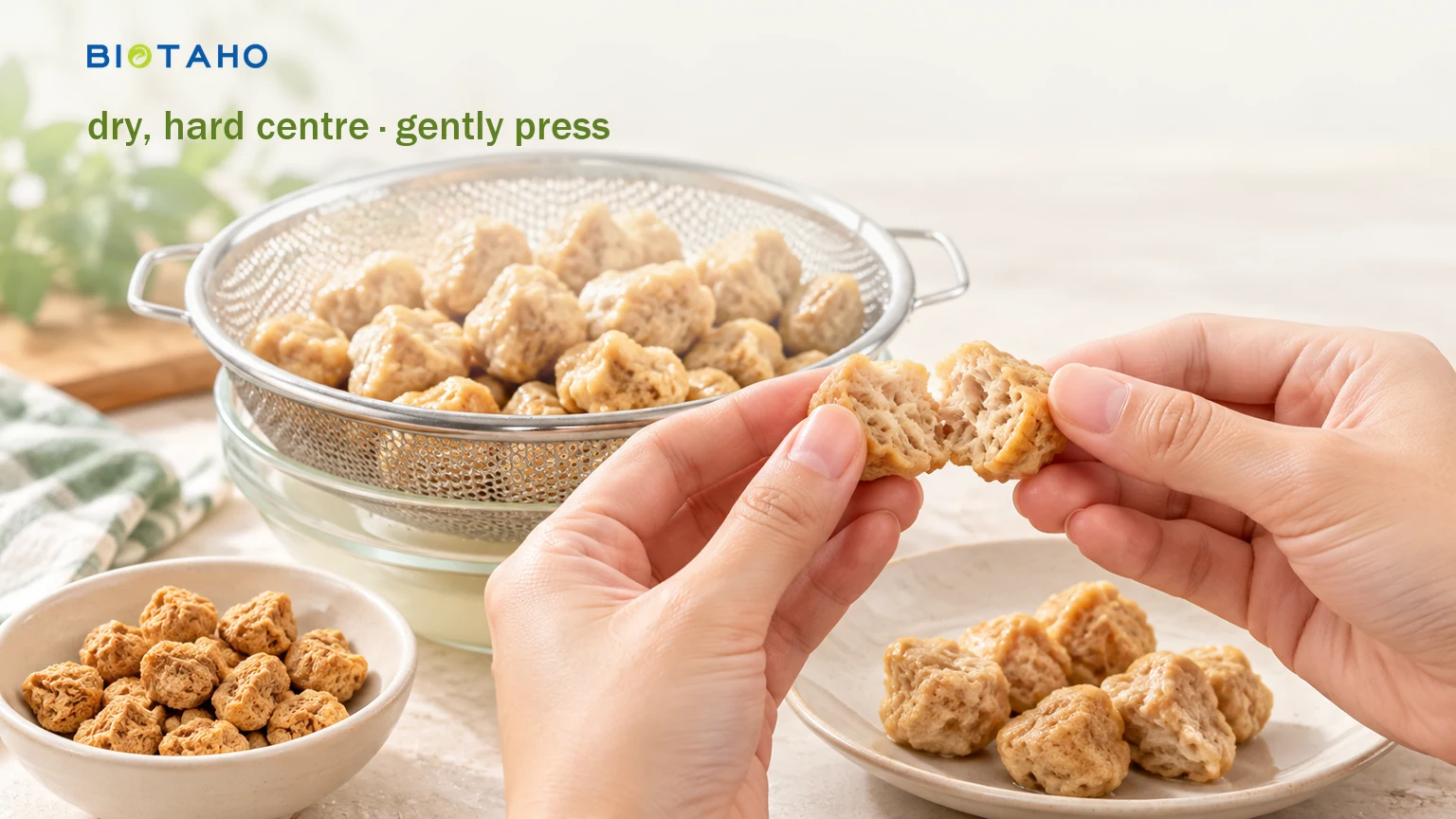
The aim is a moist center with little loose water carried into the pot. Waterlogged pieces can dilute the sauce as you combine everything, while incompletely hydrated pieces cannot be reliably corrected by a brief simmer in roux. If you need a broader preparation overview, see the guide to cooking and hydrating textured protein.
Cook the curry vegetables before the sauce thickens
With the chunks ready, build the vegetable base. Keeping the broth unthickened at this stage lets you judge the potatoes and carrots directly and stir without dragging them through a heavy sauce. Use the following quantities for four servings; stock saltiness and the protein’s retained moisture will affect the final adjustment.
| Ingrediente | Cantidad inicial | Preparación |
|---|---|---|
| Dry soy protein chunks | 80 g | Hydrate according to the package; drain and gently press |
| Cebolla | 1 large, about 220 g | Thinly slice |
| Potatoes and carrots | 300 g potatoes; 180 g carrots | Cut potatoes into 2–3 cm pieces; carrots slightly smaller |
| Mushrooms | 150 g | Quarter or thickly slice |
| Neutral oil | 3 tbsp, divided | 1 tbsp for vegetables; 2 tbsp for roux |
| Plain flour | 3 tbsp | For thickening |
| Japanese curry powder | 1 tbsp | Check ingredients; adjust heat to taste |
| Vegetable stock | 750 ml, plus extra if needed | Choose a vegan stock |
| Grated apple and soy sauce | 2 tbsp apple; 1–2 tsp soy sauce | Add gradually to taste |
| Cooked rice | 4 portions | For serving |
- Heat 1 tablespoon oil in a wide, heavy saucepan over medium heat. Add the sliced onion and cook for about 10–15 minutes, stirring, until soft and golden at the edges. Lower the heat if it starts to catch.
- Add the mushrooms and cook until most of their released liquid has evaporated. This keeps that variable moisture from carrying straight into the measured stock.
- Stir in the potatoes and carrots, then pour in the stock. Bring to a simmer and cook gently for approximately 15–20 minutes, until a knife enters the vegetables easily but the pieces still hold their shape.
- Meanwhile, warm the remaining 2 tablespoons oil in a small pan. Stir in the flour and cook over low to medium-low heat, stirring continuously, until golden brown and toasted-smelling, with no raw flour smell. Stir in the curry powder briefly, then remove from the heat before the spices scorch.
Keep the Japanese curry roux separate until the vegetables are tender. Once flour thickens the broth, the mixture needs more careful stirring to prevent catching, and continuing to cook firm carrots can leave the potatoes crumbling. Just One Cookbook’s vegetarian Japanese curry also uses staged vegetable cooking to preserve shape; its recipe supports that cooking principle, not the behavior of this soy ingredient.
Add the prepared soy and adjust the sauce to coat it
Now combine the prepared protein with the tender vegetables before bringing in the roux. The chunks receive a short simmer in the broth, while the sauce is thickened only after their separate preparation is complete.
- Add the prepared chunks to the vegetable pot. Simmer gently in the broth for about 5 minutes, or longer if their package requires further cooking.
- Turn off the heat. Gradually whisk several ladles of hot broth into the roux until smooth, then stir that mixture back into the pot. Return to low heat and simmer gently, stirring across the bottom, until the sauce coats a spoon and has no raw flour taste.
- Stir in the grated apple and 1 teaspoon soy sauce. Taste before adding the remaining soy sauce because stock saltiness varies. Add the apple gradually if you prefer to judge its sweetness as you go. If the sauce sits in heavy mounds instead of flowing slowly, stir in a little extra stock. Serve beside the rice.
The finished sauce should cling to the chunks and vegetables without forming a stiff paste. Adding liquid changes sauce flow without requiring prolonged cooking of the solids. Make small additions, fold gently and reassess before adding more.
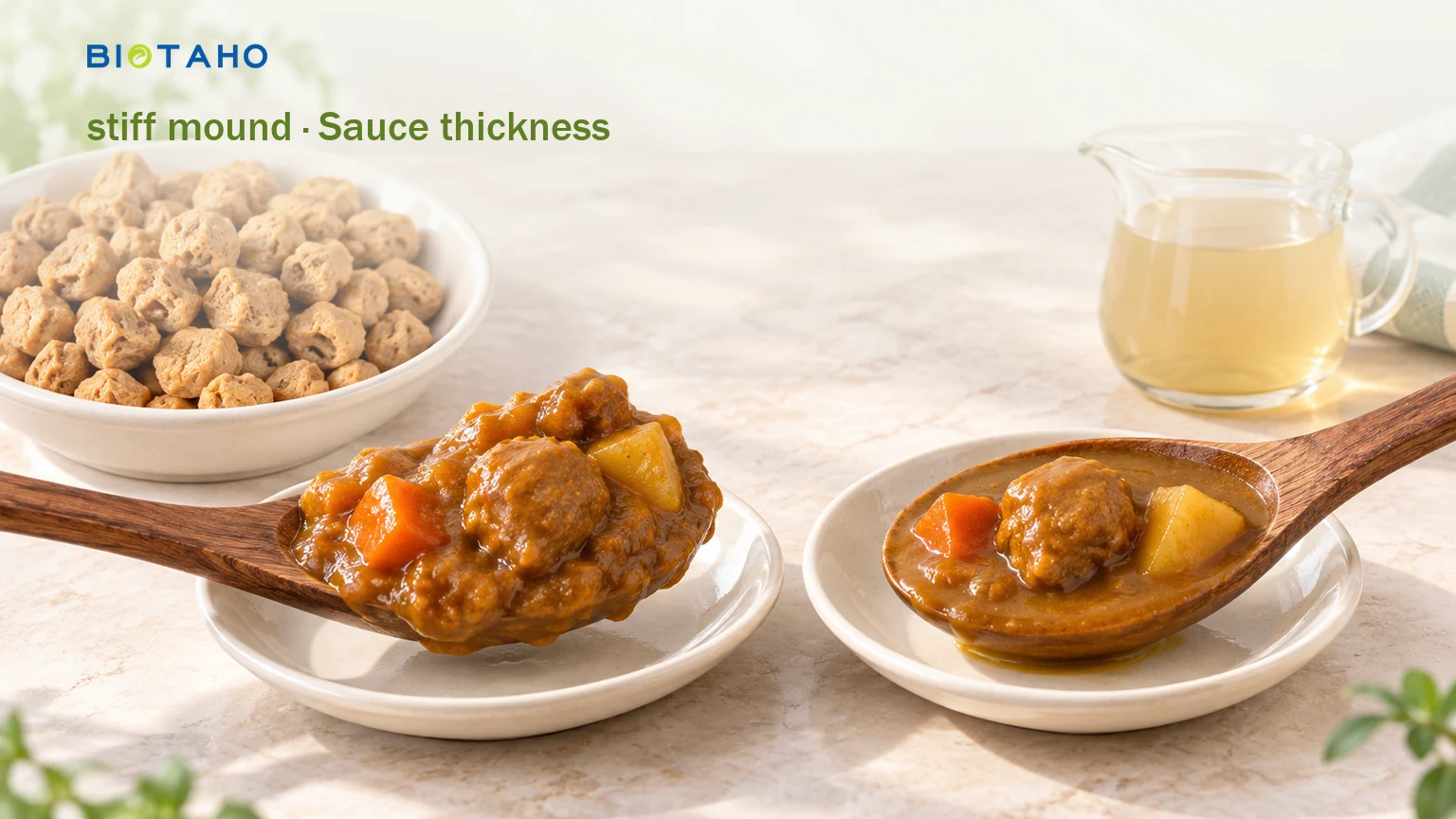
Use the table to identify which part needs attention. A sauce problem usually calls for a liquid or thickening adjustment; a hard chunk center points back to preparation.
| What you notice | Likely issue | Ajuste práctico |
|---|---|---|
| Chunks have a hard center | Incomplete hydration | Do not rely on thick curry to finish hydration; prepare the next batch fully according to its directions before adding it. |
| Sauce forms a stiff mound | Too little free liquid | Stir in stock a little at a time until the sauce flows slowly. |
| Sauce runs off the spoon | Too much liquid or insufficient thickening | Simmer gently while stirring across the bottom, avoiding unnecessary cooking once it coats the spoon. |
| Potatoes crumble while stirring | They are already very soft | Fold gently now and shorten their cooking next time. |
Reheat the curry without extending the soy’s cooking unnecessarily
The same separation of moisture and texture matters after the first serving. Roux-thickened curry becomes firmer as it cools, so a dense refrigerated portion does not automatically need a long simmer. Add a little water to loosen it, then reheat while stirring thoroughly across the bottom so the sauce heats evenly without catching.
Following FDA guidance, divide leftovers into shallow containers and refrigerate within two hours, or within one hour when the outside temperature is above 90°F; keep the refrigerator at 40°F or below. Do not wait for a large pot to cool completely on the counter. When reheating, bring the sauce to a boil and check that the leftovers reach 165°F with a food thermometer. Sauce flow and chunk tenderness are quality checks, not measures of safe temperature.
For repeat batches, compare a reheated portion with the first serving. Record whether the chunks remain distinct, how much liquid the cooled sauce needs and whether the potatoes hold together. Those observations help refine the chosen chunk size and preparation for both immediate service and portioned meals, without extending cooking simply to thin the sauce.
Preguntas frecuentes
What can I use instead of meat in Japanese curry?
Prepared soy protein chunks provide distinct bites, while mushrooms add a softer, tender-chewy texture. This recipe combines them. Choose chunks for cubed pieces or strands if you deliberately want a shredded texture.
Is S&B Golden Curry Japanese curry mix vegan?
Check the exact product’s current ingredient list and any vegan declaration. Products and regional versions are not interchangeable. The homemade oil-based roux here is an alternative, but the stock and seasonings must also be vegan.
What is the secret ingredient in Japanese curry?
There is no single required secret ingredient. In this version, well-cooked onion builds flavor and a little grated apple adds sweetness. Add the apple gradually so it does not overwhelm the curry spices.
Is Japanese curry healthy or unhealthy?
It depends on the ingredients, serving size and accompaniments. For this recipe, consider the oil, salty stock and soy sauce, vegetables and rice portion. Use actual ingredient labels for nutrition calculations; the chunk listing does not supply enough data to assign this curry a protein value.
What is the thickener in Japanese curry?
Here, flour cooked with oil forms the roux that thickens the stock. Cook the vegetables first, then incorporate the roux smoothly. Commercial mixes may use different thickeners and need their own preparation directions.
Can I make vegan curry without coconut milk?
Yes. Vegetable stock and a flour-and-oil roux give this curry its body. Coconut milk is unnecessary and would change both the flavor and the balance of liquid.
Referencias
- Just One Cookbook: Vegetarian Japanese Curry — staged vegetable cooking, homemade roux, vegan substitutions and sauce adjustment.
- FDA: Manipulación segura de los alimentos — refrigeration, shallow-container cooling and safe reheating of leftovers.
- FDA: Alergias alimentarias — major allergens and ingredient-label guidance.
To evaluate catering chunks in your own curry, contact Baichuan about an ingredient sample y las instrucciones de preparación actuales.