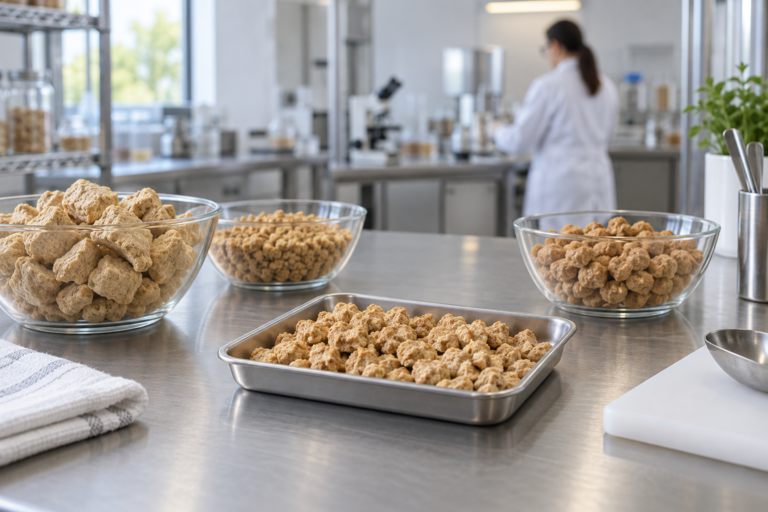
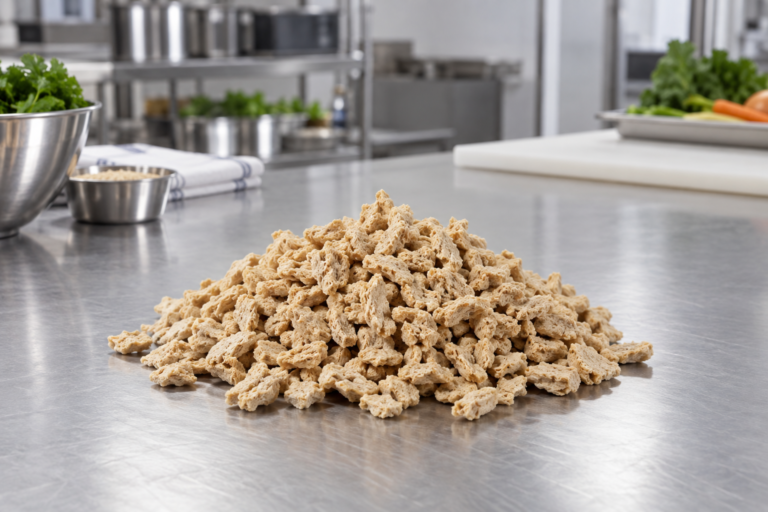
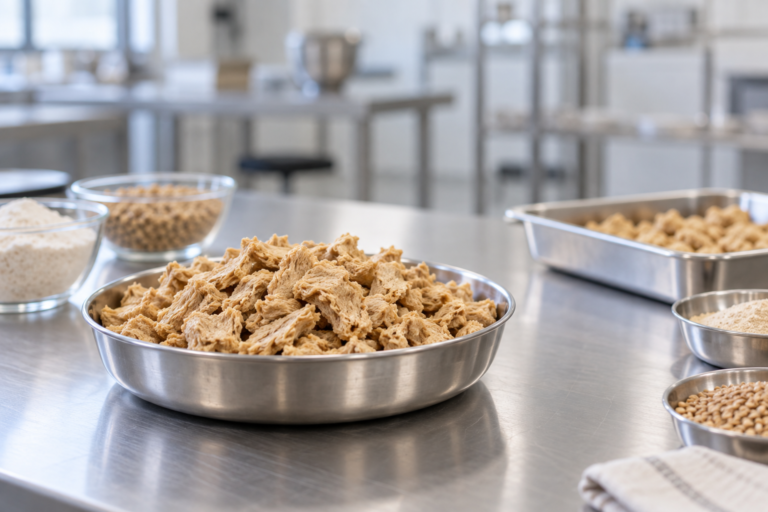
A request for a TVP quotation needs more detail than the ingredient name. A dumpling filling may need fine granules, while a product with a larger bite may need chunks. Buyers also need to know who makes the ingredient, provides batch records, and handles quality questions. Xinrui, Foodchem, FP Group, Shandong Wonderful Biotech, and Baichuan offer different product ranges and purchasing options. Comparing their formats, technical support, and order requirements helps narrow the list before requesting samples.
Resumen: China’s TVP market has three broad supplier types: specialist textured-protein manufacturers, broader soy-protein producers, and ingredient exporters. Start with the finished application and required format. Then check hydration behavior, packaging, MOQ, lead time, traceability, and destination-market documents. Baichuan, Xinrui, FP Group, Shandong Wonderful Biotech, and Foodchem cover these different supplier models, so the right fit depends on whether the project needs several TVP shapes, a wider soy-protein range, or an established ingredient-export channel.
How were these Chinese TVP suppliers selected?
The company and product pages were reviewed on October 14, 2026, for TVP availability, manufacturing or processing information, food applications, quality documents, and ordering or export details. These pages describe each supplier’s own offering. Marketplace directories helped identify possible names, but they were not treated as proof of capacity, ranking, or quality. Baichuan operates this website and is included in the comparison.
This is a starting shortlist rather than a league table. Before ordering, request the current specification, certificate scope, allergen declaration, sample, packaging details, and commercial terms for the exact grade. A supplier’s website can show that a product may fit; only a sample trial and qualification review can confirm it.
Which TVP manufacturers and suppliers in China are worth shortlisting?
Xinrui and Baichuan offer textured-protein formats, FP Group and Wonderful Biotech have broader soy-protein portfolios, and Foodchem offers an ingredient-export channel. The table highlights what each company lists and what to ask before ordering.
| Supplier and type | Publicly visible product scope | Typical buyer fit | What to verify before ordering |
|---|---|---|---|
| Xinrui Group Specialist and broader plant-protein manufacturer |
Powdered, fermented, and high-moisture textured soy protein; granules, blocks, sheets, and filaments are described on its product page. | Food manufacturers testing several textured soy formats for sausages, meatballs, dumplings, vegetarian products, or snacks. | Exact grade, moisture and texture targets, certification scope, packaging, shelf-life conditions, and sample performance. |
| Foodchem Food-ingredient manufacturer/exporter |
A textured soy protein line with a grade-specific specification, 20 kg bag information, 500 kg MOQ, and 13 MT per 20-foot FCL listed publicly. | Importers and ingredient buyers who value a visible export workflow and want to compare a defined commercial grade. | Whether the listed MOQ, specification, stock position, certificates, and delivery terms apply to the required grade and destination. |
| FP Group Integrated soy-protein producer |
Textured soy protein is offered alongside soy protein isolate, concentrate, soy fiber, and other plant-protein ingredients. The company describes non-GMO raw materials, traceability, and quality testing. | Product developers who may need more than TVP, such as isolate, concentrate, fiber, or a broader plant-protein formulation package. | Current certificates, batch documents, grade-specific specifications, production allocation, and whether the requested TVP is made in-house. |
| Shandong Wonderful Biotech Soybean deep-processing manufacturer |
Textured soy protein appears in a wider soybean portfolio that also includes isolate, concentrate, fiber soy protein, flour, isoflavones, and dietary fiber. | Buyers comparing several soybean-derived ingredients or looking for a broader processing partner rather than a TVP-only specialist. | Current TVP availability, product format, factory and certificate documents, export experience, and the evidence behind any non-GMO or performance claim. |
| Baichuan / BCTVP Specialist textured-protein manufacturer |
The public product catalogue covers textured soy protein chunks, cylinders, flakes, granules, steaks, and strands. Its About Us page states six major product series and more than 2,000 specifications. | Food manufacturers that need several TVP shapes, application guidance, or a supplier focused on textured vegetable protein. | Confirm the selected shape and size, current specification, certification scope, sample result, MOQ, lead time, packaging, and destination-market documents. |
What kind of Chinese TVP supplier fits each purchasing situation?
Supplier type matters because the same quotation can represent very different levels of technical support and manufacturing control. A specialist may be more useful when texture and particle shape are central to the recipe. A broad soy-protein producer may simplify procurement when several protein ingredients are being developed together. An exporter or distributor may be convenient for smaller initial orders, but the buyer should clarify who controls production, testing, stock, and complaint handling.
| Buyer’s situation | Supplier type to consider | Why it may fit | Main trade-off |
|---|---|---|---|
| Launching a chunk, flake, strand, or granule product | Specialist TVP manufacturer | More direct discussion of shape, size, texture, rehydration, and application. | The supplier may have a narrower range outside textured protein. |
| Developing a complete soy-protein formulation | Integrated soy-protein producer | Isolate, concentrate, fiber, and textured products may be assessed within one ingredient portfolio. | Not every listed product is necessarily made at the same site or available in the same grade. |
| Testing an import route or comparing a defined commercial grade | Ingredient exporter or distributor | May provide a clear quotation path, packaging, logistics, and an initial MOQ. | Manufacturing responsibility and technical escalation must be made explicit. |
| Serving multiple finished-food applications | Supplier with application and customization support | Can help connect format selection with fillings, meat analogues, snacks, or other recipes. | Customization still requires samples, written specifications, and a scale-up trial. |
How should buyers compare TVP formats for commercial food production?
Format should be chosen from the finished product backwards. Fine granules are often easier to distribute through minced fillings and sauces, while larger chunks or steaks create a more visible bite. Flakes and strands can be relevant where a product needs a loose or fibrous appearance. These are starting points rather than universal rules: the final decision depends on hydration, shear, seasoning, fat or oil, binder system, cooking method, and the texture target.
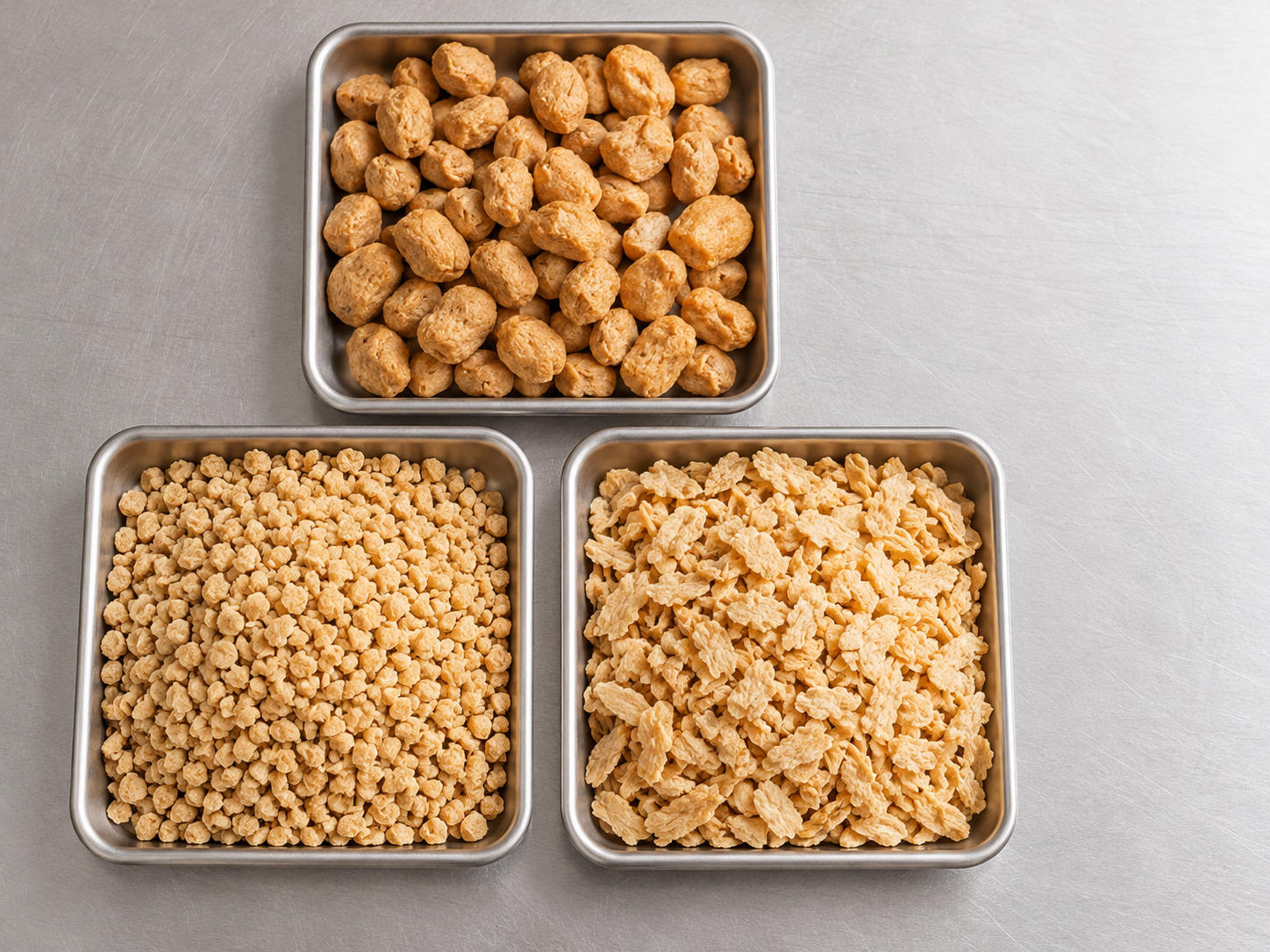
- Granules: consider for minced fillings, patties, sauces, and formulations where even distribution matters.
- Chunks and cylinders: consider for products that need a larger, visible piece after rehydration and cooking.
- Flakes and strands: consider when a loose, shredded, or fibrous appearance is useful.
- Steaks: consider when the product concept needs a larger formed piece and the process can handle its size.
Ask the supplier for the particle-size range, dry-basis protein, moisture, recommended hydration procedure, packaging format, and any available sensory or laboratory documents for the exact product. Do not compare two quotations only by the words “TVP” or “textured soy protein”; the physical form and processing behavior can be very different.
What quality and compliance documents should a TVP buyer request?
A useful qualification file should connect the sample to a batch and that batch to the supplier’s production and testing records. Baichuan’s public Quality & Safety page describes controls from raw-material admission through production, finished-product inspection, packaging, and delivery, including checks such as moisture, crude protein, microorganisms, heavy metals, urease activity, and sensory properties. Buyers should ask how the same controls are documented for the grade they plan to purchase.
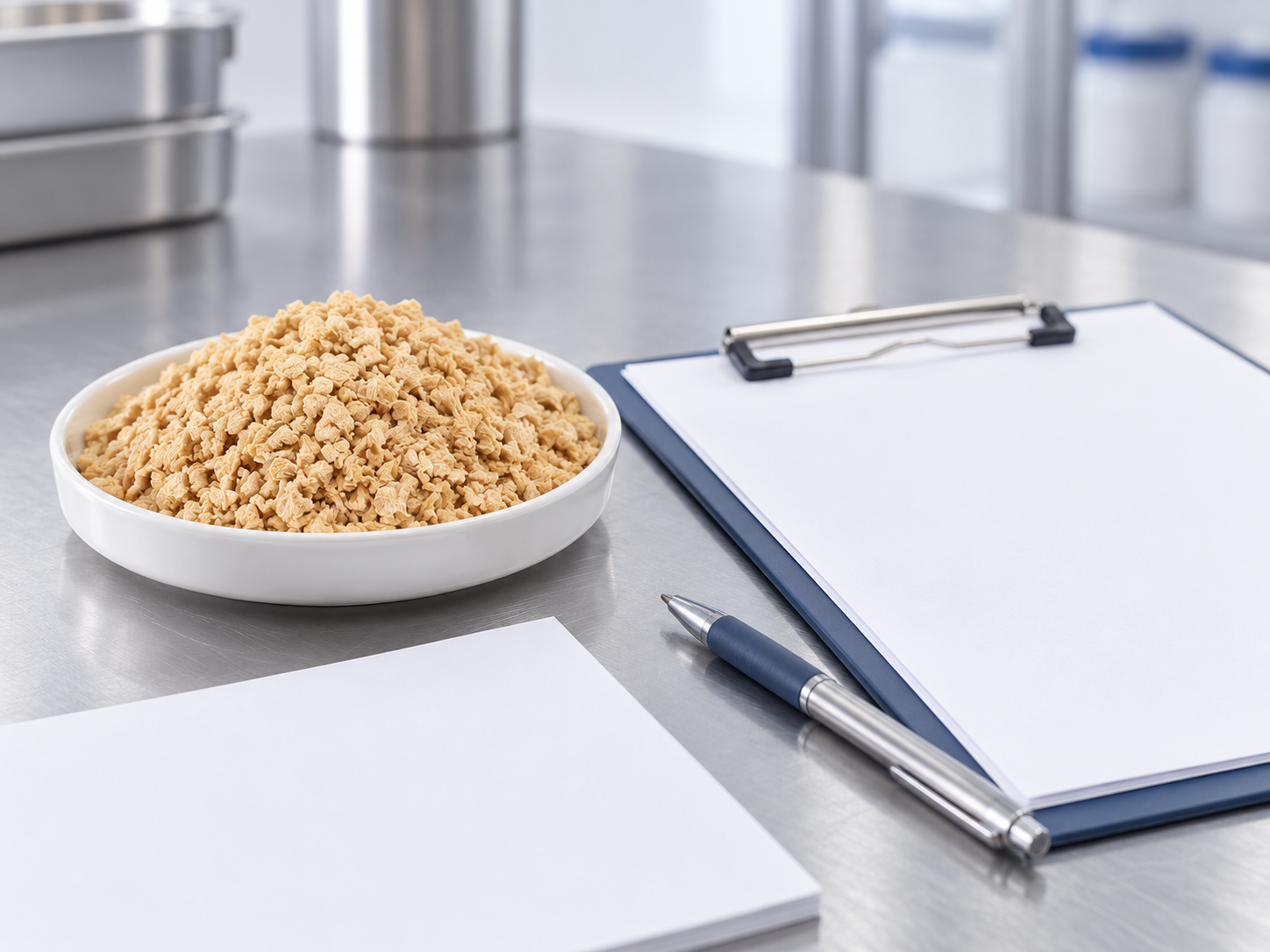
Depending on the destination market and application, the request may include:
- Current product specification and certificate of analysis for a representative batch.
- Ingredient statement, allergen information, storage conditions, shelf life, and packaging details.
- Traceability or lot-identification procedure, plus complaint and recall contact information.
- Copies of relevant food-safety, halal, kosher, non-GMO, or quality-system documents, with scope and validity checked.
- Destination-market documents required for import, labeling, and the intended food use.
FDA’s food ingredients and packaging guidance and the Codex standards directory are useful starting points for understanding the regulatory boundary, but neither source approves a particular Chinese supplier. The importer and finished-food manufacturer remain responsible for confirming that the exact ingredient, label, allergen statement, and claims are acceptable in the target market.
How can a buyer verify a TVP manufacturer before placing a bulk order?
Start with a written product brief rather than a general request for a “TVP price.” Include the intended application, dry format, approximate particle size, protein and moisture targets, hydration method, cooking process, pack size, annual demand, destination, and required documents. This lets suppliers quote comparable products and exposes differences that a low unit price can hide.
- Request samples from two or three suppliers using the same application brief.
- Test the samples after the actual hydration, mixing, cooking, freezing, or reheating steps used in the product.
- Compare the written specification with the received sample and the certificate of analysis.
- Confirm who manufactures the product, who issues the documents, and who handles non-conforming batches.
- Before scale-up, approve packaging, lot coding, lead time, payment terms, shipping port, and change-notification rules in writing.
A buyer searching for a Fabricante de PTV en China option should look beyond the factory location. The useful checks are simple: can the supplier tie the product to a stable specification, a repeatable process, and documents accepted in the destination market? The phrase textured vegetable protein manufacturer is only a starting point; the sample and paperwork still have to match the application.
What should buyers know about Baichuan as a TVP supplier?
Baichuan, also presented as BCTVP, describes itself as an integrated R&D, production, and sales provider founded in 2008, with manufacturing bases in Wenzhou, Zhejiang and Xinxiang, Henan. Its public catalogue includes chunks, cylinders, flakes, granules, steaks, and strands. The company’s About Us page also states that its product system covers six major series and more than 2,000 specifications, while its Quality & Safety page describes whole-process traceability and laboratory testing.
For a proveedor de TVP China shortlist, Baichuan’s relevant strengths are the range of textured-protein formats shown publicly and the documented quality workflow. A textured soy protein supplier China search still needs to be narrowed to the required grade and finished product. Baichuan’s public pages list HACCP, ISO 9001, ISO 22000, ISO 14001, ISO 45001, HALAL, MUI Halal, and IFS; buyers should match each certificate to the current legal entity, site, product scope, and destination requirement before using it in a purchasing or labeling decision.
Start with the Baichuan TVP product catalogue, then compare the relevant textured soy protein granules or textured soy protein chunks against the product brief. That gives the supplier a clear basis for discussing shape, size, application, and documentation.
What are the most common questions about buying TVP from China?
What is the difference between a TVP manufacturer and a TVP supplier in China?
A manufacturer controls at least part of the production process, while “supplier” can describe a manufacturer, exporter, distributor, or trading company. The distinction matters because the party quoting the order may not be the party controlling formulation, testing, lot traceability, or change management. Ask for the manufacturing entity, factory address, product specification, and document issuer before comparing quotations.
How do I choose a TVP supplier in China?
Choose by application fit first: format, size, hydration behavior, bite, cooking process, and finished-product use. Then compare the sample, current specification, certificate of analysis, food-safety documents, MOQ, packaging, lead time, and export paperwork. A supplier with a lower quoted price is not necessarily lower cost if the product requires reformulation or creates inconsistent batches.
What documents should I request from a Chinese TVP manufacturer?
Request the current specification, representative certificate of analysis, ingredient and allergen statement, storage and shelf-life information, packaging details, traceability information, and relevant certification documents. Add destination-market import or labeling documents where required. Verify that each certificate identifies the correct legal entity, site, product scope, and validity period.
What MOQ should I expect when buying TVP in bulk?
There is no single China-wide MOQ. Public supplier pages show different commercial models; for example, Foodchem’s textured soy protein page lists 500 kg for one product, while other manufacturers may quote by package, grade, or production run. Treat any MOQ as product-specific and ask whether the price includes custom packaging, testing, sample development, or mixed loading.
Which TVP format is suitable for burgers, fillings, or chunks?
Granules are often a practical starting point for minced fillings and some burger systems, while larger chunks or cylinders suit products that need a visible bite. Flakes and strands can support shredded or fibrous concepts. The correct choice must be confirmed through the buyer’s own hydration, seasoning, mixing, cooking, and freezing trial.
How should I verify a TVP supplier’s certifications?
Ask for the current certificate rather than relying on a logo or a product-page list. Check the legal entity, factory site, standard or scheme, scope, issue and expiry dates, and whether the scope covers the product being purchased. For destination-market compliance, also confirm the importer’s and local regulator’s requirements; a general quality certificate is not the same as approval for every food use.
How should a buyer make the final supplier decision?
A workable supplier decision comes down to three checks: the format suits the finished food, the sample performs in the real process, and the documents cover the intended market. Compare like-for-like products before discussing price, then confirm packaging, MOQ, lead time, traceability, and responsibility for non-conforming batches. Baichuan is one candidate for buyers seeking a specialist textured-protein manufacturer, but the selected grade still needs its own sample review and document check. The Baichuan quality and safety process provides a useful starting point for that conversation.
Referencias
- Baichuan About Us, accessed October 14, 2026.
- Foodchem Textured Soy Protein product page, accessed October 14, 2026.
- FP Group company page, accessed October 14, 2026.
- U.S. FDA: Food Ingredients and Packaging y FAO/WHO Codex texts, accessed October 14, 2026.