Replacing part of a meat formulation with a dry plant ingredient is not simply a matter of adding more material to the mixer. The ingredient must hydrate consistently, distribute through the matrix, fit the intended bite, and remain compatible with the cooking and forming process. If those conditions are not defined, a trial can create uneven texture, excess free liquid, poor slice integrity, or a label and allergen review that starts too late. This guide explains how meat extender systems are evaluated in sausage, burgers, and fillings, how TVP formats differ, and which product, process, and market documents a food manufacturer should confirm before approving a formulation.
The answer is that TVP can be evaluated as a plant-based component in a meat extender system after it is prepared according to the selected grade’s instructions and tested under the actual process conditions. The right choice depends on particle geometry, hydration behavior, target texture, mixing, forming, cooking, and destination-market labelling. Granules may be considered where fine distribution is required, while flakes, chunks, or cylinders may be assessed when a more visible or structured particulate is wanted. There is no universal inclusion rate, water ratio, cost reduction, or yield increase that can be assumed across products. The compliance frame is intended use and destination-market labelling, not a universal approval; then request the specific grade’s specification, allergen information, and application guidance.
What is a meat extender in a commercial formulation?
A meat extension ingredients system uses one or more non-meat ingredients alongside meat to change the composition or usable quantity of a finished formulation. Depending on the material and recipe, the ingredient may contribute plant protein, hydrated mass, particulate structure, water management, or cohesion. The term describes a formulation role, not a single ingredient category or a guaranteed commercial result.
For a food manufacturer, the important distinction is between extending a formula and disguising a process problem. An ingredient that absorbs water but does not fit the desired bite may create a different product rather than a successful extension. Similarly, a format that looks suitable when dry may behave differently after hydration, mixing, stuffing, forming, freezing, or cooking. A practical trial should therefore record the ingredient identity, preparation method, order of addition, process conditions, and finished-food observations.
The published review “Towards More Sustainable Meat Products: Extenders as a Strategy” discusses extenders as a formulation route that must be considered alongside product quality and consumer expectations. It does not establish one universal recipe for every meat product. The U.S. Food and Drug Administration’s food-ingredient guidance likewise provides regulatory context, while the exact requirements for a product still depend on the ingredient, intended use, finished-food label, and market.
How does TVP function as a meat extender?
TVP is supplied as a dry textured material. In a formulation trial, it is normally prepared before or during incorporation so that the development team can evaluate its hydrated size, firmness, distribution, and interaction with the other ingredients. The appropriate preparation conditions are grade-specific; a buyer should use the supplier’s current technical instructions rather than transfer a water ratio or soaking time from another product.
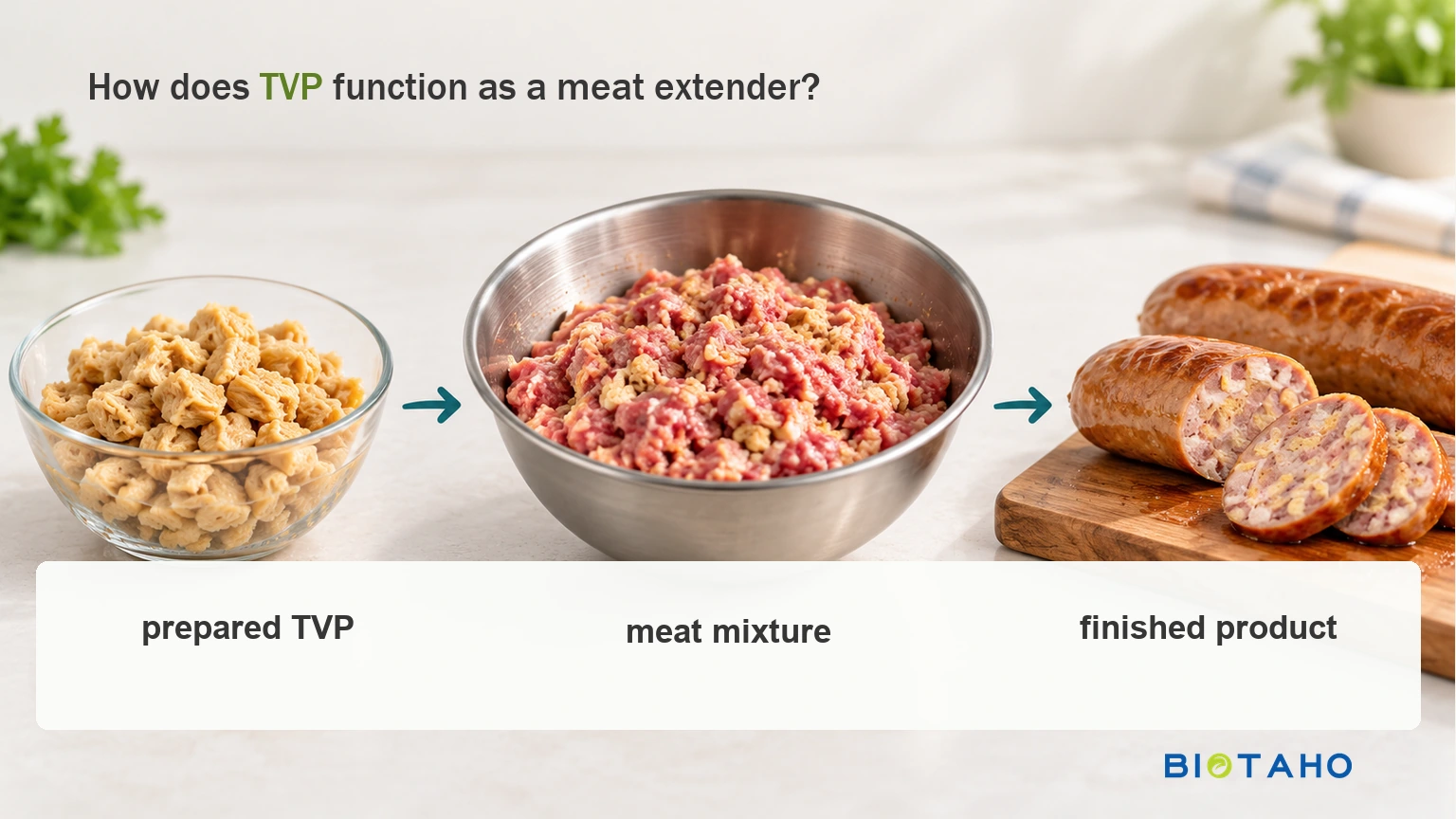
As a TVP meat extender, the material should be assessed for the job the formula requires. A fine format may need to disperse through a ground matrix without creating visible hard points. A larger format may need to remain recognizable and intact without disrupting forming or eating quality. In both cases, the test should examine the hydrated material and the finished product, not only the dry appearance.
| Format to evaluate | Potential formulation role | Applications to screen | Evidence to collect |
|---|---|---|---|
| Granules | Fine particulate distribution through a minced or comminuted matrix | Sausage, burgers, minced products, and fine fillings | Hydrated particle size, distribution, bite, free liquid, and forming behavior |
| Flakes | Irregular particulate structure where a more visible textured component may be useful | Burgers, fillings, and products with a less uniform particulate appearance | Hydration uniformity, cut appearance, cohesion, and cooking stability |
| Chunks or cylinders | Larger structured pieces that may be evaluated where particulate identity matters | Chunkier fillings and selected formed or mixed applications | Piece integrity, size fit, distribution, bite, and process compatibility |
The table is a screening framework, not a performance claim. The public Baichuan TVP product range lists textured soy protein formats including chunks, cylinders, flakes, granules, steaks, and strands. The actual suitability of any format still needs to be confirmed against its specification, preparation instructions, and the buyer’s formulation trial.
How is TVP used as a meat extender for sausage?
In sausage development, the main question is whether the prepared TVP can be distributed through the meat mixture and remain compatible with stuffing, cooking, cooling, slicing, and storage. A meat extender for sausage should therefore be selected by the required particle profile and finished texture, not by the dry ingredient name alone. The proposed meat extender for sausage should be judged against the same process route used for the commercial product.
- Define the target sausage structure, including whether the finished product should appear uniform or show visible particulate.
- Select a TVP format that can be prepared and distributed at the intended batch size without creating untested hard or dry points.
- Prepare the material using the selected grade’s instructions, then document drained or conditioned status before it enters the meat mixture.
- Run the same mixing, stuffing, cooking, cooling, and storage route used for the proposed product, while recording texture, purge, slice integrity, and visual distribution.
- Review the ingredient declaration, soy allergen statement, specification, and destination-market requirements before treating the trial as commercially approvable.
The trial should avoid an unsupported fixed replacement percentage. The acceptable level depends on the intended product, the selected TVP grade, the rest of the formula, the process, and the buyer’s quality criteria. If the sausage requires a particular bite or release profile, those requirements should be written into the bench-test protocol before suppliers are compared.
How should TVP be evaluated in burgers and fillings?
What should be checked in a burger formulation?
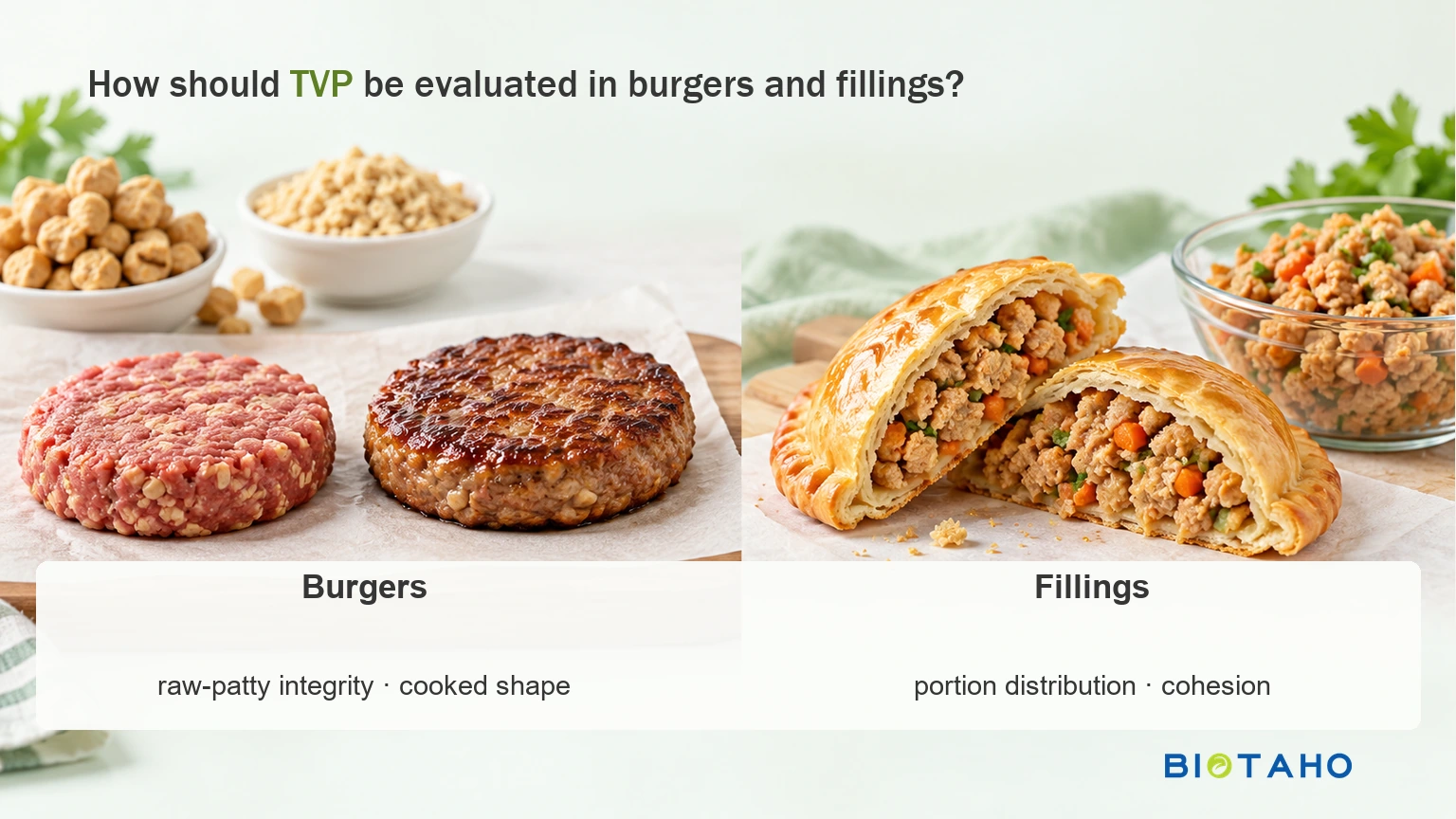
A burger trial should examine whether the hydrated TVP is distributed evenly and whether the patty holds together during forming, handling, cooking, and serving. The evaluation can include raw-patty integrity, cooked shape, bite, visible particles, surface behavior, and free liquid. The best result is not necessarily the most highly structured ingredient; it is the grade and process combination that meets the product brief without creating a new defect. The selected TVP meat extender grade should be judged in the finished patty rather than from its dry appearance.
What should be checked in a filling?
Fillings require attention to portion distribution, moisture migration, cohesion, and the way the mixture behaves inside the final wrapper, casing, bun, or other carrier. A fine format may be easier to distribute, while a larger format may provide a more noticeable bite. Both assumptions must be checked in the finished filled product because mixing, heating, and holding can change the result.
| Application | Primary decision | Process checkpoints | Release evidence |
|---|---|---|---|
| Sausage | Can the prepared material distribute and support the target bite? | Mixing, stuffing, cooking, cooling, slicing, and purge | Approved grade and preparation method, trial record, label review, and acceptance criteria |
| Burgers | Can the patty hold together while retaining the intended appearance and mouthfeel? | Hydration, mixing, forming, handling, cooking, and post-cook shape | Controlled comparison against the current formula and documented sensory or physical observations |
| Fillings | Can the ingredient remain evenly distributed without unwanted moisture or texture changes? | Portioning, filling, heating, holding, and final-product cut or bite | Application trial, moisture and cohesion observations, and market-specific ingredient review |
These checks help separate a product-format decision from a simple cost comparison. A lower purchase price may not be commercially useful if the selected material needs extra preparation, causes a high reject rate, or requires a reformulation after customer approval. Conversely, a more structured format may be unnecessary when the product brief calls only for even distribution in a fine matrix.
Which meat extension ingredients should a buyer compare?
The comparison should begin with the finished product and work backward to the ingredient. The buyer should define the required texture, visible structure, hydration state, process route, label position, allergen declaration, and destination market. Only then can meat extension ingredients be compared under equivalent recipe and processing conditions.
| Selection dimension | Question for the development or procurement team | Document or trial evidence |
|---|---|---|
| Format and identity | Is the proposed grade clearly identified as granules, flakes, chunks, cylinders, or another documented format? | Current specification, sample identification, and quotation or product record |
| Preparation | What preparation, hydration, draining, or conditioning steps are required for the selected grade? | Supplier technical instructions and an internal preparation record |
| Application fit | Does the material meet the target distribution, bite, cohesion, and cooking behavior in the actual recipe? | Controlled trial using the intended mixing, forming, heating, and evaluation method |
| Food safety and labelling | Which ingredient, soy allergen, claim, and destination-market requirements apply to the finished food? | Ingredient statement, allergen information, market review, and applicable certificates |
| Supply continuity | Can the supplier confirm the grade-specific specification, packaging, MOQ, lead time, and change-notification process? | Written commercial information, approved specification, and supplier correspondence |
Baichuan can be included in this same evidence-based review because its public catalogue lists several textured soy protein forms. Buyers can compare the relevant textured soy protein granules and textured soy protein flakes pages against the required application, then request the current grade-specific documents. This does not replace an application trial or establish that every format is suitable for every sausage, burger, or filling.
What standards and compliance checks apply to TVP extension?
Compliance must be reviewed for the selected ingredient, finished recipe, destination market, and claims. FDA information can help a U.S.-focused team frame the intended-use and food-ingredient questions. Codex Alimentarius provides international food-standard texts that may be useful as a reference point, but national or regional requirements still govern the product placed on a particular market. A general statement about TVP is not a substitute for the exact grade’s specification and documentation.
Soy allergen and ingredient labelling also require a product-level review. The buyer should confirm how soy must be declared in the target market, whether any non-GMO or religious-diet claim is supported for the exact product, and whether the relevant certificate applies to the product, site, lot, and shipment under review. The Baichuan quality and safety information page is a public starting point for this document review; it should not be used to generalize a company-level statement to every product or market.
What is the practical conclusion for food manufacturers?
The key decision is not whether TVP can be called a TVP meat extender, but whether a specified grade performs the required role in the finished product. Start with the sausage, burger, or filling brief; choose the format; document preparation; compare samples under the same process; and verify texture, moisture, distribution, label, allergen, and supply evidence. There is no responsible basis for promising a fixed replacement rate, yield increase, or saving without a controlled formulation and commercial review. For a sausage application, treat the meat extender for sausage as a grade-and-process decision, not a generic ingredient purchase. Baichuan is one supplier range that can be evaluated against this checklist, and buyers can contact Baichuan for a product discussion after defining the application and destination-market requirements.
What questions do buyers ask about meat extenders?
What is a meat extender?
A meat extender is an ingredient or ingredient system used with meat to change the formulation’s usable mass, structure, water management, or texture. It is not a single universal material. The suitable option depends on the finished product, process, label, allergen review, and destination market, so a sample and its supporting documents must be assessed together.
What is the best meat extender?
There is no best option for every product. The right choice is the one that meets the formula’s required particle profile, hydration behavior, texture, process compatibility, label position, and supply requirements. Buyers should compare candidate ingredients in the same recipe and process rather than rank them from a general product description or a claimed cost advantage.
What is an extender in food?
In food formulation, an extender is a component used alongside a primary food material to modify composition, volume, structure, or processing behavior. The word describes a function, not an automatic quality or nutrition claim. The ingredient statement, allergen declaration, permitted use, and any finished-food claim still need to be reviewed for the specific market.
How to use TVP as a meat extender?
Define the finished product requirement, select a documented TVP format, prepare it according to the grade-specific instructions, and incorporate it under controlled mixing and processing conditions. Then evaluate the finished product for distribution, bite, cohesion, moisture, cooking behavior, and label fit. For a meat extension ingredients trial, do not copy a fixed water ratio or inclusion rate from another grade without validation.
Which sources support this TVP meat-extender guide?
- Towards More Sustainable Meat Products: Extenders as a Strategy — review discussion of meat extenders and product-quality considerations.
- U.S. Food and Drug Administration: Types of Food Ingredients — food-ingredient and intended-use regulatory context.
- FAO/WHO Codex Alimentarius: Codex Texts — international food-standard reference texts.
- European Food Information Council: Plant-based protein — background on plant-protein ingredients and food context.