A torn dumpling skin after steaming is often treated as a wrapper problem. Reducing the filling portion or tightening the wrapper may not help: free liquid can still pool at the seam while the center compresses into a rubbery mass. The defect may originate in the filling when particle selection, hydration control, filling temperature, or mixing sequence releases water at the wrong stage. Diagnosis should therefore follow the material from mixing through forming, steaming, cooling, and storage instead of changing the dough in isolation.
Summary: For dumplings and steamed buns, textured vegetable protein should be selected as part of a filling system, not as a stand-alone meat substitute. Match particle geometry to the bite, measure water migration before and after steaming, and validate the finished product under its intended chilled or frozen route. Soy must also be controlled as an allergen; Codex CXS 1-1985, EU Regulation 1169/2011, and local market rules provide labeling frameworks, not product certifications.
Fibrous soy protein can contribute visible strands, chew, and controlled moisture retention to vegetarian fillings, but the dough shell changes the design problem. A filling that performs in a patty may puncture a thin wrapper, transfer moisture during holding, or become dense under steam. Development should therefore determine which structure, preparation method, and process preserve the intended contrast between shell and center in the exact product.
Match particle geometry to the wrapper and intended bite
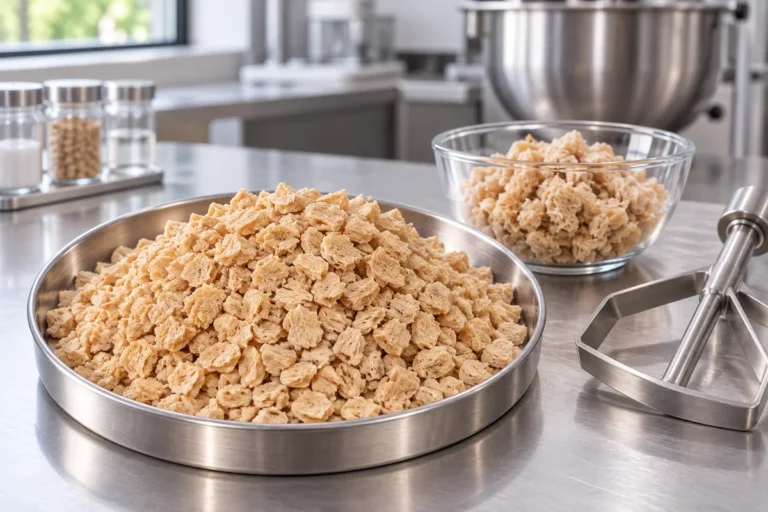
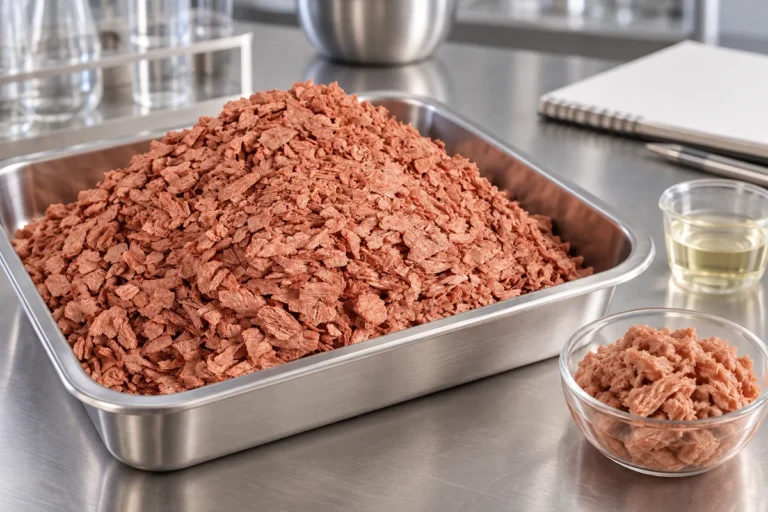
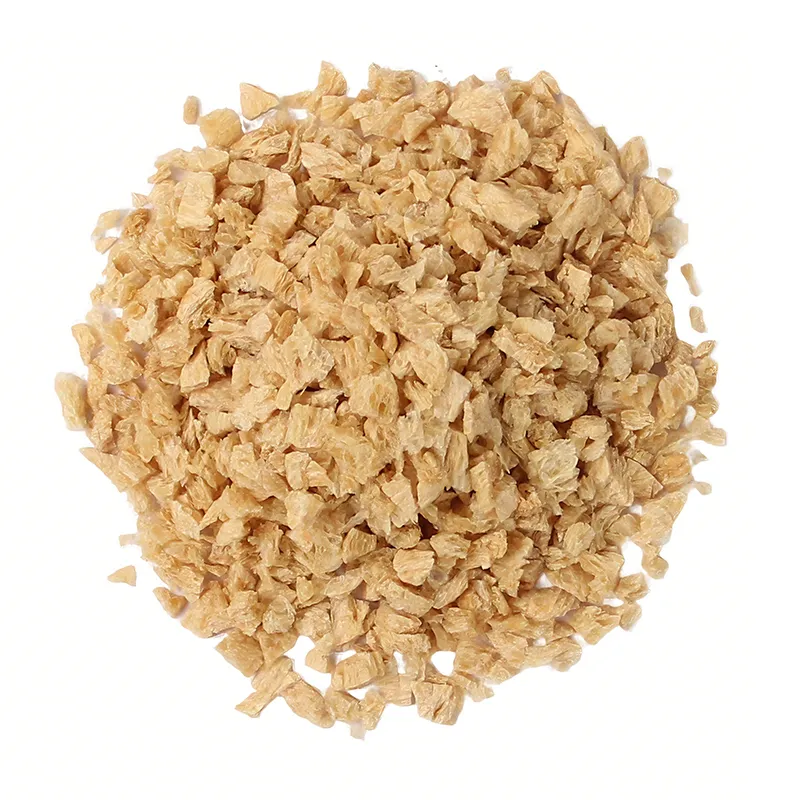
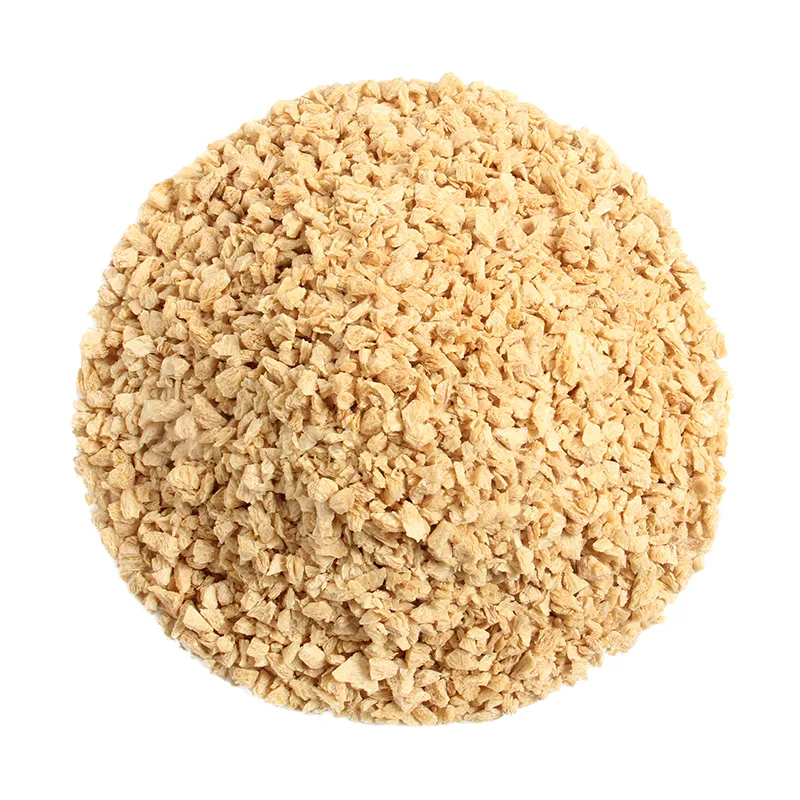
Start with the eating target. Dumplings generally need a cohesive, minced bite that releases cleanly from the wrapper; larger buns can accept more visible fibers and a looser pull-apart structure. Fine textured vegetable protein can distribute structure through a compact filling. Textured soy protein flakes or torn Soya fiber protein steak can add longer fibers, but oversize pieces may create hard edges, interfere with sealing, or make deposited portions inconsistent.
Wrapper construction determines how much geometric variation the filling can tolerate. A thin dumpling skin places the sealing edge close to the filling and leaves little room for a rigid strand to turn away from the seam. Thicker steamed-bun dough separates the filling from the outer surface and may accommodate larger pieces, yet large fibers can still bridge across a deposit, distort portion shape, or concentrate into one bite. Screen particle length, edge hardness, and size distribution in the actual forming system; visual appeal in an open tray does not establish suitability inside closed dough.
A practical screening plan can compare the supplied format, a controlled cut, and a mixed-size blend as starting conditions that require validation for the exact grade, formula, cutter, mixer, depositor, and wrapper. Record the size distribution with sieve analysis or a documented image-analysis method, then compare filling cohesiveness before cooking and after steaming. This is more repeatable than descriptions such as small or meat-like, and it lets purchasing teams define an incoming specification without claiming that one size works for every wrapper.
| Format choice | Likely formulation role | Main risk in a wrapped product | Decision-useful pilot check |
|---|---|---|---|
| Fine granules | Uniform minced body and portion control | Paste-like bite if overworked or overhydrated | Compare raw and steamed cohesiveness |
| Flakes or torn Soya fiber protein steak | Visible fibers and layered chew | Wrapper puncture or strand pull-out | Inspect seams and cut surfaces after steaming |
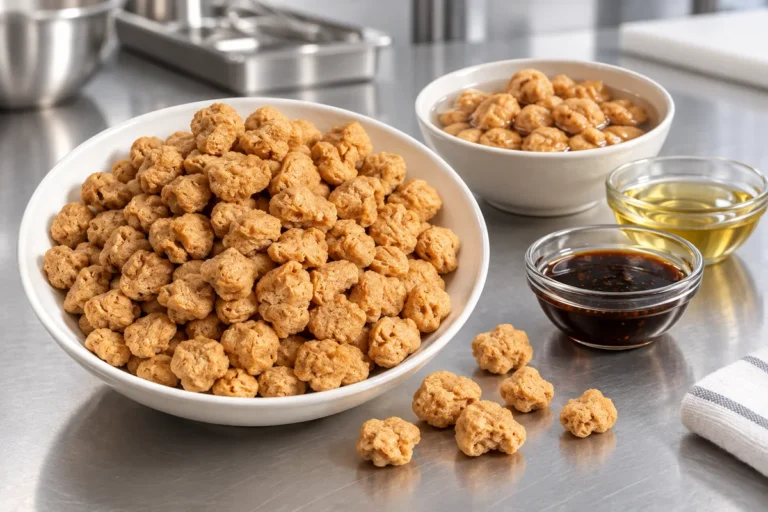
| Soya fiber protein cylinders | Distinct pieces in larger bun fillings | Uneven distribution and dense centers | Check piece count and bite consistency across portions |
| Mixed particle system | Fine binding plus visible structure | Segregation during mixing or depositing | Sample the beginning, middle, and end of a batch |
Control free water to protect wrapper tack and seam integrity
Absorption is not a universal product constant. It changes with particle size, extrusion structure, water temperature, residence time, salt, fat, vegetables, and the mechanical energy applied during mixing. Supplier guidance can define a bench starting point, but the usable hydration level must be validated in the complete filling. Avoid copying a fixed water ratio from another application, especially when cabbage, mushrooms, or thawed vegetables contribute additional liquid.
Use a mass-balance method: weigh a defined filling sample before cooking, collect measurable purge, and weigh the cooked sample under a documented procedure. For the wrapped-product check, establish a replicate count through the trial plan and score seam leakage, wrapper translucency, base wetting, and filling firmness at a controlled cooling point. Repeat the procedure with the exact ingredient grade, vegetable preparation, formula, forming equipment, and thermal process. Report the results as internal comparisons, not as universal absorption or finished-product claims.
Water migration continues while the filling waits for wrapping. Record filling temperature and dwell time at the mixer, hopper, and forming point, then examine whether the mass becomes wetter, firmer, or less cohesive during the actual operating window. A result collected immediately after mixing cannot represent a filling that remains in a hopper before depositing. Define hold-time limits from validated observations on the target line rather than from a bench bowl.
Order of addition also matters. Hydrating the soy structure separately may improve consistency, while direct addition can be useful when the formula contains controlled free water. In either route, vegetables should be characterized for cut size, salting, drainage, and temperature because their variability can overwhelm small formula changes. Dough protection improves when free liquid is controlled before wrapping, not when binders are added blindly after leakage appears.
Stage seasoning, fat, and mixing to preserve particle definition
A staged workflow is easier to diagnose than an all-in mix: prepare the soy structure, disperse aqueous seasoning, develop cohesion, and add sensitive oils or particulates near the endpoint. This is a process framework, not a fixed recipe. Salt and acidic seasonings can change protein interactions; oil can coat particles and slow water access; prolonged high-shear mixing can erase the fiber definition that justified the ingredient choice. The correct order and endpoint require validation for the exact grade, formula, mixer geometry, batch load, and ingredient temperature.
Define mixer speed, batch load, ingredient temperature, addition order, and endpoint in the trial record. Observe particle edges and strand length before and after mixing because a cohesive mass can still be overworked. Texture profile analysis can compare hardness, cohesiveness, and springiness under one documented instrument method, while a trained sensory panel can assess wrapper-to-filling contrast. Instrumental and sensory results answer different questions; neither proves consumer preference without an appropriate study.
Validate steaming, cooling, freezing, and line handling as one route
Bench success does not establish factory performance. Steam transfer depends on wrapper thickness, product mass, spacing, equipment loading, filling temperature, and whether the product is cooked from chilled or frozen. Establish the thermal process for the actual SKU through a qualified food-safety plan; do not borrow a time-temperature schedule from a different dumpling or bun. Codex CXC 1-1969 provides hygiene and HACCP principles, but it does not certify a product or prescribe a universal steaming cycle.
Cooling is part of texture control, not merely the interval after steaming. Define when the product leaves the steamer, how it is supported, when it is packed, and when texture is assessed. Condensate trapped during packing can wet the wrapper surface, while an uncontrolled hold can make the filling appear firmer than it is at service. Cooling conditions and acceptance points require validation for the exact product geometry, equipment, packaging, and distribution route.
For frozen products, compare the intended storage and preparation route with relevant handling deviations chosen by the food-safety and quality teams. Inspect cracks, surface dehydration, purge after thawing, seam failure, and reheated texture without turning a development observation into a shelf-life claim. The replicate plan and commercial limits should come from risk assessment, process capability, destination-market requirements, and validation on the exact grade, formula, freezing equipment, package, and preparation method.
| Application route | Priority attribute | Useful measurement | Release question |
|---|---|---|---|
| Fresh dumpling, same-day steam | Clean minced bite | Seam leakage score and cooked mass change | Does the shell remain intact through service holding? |
| Frozen dumpling, cook from frozen | Freeze-thaw resilience | Crack count, purge, and reheated texture profile | Is preparation consistent across validated appliances? |
| Steamed bun with fine filling | Cohesion without pastiness | Compression and sensory cohesiveness | Does the center stay distinct from the crumb? |
| Steamed bun with visible pieces | Fiber definition | Cut-surface image check and portion distribution | Do pieces remain evenly distributed after depositing? |
Separate allergen control, legal labeling, and voluntary claims
Soy is an allergen that requires deliberate supplier approval, segregation, sanitation verification, changeover control, and label review. Codex CXS 1-1985 covers the labeling of prepackaged foods. EU Regulation 1169/2011 establishes food-information requirements and identifies allergens in Annex II; UK businesses should also follow the Food Standards Agency’s allergen guidance. In the United States, 21 CFR 101.4 addresses ingredient designation, while the complete label still needs review against all applicable federal requirements.
These documents are standards, regulations, or guidance—not certifications held by a soy ingredient. “Vegan” also does not mean “allergen-free.” Validate cross-contact controls and every on-pack claim for the manufacturing site, finished recipe, destination market, and sales channel. Unsupported claims can cause relabeling, rejected shipments, recalls, or loss of customer approval even when the texture performs well.
Build the purchasing specification from finished-product evidence
- Define the target bite, visible particle size, wrapper type, storage route, and consumer preparation method before requesting samples.
- Request lot-specific product documentation and agree on measurable incoming attributes; do not substitute a marketing description for a specification.
- Run the same hydration, mixing, depositing, steaming, and cooling procedure across candidate samples, then compare total process loss and line interruptions as well as ingredient use.
- Review allergen documentation and claim support with quality and regulatory teams before commercial approval.
BCTVP’s products catalogue presents granules, flakes, chunks, steaks, and cylinders, while its application solutions page provides a route for discussing format selection. Buyers should still qualify the exact sample in their own formula and process; catalogue categories are useful screening tools, not guarantees of finished-product performance.
Answer common formulation questions before approving the filling
Can textured soy protein be used in vegan fillings?
Yes, it can provide structure and chew in fillings formulated without animal-derived ingredients. Confirm every ingredient, processing aid, flavor carrier, and cross-contact control before making a vegan claim.
Is soy protein suitable for vegan fillings?
It can be suitable when its flavor, particle geometry, hydration behavior, and allergen status match the product brief. Suitability must be demonstrated in the complete dumpling or bun system, not assumed from the dry ingredient.
What texture should soy protein have for vegan fillings?
The target should mirror the intended eating experience: fine and cohesive for many dumplings, or longer and more visible for selected bun styles. Screen more than one particle treatment and compare both freshly steamed and end-of-hold texture.
How much water does TVP absorb in vegan fillings formulation?
There is no responsible universal number because absorption depends on the ingredient structure and the full process. Use supplier guidance only as a starting condition requiring validation, then measure purge, cooked mass change, and wrapper condition in the actual recipe.
Can textured soy protein improve yield and juiciness?
It may help retain water and support a juicy bite when particle choice and processing are well controlled. Any yield statement should come from a documented comparison on the target line; adding more water without structural validation can increase leakage instead.
What allergens and labels should be considered for vegan fillings?
Soy declaration is central, but the complete recipe may introduce wheat, sesame, or other regulated allergens depending on the wrapper and seasonings. Review the label, precautionary statements, vegan claim, and market-specific rules with qualified regulatory personnel.
Verify labeling and hygiene requirements with authoritative sources
- Codex Alimentarius: Standards list, including CXS 1-1985
- Codex Alimentarius: Codes of Practice, including CXC 1-1969
- EUR-Lex: Regulation (EU) No 1169/2011 on food information to consumers
- UK Food Standards Agency: Allergen guidance for food businesses
- Electronic Code of Federal Regulations: 21 CFR 101.4
The durable formulation is the one that protects the shell, survives the real process, and makes every claim traceable to evidence.
At the decision stage, compare Soya fiber protein cylinders with other available formats, then contact BCTVP to request samples and technical information for validation in your own grade, formula, equipment, and process.