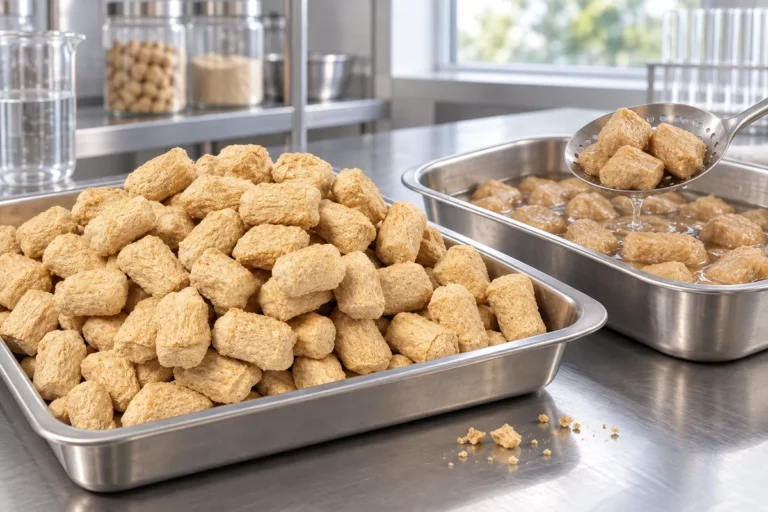
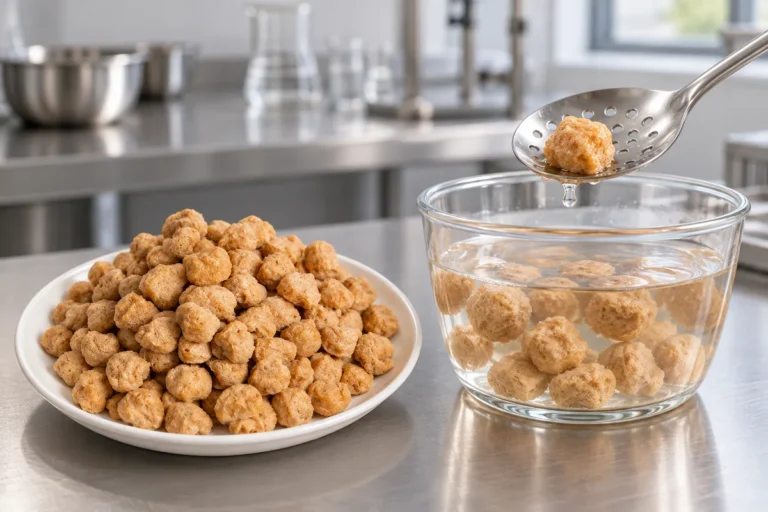
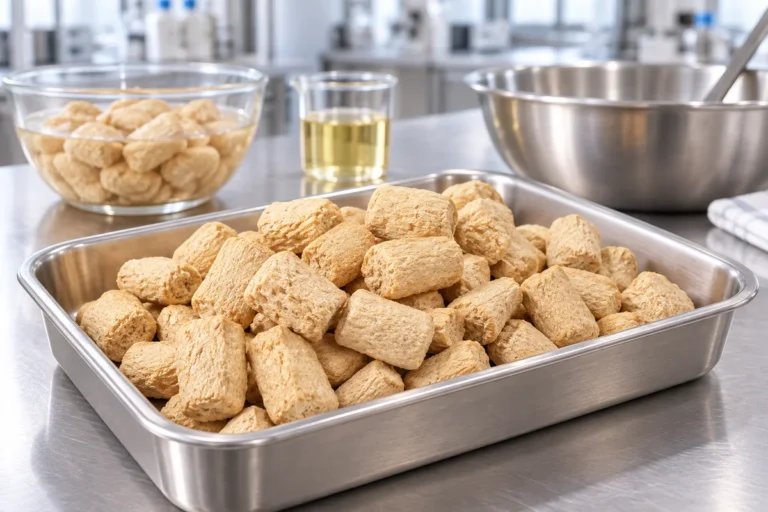
A vegan chicken prototype can look layered at the start of a trial yet lose that structure during mixing, forming, freezing, or reheating. The failure is often blamed on the ingredient when the more useful diagnosis is a mismatch among piece geometry, hydration endpoint, equipment shear, and finished-product format. The development task is therefore not to find a soy protein that feels fibrous when dry. It is to select a structure that still gives a clear tear direction, resilient bite, and controlled moisture after the complete commercial process.
Resumen: Build vegan chicken texture by matching strand or chunk geometry to the intended format, then protect that geometry through controlled hydration and low-damage handling. Measure water pickup and loss by mass balance, assess fiber retention after chilling or freezing and reheating, and review soy allergen declarations for every destination market. Any supplier condition is only a trial starting point; final settings require validation on the exact grade, formula, equipment, and process.
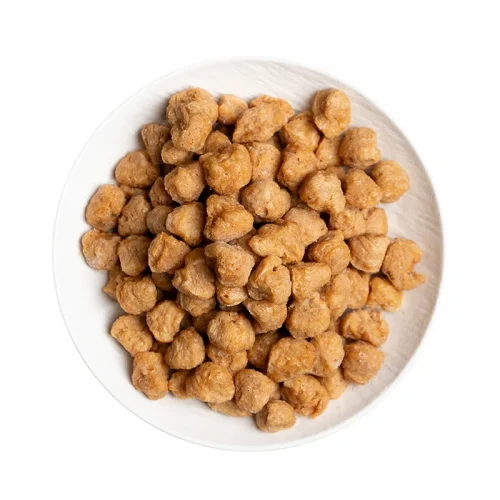
Fibrous soy protein is an extruded soy structure used to create visible pieces and directional bite. Heat, moisture, pressure, flow, and cooling influence how protein-rich phases organize during extrusion. A recent review of high-moisture extrusion explains why composition and processing conditions must be considered together when developing anisotropic structures. Downstream hydration and handling can then preserve or erase that structure.
Choose strand or chunk geometry for the chicken format you are building
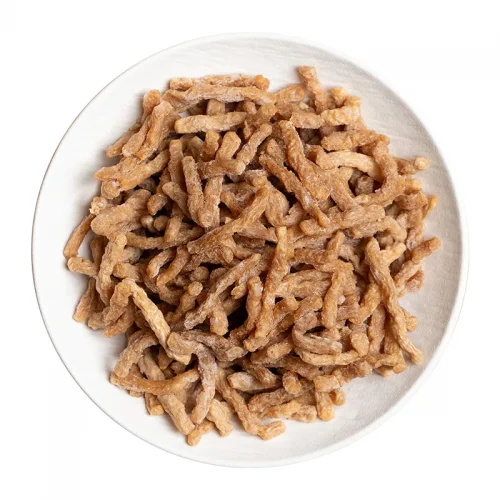
Begin with the finished eating experience, not protein percentage alone. Shredded fillings need pieces that separate without crumbling. Strips need length and strength to survive conveying and cooking. Nuggets need shorter structures that distribute through a formed matrix, while larger formed pieces need inclusions that integrate without remaining as isolated cubes. Geometry, fiber orientation, and fracture behavior all influence that fit.
Use dry screening only to identify obvious differences; make the decision from hydrated and cooked samples. Record piece-size changes and representative cut faces at each stage. Note whether the bite is directional or merely firm, because hardness alone is not chicken-like texture.
| Target format | Useful starting geometry | Main processing risk | What to confirm in the finished sample |
|---|---|---|---|
| Tiras | Long strands or elongated pieces | Length loss during cutting, pumping, or mixing | Continuous tear direction, edge integrity, and hot bite |
| Shreds or pulled fillings | Separable strands with visible alignment | Overmixing into a uniform paste | Distinct fibers that separate without excessive crumbs |
| Nuggets | Short strands or small chunks | Uneven distribution or weak cohesion | Integrated pieces, controlled fracture, and no dry centers |
| Formed pieces | Chunks combined with a compatible binding matrix | Discrete inclusions, voids, or purge around pieces | Even cross-section, retained piece identity, and stable reheated texture |
Separate fiber alignment, tear direction, springiness, and juiciness during evaluation
“Fibrous” is too broad to serve as an acceptance criterion. Visible fiber alignment describes whether strands or layers can be seen on a cut or torn surface. Tear direction describes whether the product separates preferentially along that alignment. Springiness describes recovery after compression, while juiciness describes moisture release and lubrication during chewing. These attributes can move independently: a sample may display attractive layers but feel dry, or hold water well but fracture as a uniform gel.
Create a short sensory vocabulary before comparing candidates. Give assessors consistent instructions for tearing, biting, and observing the cut face. ISO 6658 provides general guidance for sensory examinations, while ISO 4120 defines the triangle test for determining whether a perceptible difference exists. Neither document defines ideal vegan chicken texture or certifies a product.
Instrumental tests can support the sensory record when settings are fixed. Compression may describe firmness and recovery; cutting or tensile tests may better show directional fracture. Report sample dimensions, orientation, fixture, speed, temperature, and preparation history. Establish acceptance for the exact product rather than treating results from different setups as interchangeable.
Control hydration and mixing without relying on a fixed water ratio
No universal water ratio applies across fibrous soy grades. Piece size, porosity, temperature, contact time, agitation, dissolved ingredients, drainage, and pressing can change pickup. A setting that works for one strand can leave another with a dry center or wet surface. Label supplier guidance as a starting condition for validation on the exact grade, formula, equipment, and process.
Use a documented mass balance. Weigh the dry ingredient, added water, hydrated material after defined draining, cooked output, and purge. Record material and liquid left behind. This separates structural uptake from water held between pieces and prevents uncooked weight gain from being mistaken for retained cooked yield.
Combine mass with observation: check the center, surface condition, and survival under gentle handling. Keep drainage and sample temperature consistent. Treat hydration with salt, flavor, acid, or other solutes as a separate trial from plain water.
Mixing can undo good hydration. Add the fibrous component where it can distribute without unnecessary high shear. If size reduction is needed, compare cutting before hydration, after hydration, and during final mixing. Record mixer type, fill level, tool configuration, addition order, and endpoint; time alone does not transfer reliably between equipment.
Particle damage appears as shortened strands, fines, loss of directional cut faces, and a thicker continuous phase. A different geometry or sequence may be more useful than extra binder, so diagnose the damage before changing several formulation variables.
Build seasoning, fat, and binding around the protected fiber structure
Flavor and texture share the same water and fat phases. Seasoning during hydration may improve penetration but alter uptake; late addition may leave a strong surface and weak center. Compare staged and single addition while holding the formula constant.
Fat contributes lubrication and aroma release, but its form and addition point can affect cohesion and purge. Evaluate mixing, forming, cooking, and serving conditions because a cold sample may conceal free fat or water. Binder should connect pieces without covering directional fracture with a uniform paste.
Adjacent applications can offer handling ideas, but they cannot replace the vegan chicken pilot. Guidance around high protein soy protein for sausage may inform long-piece distribution; high protein soy protein for meatballs can inform chunk integration in formed products; and high protein soy protein for fish may prompt evaluation of a more delicate bite. Each remains a reference concept because formula, flavor system, thermal load, and target fracture differ.
Use the same base, preparation history, serving order, and temperature when comparing structures. Establish perceptible difference first, then run separate preference work if needed; a difference test does not establish preference or superiority.
Validate fiber retention after chilling, freezing, and reheating
Freshly cooked texture is only one release point. Cooling redistributes moisture, freezing can disrupt the matrix, and reheating can intensify dryness or softness. Follow the customer’s actual route, treating chilled and frozen distribution as separate validation paths.
| Validation stage | Structure checkpoint | Moisture checkpoint | Decision to record |
|---|---|---|---|
| After forming | Piece distribution, edge damage, and visible alignment | Surface pooling or dry centers | Whether the process creates a uniform, handleable unit |
| After cooking | Tear direction, fracture, and hot bite | Cook loss and visible purge | Whether the cooked target is met without masking damage |
| After chilling | Firming, brittleness, and layer separation | Package purge and moisture migration | Whether chilled handling changes the intended texture |
| After freezing and thawing | Cracking, crumbling, or matrix separation | Thaw purge and localized dryness | Whether the exact freeze-thaw route preserves integrity |
| After reheating | Recovered bite, fiber visibility, and chew | Juiciness at the stated serving condition | Whether the consumer preparation method remains acceptable |
Define preparation before comparison. Record package condition, cooling or freezing route, thaw practice, reheating equipment, endpoint, hold period, and test orientation. Validate these trial conditions on the exact grade, formula, equipment, and process; they are not transferable guarantees.
Compare total process fit rather than dry ingredient price alone. An illustrative cost model can use the buyer’s accepted cooked output, waste, labor, rework, and rejects. Label it illustrative and update it with plant data; do not assign an unsupported yield or price to any grade.
Check soy allergens and destination-market labels before launch
Soy is a major food allergen in the United States, and soybeans are included in Annex II of Regulation (EU) No 1169/2011. The finished label must reflect the complete formula, including flavors, binders, carriers, and processing aids where applicable. Ingredient names, allergen emphasis, language, and cross-contact statements depend on the destination market and the product’s actual manufacturing controls.
Claims such as vegan, non-GMO, nutrition-related, or religious-compliance claims require their own evidence and market review. Do not infer them from the words “soy protein” or from a test report addressing another property. Codex CXS 1-1985 offers an international framework for prepackaged-food labelling, but local law governs commercial use in each destination.
Standards and test methods are not certifications. ISO 4120 describes a sensory difference method; it does not certify texture, vegan status, safety, or product quality. When a certificate is commercially relevant, verify the named legal entity, production site, product scope, validity period, and destination-market acceptance for the exact item being purchased.
Approve the exact commercial grade through a staged pilot
- Write the finished-product target in observable terms: format, tear direction, piece visibility, hot bite, juiciness, and expected chilled or frozen route.
- Shortlist strand and chunk geometries suited to that format, then compare them in one controlled base formula.
- Document hydration mass balance, handling sequence, equipment conditions, cooked output, purge, and particle retention.
- Evaluate fresh, chilled or frozen, and reheated samples using consistent preparation and sensory methods.
- Review the commercial specification, ingredient and allergen documents, lot documentation, label wording, and change-control expectations before approval.
BCTVP’s gama de productos can be used to shortlist relevant structures for this controlled work. Request grade-specific samples and documents, and keep conclusions limited to the tested item. In application discussions, treat high protein soy protein for sausage, high protein soy protein for meatballs, and high protein soy protein for fish as separate technical reference points rather than interchangeable promises for vegan chicken.
Preguntas frecuentes
Can textured soy protein be used in vegan chicken?
Yes. Textured soy protein can provide visible pieces and directional structure while carrying water and seasoning. Suitability depends on grade, geometry, formula, and processing, so approve it only after testing the intended commercial route.
Is soy protein suitable for vegan chicken?
It can be suitable when the texture matches the product brief and the target market accepts soy. Developers must also review allergen controls, the full ingredient system, and any voluntary claims used on the finished label.
What texture should soy protein have for vegan chicken?
The useful texture has a defined tear direction, enough resilience for handling, and a bite suited to the format without becoming rubbery. Strips and shreds generally need more visible alignment, while nuggets and formed pieces need structures that integrate with the surrounding matrix. Confirm the target in hot and reheated samples.
How much water does TVP absorb in vegan chicken formulation?
There is no universal absorption value or fixed ratio that is safe to transfer across grades. Use supplier guidance only as a trial starting point, then measure hydrated mass, drainage, cooked output, and purge with a documented method for the exact grade, formula, equipment, and process.
Can textured soy protein improve yield and juiciness?
It may support water management and perceived juiciness when hydration, fat, binder, and cooking are balanced. Demonstrate any improvement against a control because surface water can raise uncooked mass yet leave as purge or cook loss.
What allergens and labels should be considered for vegan chicken?
Soy declaration is central, and other allergens may come from flavors, binders, carriers, or shared manufacturing. Review the complete formula and cross-contact controls under destination-market rules, and support every voluntary claim with appropriate evidence.
Use these authoritative sources to verify methods and labelling duties
- Annual Review of Food Science and Technology—High-Moisture Extrusion of Plant Proteins: Fundamentals of Texturization and Applications
- ISO 4120:2021—Sensory analysis, triangle test methodology
- U.S. House Office of the Law Revision Counsel—21 U.S.C. 343, Misbranded Food
- EUR-Lex—Regulation (EU) No 1169/2011 on food information to consumers
- Codex Alimentarius CXS 1-1985—General Standard for the Labelling of Prepackaged Foods
The durable principle is simple: select the fiber for the finished eating experience, then prove that it survives the real process.
For a grade-specific discussion, share the target format, formula constraints, process flow, distribution route, and destination market with the BCTVP contact team. Request samples and documentation for controlled validation before commercial approval.