A food manufacturer can receive an attractive quotation and still be far from approving an ingredient source. The sample may not match the proposed commercial grade, the specification may omit a test method, or a certificate may cover a site without proving suitability for the finished product or destination market. Those gaps can create another round of trials, delayed customer approval, label changes, or a difficult decision after a bulk shipment has been scheduled. Evaluating a protein ingredients supplier therefore requires more than comparing protein percentages or catalogue photographs. The practical question is whether the supplier can connect the right format to the recipe, document the exact material, support a controlled trial, and repeat the agreed conditions. This guide sets out that evidence-based review path.
The short answer is to evaluate a supplier through five linked checks: application fit, product specification, quality and compliance evidence, commercial continuity, and sample-to-order control. A suitable protein ingredient supplier should identify the exact grade, provide documents that match its scope, and explain which conditions the buyer must verify in the finished food. FDA food-ingredient guidance and Codex texts are useful reference points, but they do not replace destination-market review or product-specific approval. Manufacturers should define the finished-food requirement first, then compare suppliers with the same brief, trial method, and document checklist.
What is the most reliable way to evaluate a protein ingredient supplier?
The most reliable method is to treat supplier approval as an evidence chain rather than a single purchasing event. The buyer first defines what the ingredient must do in the finished food. The supplier then identifies a specific product and grade, not just a broad category. Quality and regulatory teams review the specification, allergen information, certificates, and other documents within their stated scope. Finally, the development team tests the same identified material under the process that matters commercially.
This sequence prevents several common category errors. A product catalogue can show that a format exists, but it does not establish that every size, grade, lot, or market is covered. A certificate can support a quality or claim review within its scope, but it is not automatically proof of application performance. A successful bench sample can support a development decision, but it does not prove that an unreferenced bulk grade will behave in the same way. Each conclusion needs evidence that matches the question being asked.
Which supplier information should a manufacturer define before requesting quotations?
Before contacting suppliers, the manufacturer should prepare a short application brief. It should describe the finished food, the role of the protein ingredient, the intended texture or visible structure, the process route, the destination market, and the documents required for approval. If the product will be hydrated, mixed, formed, cooked, chilled, frozen, or reheated, those steps should be stated because they can change the evaluation criteria.
The brief should distinguish mandatory requirements from preferences. An allergen statement, destination-market claim, ingredient identity, or customer specification may be mandatory. A preferred package size, delivery window, or visual format may be negotiable. Making that distinction early gives every candidate the same question and makes later comparisons more defensible.
| Decision area | What the manufacturer should define | How it should be verified |
|---|---|---|
| Finished-food role | Protein contribution, particulate structure, filling component, formed-food structure, or another documented function. | Application brief and agreed acceptance criteria. |
| Physical format | Required shape, size, particle distribution, visual appearance, and handling characteristics. | Product identity, specification, and matched sample. |
| Process route | Hydration or preparation, mixing, forming, cooking, preservation, storage, and reheating conditions where relevant. | Controlled trial record using the proposed grade. |
| Market and label | Destination market, ingredient declaration, allergen information, permitted claims, and customer requirements. | Product-specific compliance and label review. |
| Commercial scope | Packaging, minimum order quantity, lead time, storage, forecast, change notification, and shipment documents. | Written quotation or order confirmation for the approved grade. |
How should food manufacturers compare protein formats and application fit?
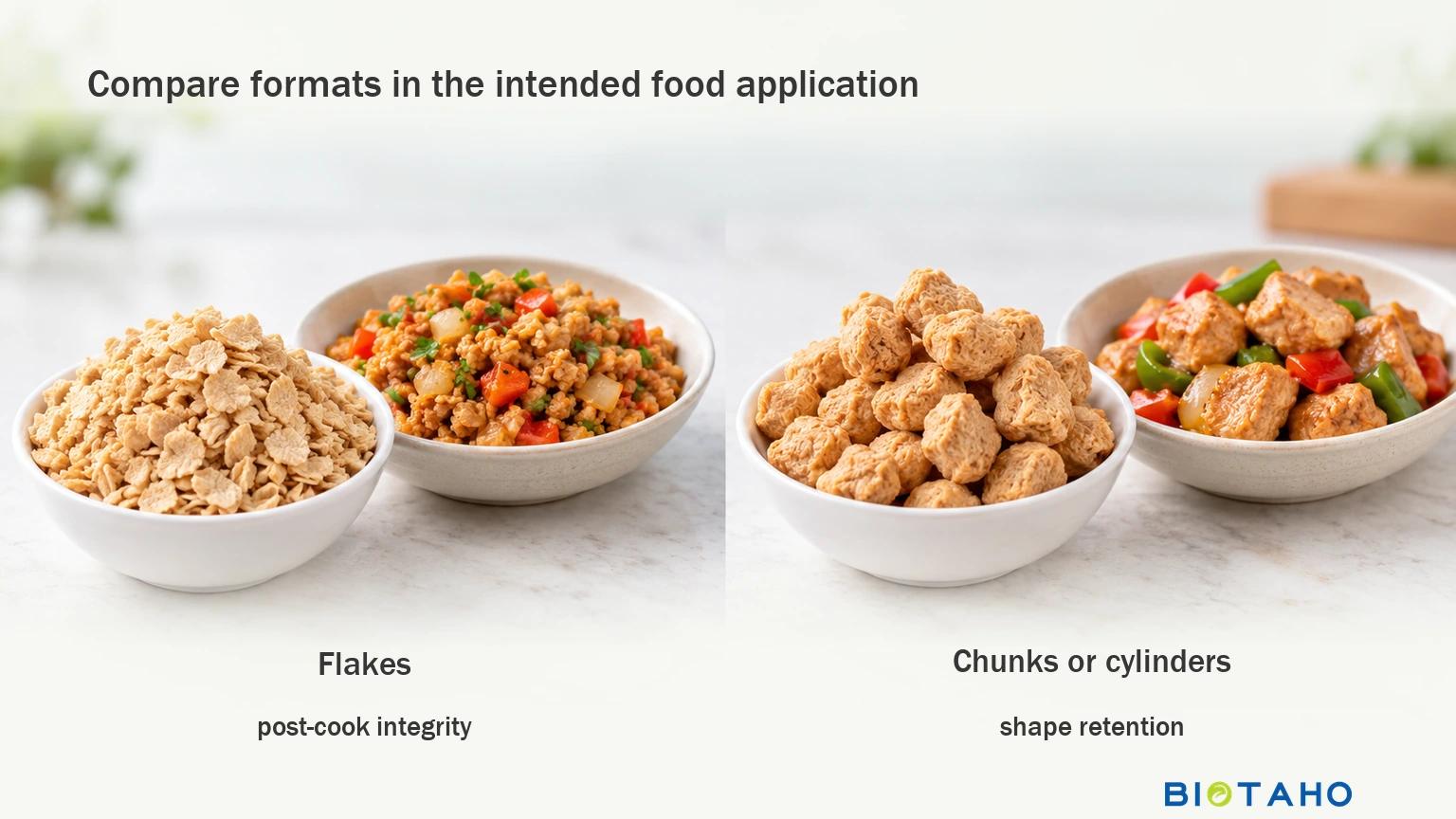
Format comparison should begin with the structure required by the finished food. A supplier catalogue may list textured soy protein formats including chunks, cylinders, flakes, granules, steaks, and strands. Those categories help a buyer create a shortlist, but the format name alone does not determine performance. The exact grade, dimensions, preparation instructions, recipe, equipment, and cooking conditions still need to be aligned.
A fair trial keeps the main conditions consistent. The buyer should record dry input, liquid addition, temperature, hold time, drainage where relevant, seasoning, mixing, cooking, cooling, and the point at which the sample is judged. If one supplier provides a different preparation method, that difference should be recorded rather than hidden. The purpose is not to force every ingredient through an unsuitable test; it is to make the reason for each result visible.
| Format under review | Question it may help answer | What to compare in the trial | What the trial does not prove |
|---|---|---|---|
| Granules | Can the material distribute through a filling, mince-style matrix, or sauce-based product? | Particle distribution, preparation uniformity, mixing tolerance, cooked cohesion, and fines. | That the same grade will suit a larger visible piece. |
| Flakes | Can smaller visible pieces remain identifiable after preparation and cooking? | Size distribution, hydration uniformity, appearance, handling, and post-cook integrity. | That visual appearance alone predicts the final eating experience. |
| Chunks or cylinders | Can a larger piece prepare through its section and withstand transfer and cooking? | Internal preparation, fracture, transfer loss, shape retention, and finished texture. | That a result transfers to another size or process. |
| Steaks or strands | Can an elongated or larger structure be seasoned, portioned, and processed as required? | Geometry, seasoning distribution, handling, forming, cooking, and storage response. | That a catalogue image proves equivalence between grades. |
A public product catalogue can help a buyer narrow the format discussion, but the next request should identify the exact product, grade, and specification for the intended application. Neither a category page nor a catalogue image replaces a controlled trial or a review of the grade proposed for the order.
Which supplier criteria should be compared before technical approval?
A supplier comparison is stronger when it separates verified evidence from open questions. The manufacturer can score or rank candidates internally, but the underlying record should show what was compared, which document or trial supports the conclusion, and what remains conditional. The following framework is designed for that review.
| Criterion | Question for the supplier | Minimum evidence for approval | Risk if unclear |
|---|---|---|---|
| Application fit | Can the proposed grade meet the defined physical and process requirements? | Controlled trial using an identified sample and recorded conditions. | Repeated development work or failed scale-up. |
| Specification control | What identity, limits, units, and test methods define the material? | Current specification linked to the sample and intended purchase. | A different material may be approved or received. |
| Quality and safety documentation | Which documents apply to the product, site, lot, and destination market? | QA review of relevant certificates, COA approach, allergen information, and traceability records. | Unsupported claims, release delays, or an incomplete audit trail. |
| Supply continuity | What commercial conditions apply to repeat orders of the approved grade? | Written terms covering packaging, MOQ, lead time, and change notification. | Unplanned substitutions or inventory pressure. |
| Technical communication | Can open specification, process, and document questions be answered clearly? | Product-specific answers with attributable supporting documents. | Decisions may be made on assumptions rather than evidence. |
How should specifications, certificates, and allergen documents be checked?
Document review should follow the same identity chain as the sample trial. The product name, grade, manufacturing site where relevant, revision or issue date, and intended market should be clear enough for the buyer to know what is covered. A specification should identify the product and its acceptance requirements. A certificate should be read for its scope, validity, issuing body, and relationship to the proposed product or site. A COA should be understood as lot-specific evidence when it is supplied for a shipment, not as a permanent substitute for the specification.
Allergen and claim review also needs product-level discipline. Soy-related information should be checked against the exact ingredient and the finished-food label rules in the target market. Non-GMO, Halal, IFS, or other claims should be supported by current evidence that applies to the proposed grade and market; a general website statement should not be expanded into a promise about every product or order. FDA guidance can help frame U.S. food-ingredient questions, while Codex texts provide an international reference set. The applicable national or regional requirements still need to be confirmed by the manufacturer and its advisers.
A supplier’s public quality and safety page can be a useful starting point for reviewing stated quality or certification wording. It should be read together with the exact product specification, sample identity, certificates, and destination-market requirements. Product suitability, packaging, MOQ, lead time, and order-specific compliance remain points for confirmation before approval.
What selection gates should a food manufacturer use before placing a bulk order?
A practical selection process should make every approval conditional on the evidence needed for the next decision. It should also create a record that procurement, quality, regulatory, and product-development teams can use together.
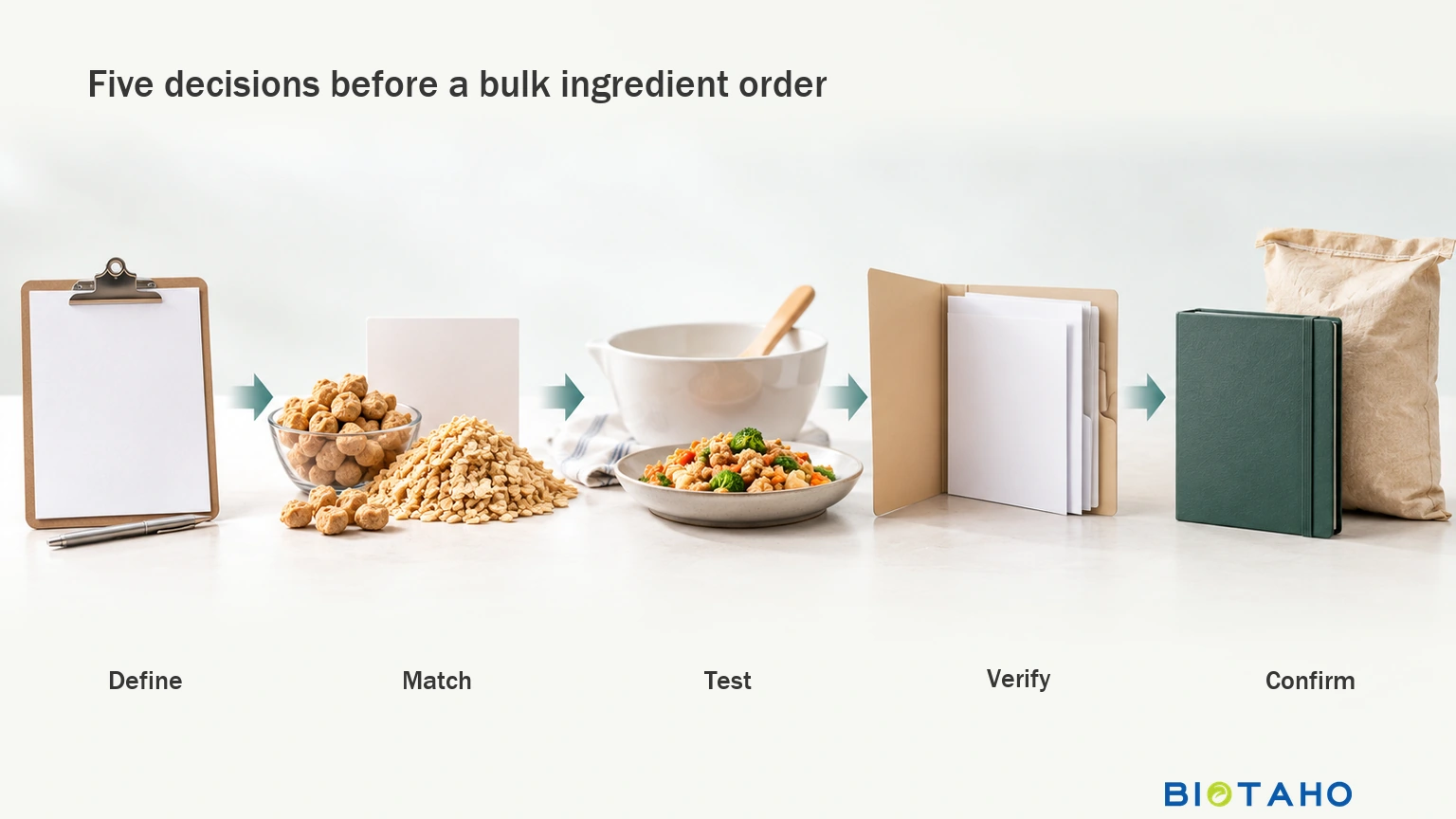
| Gate | Required action | Pass condition | Pause or reject signal |
|---|---|---|---|
| 1. Define | Write the finished-food, process, market, and documentation brief. | All mandatory requirements have an owner and a verification method. | The supplier is being selected before the application is clear. |
| 2. Match | Identify the exact format, grade, and proposed use. | The sample and documents refer to the same product identity. | The offer relies on a broad category or catalogue image only. |
| 3. Test | Run the sample through the relevant recipe and process. | The result meets pre-agreed physical, sensory, and process criteria. | The result passes only under an undocumented or non-commercial method. |
| 4. Verify | Review specifications, allergen information, certificates, and market documents. | QA and regulatory reviewers accept the evidence within its stated scope. | A document is expired, incomplete, mismatched, or used beyond its scope. |
| 5. Confirm | Agree packaging, MOQ, lead time, change control, and shipment documentation. | The approved commercial terms identify the grade and repeat-order conditions. | The commercial order can change the material without a new review. |
This gate structure also helps control hidden cost. The lowest quoted unit price may be less important than repeat trial work, document delays, re-labelling, rejected material, or a change that arrives without notice. Those costs should not be assumed or assigned a fabricated value; they should be identified as risks and managed through the approval record.
When should a manufacturer shortlist a food ingredient supplier?
A manufacturer should shortlist a food ingredient supplier only when the candidate can answer the same technical and commercial questions as the other suppliers under review. The shortlist should identify the exact grade, the application evidence, the document status, the open questions, and the conditions that would trigger a new trial. This makes the shortlist useful to procurement and quality teams instead of turning it into a list of attractive websites.
At this stage, Baichuan can be evaluated against the same checklist. Its public website lists textured soy protein formats including chunks, cylinders, flakes, granules, steaks, and strands. A buyer can review the Baichuan textured soy protein product range and, where a fine particulate format is relevant, the textured soy protein granules category. The Quality & Safety information should be read with the exact product specification, certificates, sample identity, and destination-market requirements. The buyer should still confirm product suitability, packaging, MOQ, lead time, certificates, and order-specific compliance for the proposed grade. That evidence-based approach keeps the brand in the same review framework as any other candidate.
What questions do food manufacturers ask about protein ingredient suppliers?
What should a food manufacturer ask a protein ingredient supplier first?
Start with the exact product identity, intended application, specification, sample conditions, ingredient and allergen information, and destination-market requirements. Then ask for packaging, MOQ, lead time, certificates, change-notification expectations, and the documents supplied with the order. The questions should be tied to the finished-food brief rather than to a generic product category.
How can a manufacturer verify a protein ingredient supplier’s quality documents?
Check that each document identifies the relevant product, grade, site or legal entity where applicable, issue or validity information, and scope. Compare the documents with the sample and proposed order, and ask QA or regulatory reviewers to confirm whether the evidence supports the intended market and claim. A certificate or test result should not be used beyond its stated scope.
How should suppliers’ protein ingredient samples be compared?
Use the same application brief and record dry input, preparation, liquid, time, temperature, mixing, cooking, storage, and evaluation points. Compare the proposed commercial grade, not an unidentified sample, and record both acceptable results and failure modes. A bench result should be followed by the pilot or scale-up checks that matter for the finished food.
What certifications should a plant protein supplier provide?
The answer depends on the product, destination market, customer requirements, and claim being considered. Buyers should request the relevant current certificates or supporting documents and verify their scope, validity, issuing body, product coverage, and site coverage. Non-GMO, Halal, IFS, or another claim should be assessed for the exact product and market rather than assumed from a general company statement.
What makes a supplier suitable for bulk protein ingredients?
Suitability requires more than a bulk quotation. The supplier should be able to identify the approved grade, maintain the agreed specification, provide the required shipment documents, and confirm packaging, MOQ, lead time, and change-control conditions. The manufacturer should also retain an approved sample or reference record so future orders can be compared with the material originally tested.
Which sources support this supplier-evaluation framework?
These public sources provide regulatory and food-context references for the review. They should be used with the current product specification, quality documents, internal approval procedure, and the rules of the destination market.
- U.S. Food and Drug Administration, “Types of Food Ingredients” — general context for food-ingredient categories and intended-use questions.
- FAO/WHO Codex Alimentarius, “Codex texts” — international food-standard reference texts to review alongside applicable national or regional requirements.
- European Food Information Council, “Plant-based protein: all you need to know to get enough of it” — public background on plant-based protein in food and diet context.
- National Library of Medicine, PubMed Central — public literature database for reviewing published evidence relevant to protein ingredients and food formulation.
How should a buyer make the final supplier decision?
The final decision should follow a clear order: define the finished-food job, identify the exact ingredient grade, compare samples under a controlled method, verify the document scope, and confirm the commercial conditions for repeat supply. The key risk is the gap between the material tested and the material ordered, especially when a broad product name is treated as a complete specification. That gap should be closed before approval, not after a shipment arrives. Baichuan’s public textured soy protein range can be included in the same evidence-based review, and buyers can contact Baichuan for a product discussion after preparing the application brief and document checklist.