Prolongar o tempo de remolho e adicionar mais caldo pode amolecer a parte externa dos cubos de soja, deixando um miolo pálido e denso. Cortar pedaços de diferentes tamanhos ajuda a identificar se o problema está relacionado à geometria dos pedaços. O problema provável não é simplesmente um “TVP de má qualidade”, mas sim uma incompatibilidade entre a densidade dos pedaços, a temperatura do líquido, o tempo de remolho e a etapa final de cocção.
Resumo: Um núcleo seco geralmente indica que a água não alcançou o centro antes que a superfície já tenha amolecido. Inicie com um ensaio controlado — por exemplo, na proporção de 1 parte de produto seco para 2 partes de líquido, em peso —, depois altere um fator de cada vez, corte pelo menos 10 amostras e valide as condições ideais para a especificação e o processo em questão. A geometria da peça é relevante: um estudo sobre TVP de soja 2026 associou estruturas mais densas a uma reidratação inferior e a uma dureza maior; portanto, apenas prolongar o tempo de imersão pode não resolver a causa raiz.
Por que o centro pode permanecer seco enquanto a superfície amolece
A reidratação é um problema de transporte. O líquido penetra nos poros e se desloca em direção ao núcleo, enquanto o calor altera a velocidade de molhamento e amolecimento. Peças grandes e compactas apresentam um caminho de difusão mais longo do que flocos ou grânulos. Se as peças flutuarem, aglomerarem-se ou ficarem acima do líquido, a área de contato efetiva diminui ainda mais. Um caldo salgado, açucarado ou oleoso também pode comportar-se de maneira diferente da água pura, razão pela qual uma referência com água deve ser estabelecida antes da otimização do sabor.
A estrutura não é um detalhe abstrato. Um estudo revisado por pares sobre TVP de soja extrudida com baixo teor de umidade comparou espessuras de fendas do bocal de 1.0, 1.4 e 1.8 mm; o material mais denso apresentou menor reidratação e maior dureza do que o material mais poroso. Esses resultados são específicos do estudo e não constituem uma especificação de absorção para outro grau, mas explicam por que duas peças de tamanho semelhante podem hidratar de maneira diferente. Leia o Estudo de Pesquisa em Ciência e Tecnologia de Alimentos como evidências para a estrutura de controle, e não como uma fórmula a ser copiada.
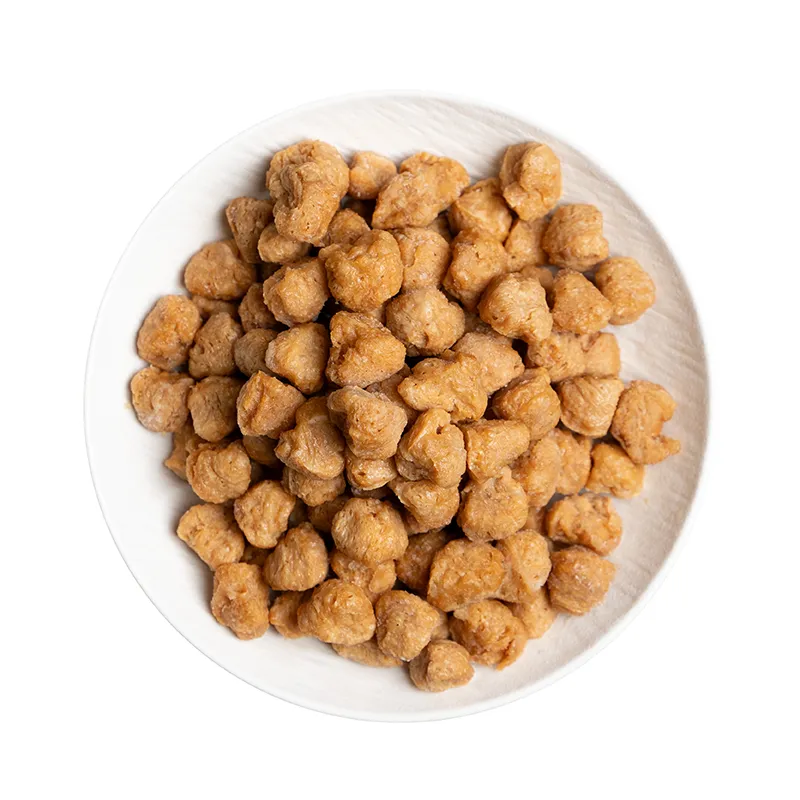
Um diagnóstico útil permite distinguir três condições. Um miolo esbranquiçado ou crocante indica penetração incompleta. Um miolo firme, mas húmido, pode corresponder a uma textura deliberadamente densa. Uma superfície macia com um centro seco sugere um tratamento superficial excessivamente agressivo — frequentemente decorrente de temperatura demasiado elevada, tempo excessivo ou forte agitação aplicados antes que o miolo atinja o ponto ideal. Para high protein soy chunks, procurement teams should therefore request the supplier’s grade-specific preparation guidance and test multiple pieces, not judge a batch from one sample.
Do not call every firm centre a hydration failure. A deliberately dense grade can retain a moist bite after the core is wet; incomplete hydration leaves an opaque, brittle or powdery interior. Surface over-softening is different again: the exterior loses definition while the centre remains under-hydrated. Confirm the target texture, correct the process, or reduce surface stress accordingly.
Sample the whole piece-size distribution before changing the recipe
A single chunk is not a production diagnostic. Take a representative sample across the size range and from more than one vessel location, then cut the thickest section. Record dry, partly hydrated and fully hydrated centres by size band. Failure concentrated in large pieces points to size distribution; failure near the top points to submersion or circulation. One cut piece never represents the lot.
Build a Hydration Window Instead of Chasing One “Best” Ratio
The fastest route to a robust process is a small factorial trial. Record dry mass, liquid mass, starting and ending liquid temperature, time, piece size band, hydrated mass and drained mass. Then cut 10 representative pieces and score the core on a simple 0–3 scale: 0 for dry, 1 for partly hydrated, 2 for fully hydrated but firm, and 3 for fully hydrated and soft. This is an in-house diagnostic method, not a certification or a universal standard.
The conditions below are starting trial conditions only. They require validation for the exact grade, batch, broth composition, equipment load and downstream heating process; they are not fixed hydration ratios or supplier performance claims.
| Trial variable | Suggested starting comparison | What to measure | Decision signal |
|---|---|---|---|
| Liquid-to-dry-product ratio | 2:1, 2.5:1 and 3:1 by weight | Free liquid, mass gain and 10 cut centres | Choose the lowest trial point that hydrates the core without leaving excessive free liquid |
| Initial liquid temperature | 60°C, 75°C and 90°C | Actual product temperature at 0, 10 and 20 minutes | Avoid a condition that softens the surface before the centre becomes moist |
| Soak time | 10, 20 and 30 minutes | Core score, surface integrity and drained mass | Stop extending time when core improvement levels off or the surface begins to break |
| Hydration medium | Plain water baseline, then the intended broth | Core score, flavour distribution and free liquid | If broth underperforms water, test its salt, sugar, acid and oil contribution separately |
Keep the vessel covered to reduce heat loss, maintain full submersion and use gentle turning rather than crushing agitation. If a 30-minute trial still leaves a hard centre while the surface deteriorates, do not keep adding time. Compare a smaller piece, a more open structure or a staged process in which hydration continues during the recipe’s controlled thermal step. high protein soy chunks should be evaluated at the same bed depth and batch loading expected in production because circulation changes with scale.
Scale changes each piece’s temperature and contact history. A lightly loaded bench vessel can recover heat quickly, while a heavily loaded vessel may cool, form a deeper bed and circulate less evenly. Measure temperature after loading, not only the setpoint. Agitation can improve contact and reduce floating, but aggressive mixing can abrade a softened surface or create fines. Validate the gentlest effective motion on the actual equipment and loading.
Establish the first window in plain water whenever possible. Broth adds variables: dissolved solids can change viscosity; salt and sugar change the surrounding solution; acid can alter perceived firmness; and oil can interfere with wetting. Broth may be the commercial answer, but it is harder to diagnose. Establish water performance first, then isolate the formulation variable that shifts the result.
Control Draining, Holding and the Final Cook
Hydration does not end when the timer rings. Drain method changes both yield and bite: gravity draining leaves more surface liquid than pressing, while aggressive squeezing can collapse pores and damage fibres. Standardise drain time—for example, a 2-minute screen drain as an initial trial point—and weigh the sample immediately. Validate that condition for the exact grade and process before adopting it.
Next, assess texture after the real cook, not only after soaking. A two-cycle texture profile analysis (TPA) can compare hardness, cohesiveness and chewiness under fixed sample dimensions and compression settings. If instruments are unavailable, use a blinded sensory cut-and-bite score with a written reference scale. TPA and sensory scoring are test methods; neither is a product certification.
Holding time also matters. Hydrated pieces may continue to redistribute moisture, yet exposed surfaces can dry during staging. Run a 0-, 15- and 30-minute covered-hold comparison as a starting trial, then validate it at line scale. Include cook loss, broken-piece percentage and retained drained mass in the decision. The cheapest dry ingredient can create a higher total cost if it needs rework, causes filling inconsistency or loses structure during mixing.

Choose the Format That Matches the Finished Product
Changing the format can be more effective than forcing a dense chunk through an unsuitable hydration step. Soya fiber protein chunks suit visible pieces and a substantial bite, but they demand the most attention to core hydration. Soya fiber protein flakes distribute through patties, fillings and formed products with a shorter wetting path. Soya fiber protein granules are useful when even particle distribution matters more than a whole-muscle appearance.
| Formato | Best-fit product design | Main hydration risk | Procurement check |
|---|---|---|---|
| Cangadas | Visible pieces, stews and plant-based meat cubes | Dry core or wide piece-to-piece variation | Piece-size distribution, density, broken fraction and grade-specific preparation guidance |
| Flocos | Fillings, formed products and layered bite | Surface softening or fibre damage during mixing | Flake thickness, integrity after hydration and compatibility with the mixer |
| Grânulos | Mince, sauces and finely distributed protein systems | Overhydration or free-water competition with binders | Particle-size distribution, fines and final-cook texture |
For a supplier trial, ask for one representative production lot and document its dry dimensions, moisture, bulk density and preparation guidance. Test Soya fiber protein flakes and Soya fiber protein granules beside the current chunk only when the finished product can accept a different visual profile. The purpose is not to find the format that absorbs the most liquid; it is to find the format that delivers the target bite with repeatable processing and manageable total cost.
Use Standards and Documentation to Define a Defensible Specification
O Codex list of standards includes CXS 174-1989, the General Standard for Vegetable Protein Products. It provides a useful international reference point, but applicability depends on product identity, destination market and claims. In the United States, ingredient declarations are governed by 21 CFR 101.4, and soy is addressed in the major-allergen provisions of 21 U.S.C. 343(w). These are regulatory references, not certifications of any particular product.
Before approving Soya fiber protein chunks, request the current specification, ingredient statement, allergen statement, lot traceability documents and recommended handling method. Review the broader soy protein product portfolio only after the process team has defined acceptable size, density and post-cook texture. A sample that looks right while dry is not sufficient evidence of production fit.
Translate the trial into a purchase specification: state the format, acceptable piece-size range, target post-hydration texture, inspection method, hydration medium and final thermal process. Keep incoming-material checks separate from process validation. A specification defines what arrives; a line trial shows what it does in a particular formula and equipment set. This prevents a test method or regulatory reference from being misrepresented as a product certification.
Perguntas frequentes
How do you rehydrate textured soy protein?
Weigh the dry product and liquid, fully submerge the pieces, control the actual temperature and drain by a repeatable method. Cut at least 10 pieces from different size bands to check the core, then validate the chosen conditions for the exact grade and production process.
Do I have to rehydrate TVP?
Not always. Some formulations add dry TVP directly when enough mobile water and cooking time are available, but this can shift water away from binders, sauces or other ingredients. Validate direct addition with final-cook texture, free-water and yield checks rather than assuming the recipe will hydrate every particle evenly.
What is the best water-to-TVP ratio?
There is no universal best ratio because format, density, initial moisture, broth composition and target bite differ. A 2:1 to 3:1 liquid-to-dry-product comparison by weight can be used only as a starting trial range; the exact grade and process must determine the approved ratio.
How long should TVP be soaked?
Use time points rather than one inherited number. Ten, 20 and 30 minutes can serve as starting trial conditions, provided temperature and piece size are held constant and the centre is inspected. Validate the shortest time that hydrates the core without weakening the surface.
Should TVP be hydrated with water or broth?
Start with water to establish the material’s baseline, then repeat the test with the intended broth. Salt, sugar, acid and oil can change wetting, flavour distribution and perceived firmness, so the commercial broth needs its own validated hydration window.
How do you drain TVP after rehydration?
Use a defined screen size, bed depth and drain time, then weigh the product. Pressing or squeezing should be a separate controlled trial because it may remove flavour liquid or damage structure. Judge the result after the final cook as well as immediately after draining.
Use Evidence and a Trial Plan Before You Commit
- “Effect of nozzle slit thickness on the rehydration and textural properties of textured vegetable protein produced by low-moisture extrusion of defatted soy,” Food Science and Technology Research, 2026.
- Codex Alimentarius, CXS 174-1989, General Standard for Vegetable Protein Products.
- Electronic Code of Federal Regulations, 21 CFR 101.4, Food; designation of ingredients.
- United States Code, 21 U.S.C. 343(w), major food allergen labelling provisions.
A reliable chunk is not the one that absorbs the most liquid; it is the one that reaches the target centre texture without sacrificing surface integrity or process control. To compare grades against your equipment and finished-product target, contact Baichuan with your piece size, hydration method and final cooking conditions.