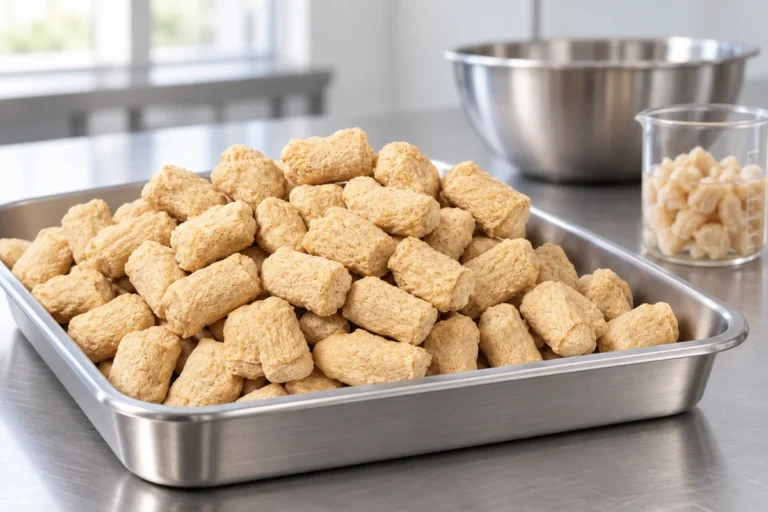
In Hamburg, a procurement manager for a European meat-alternative brand walked a Chinese extrusion plant and rejected the supplier on the spot. His stated reason, recorded in the audit note, was that “the protein looked too uniform — it must be over-processed.” Six months and two failed suppliers later, he returned. The uniformity he had distrusted was in fact the visible signature of a well-controlled line: stable barrel temperature profiles, consistent feed moisture, tight die pressure. The two suppliers he chose instead had delivered visually “natural” variation that turned out to be lot-to-lot chaos, costing him three production stoppages and a delisting. Consistency is the output of process control, not evidence of a flaw. Understanding the process of textured protein lets buyers evaluate TVP manufacturers in China on evidence rather than appearance.
Summary: Textured protein is made by feeding defatted soy flour into a high-temperature, high-pressure twin-screw extruder at 140–180°C; as the melt exits the die, a sudden pressure drop flashes internal water to steam and expands the mass into a porous, fibrous structure, which is then cut, dried to 8–10% moisture and sieved. The honest answer is that extrusion parameters — barrel temperature, screw shear, feed moisture and die geometry — decide protein retention, texture and hydration behaviour far more than raw material alone; fibrous soy protein uses a directional cooling variant of the same process. Baichuan runs these lines under HACCP, ISO 9001 and ISO 22000. See what it is first.
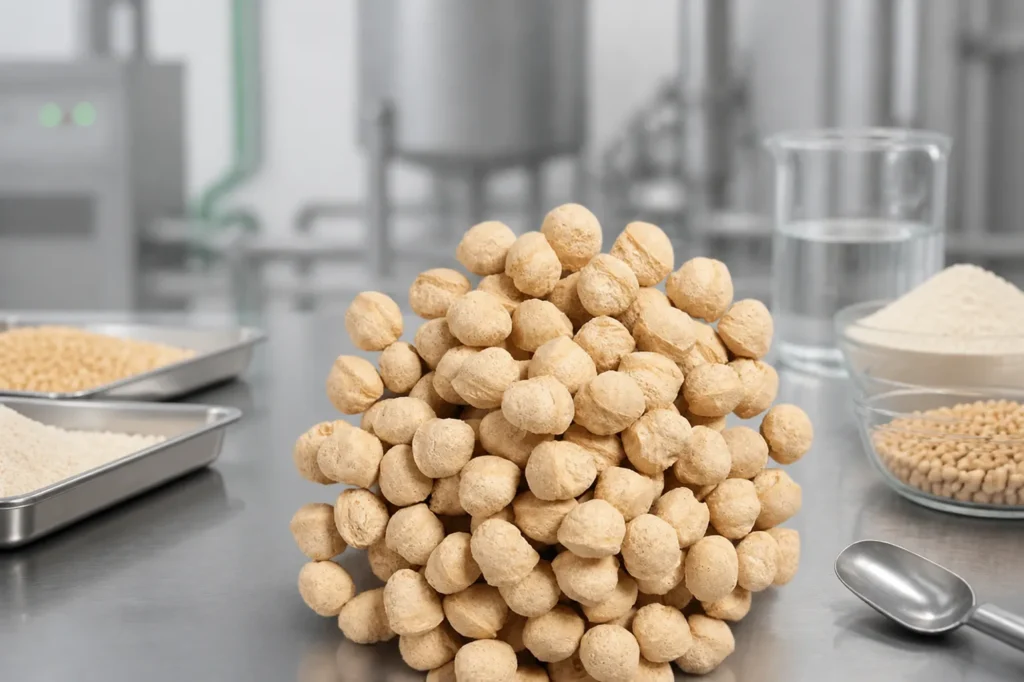
Step 1: Raw Material Preparation
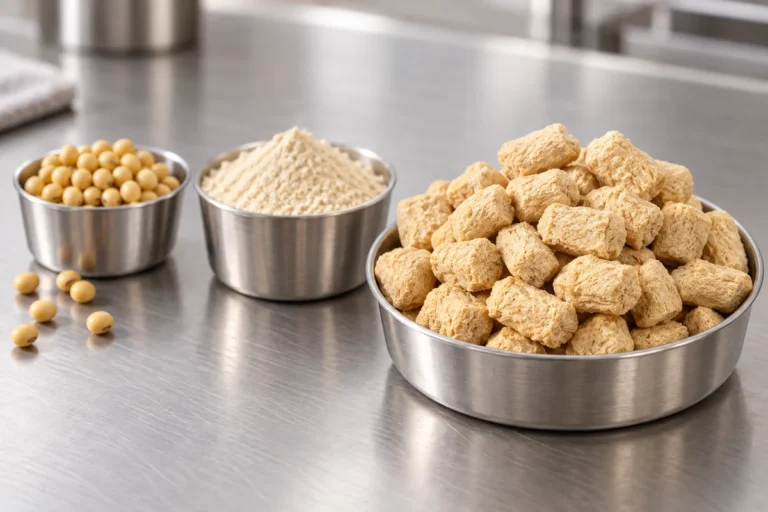
Defatted soy flour is the base — soybeans that have been dehulled, flaked, solvent-extracted to remove oil, and desolventised. Residual fat sits at 0.5–1.5% and protein at 50% or above on a dry basis. The flour’s protein content sets a hard ceiling: extrusion concentrates nothing, so 48% flour cannot produce 60% textured protein.
Two flour properties matter beyond protein. Protein Dispersibility Index, or PDI, indicates how much native protein remains undenatured; a PDI in the 55–75 range typically extrudes best because the protein still has the capacity to unfold and re-network. Particle size distribution affects feed consistency into the extruder throat — irregular flour causes feed surging, which shows up downstream as density variation in the finished nuggets. Incoming flour should be verified for protein by AOAC 992.23, moisture, urease activity and microbiology as a documented HACCP control point.
Step 2: Conditioning and HTHP Extrusion
Flour is metered into a pre-conditioner where water and sometimes steam bring feed moisture to roughly 25–35% for dry-textured products. The conditioned mass enters a co-rotating twin-screw extruder. Inside the barrel, mechanical energy from the screws combines with jacket heating to reach 140–180°C under pressures typically between 20 and 60 bar.
Three things happen simultaneously. Heat denatures the globular soy protein, unfolding it and exposing reactive sites. Shear from the screw profile aligns those unfolded chains in the direction of flow. Pressure keeps the water liquid despite being far above its atmospheric boiling point, so the material behaves as a continuous viscoelastic melt rather than a wet powder. This is the moment the product is actually created — everything after is stabilisation. Our reliability guide details which of these parameters a buyer can and should verify during an audit.
| Stage | Key Condition | Controlled Variable | Failure Mode If Uncontrolled |
|---|---|---|---|
| Flour feed | Defatted soy, >50% protein, PDI 55–75 | Protein, moisture, particle size | Low protein ceiling, feed surging |
| Pre-conditioning | 25–35% moisture | Water/steam dosing | Uneven melt, weak texture |
| Extrusion | 140–180°C, 20–60 bar | Barrel zones, screw speed | Burnt notes or under-texturised mass |
| Die expansion | Rapid pressure drop | Die geometry, back pressure | Poor porosity, low hydration |
| Cutting | Rotating knife at die face | Knife speed vs throughput | Inconsistent piece size |
| Drying | To 8–10% moisture | Air temp, belt residence time | Mould risk or brittleness |
| Sieving & metal detection | Format separation, CCP | Mesh sizes, detector sensitivity | Off-spec particle mix, contamination |
Step 3: Expansion, Cutting and Drying
At the die, the melt exits into ambient pressure. Superheated internal water flashes instantly to steam, inflating the protein matrix from within and freezing the aligned structure into a porous, sponge-like solid. Die geometry determines cross-section — round for granules, rectangular slots for strips, larger apertures for chunks — while a rotating face knife sets length.
The expanded product leaves the die at 20–25% moisture and must be dried to 8–10% for shelf stability. Drying is gentler than it sounds: typically 80–120°C on a multi-pass belt dryer with controlled residence time. Dry too fast and the outer layer case-hardens, trapping internal moisture and causing later mould; dry too far and the material becomes brittle and fractures during handling and shipping. After drying, material is cooled, sieved into format grades, passed through metal detection as a critical control point, and packed. See packaging for the moisture-barrier specifications that protect that 12–24 month shelf life in transit.
Fibrous vs Standard: The Same Science, Tighter Control
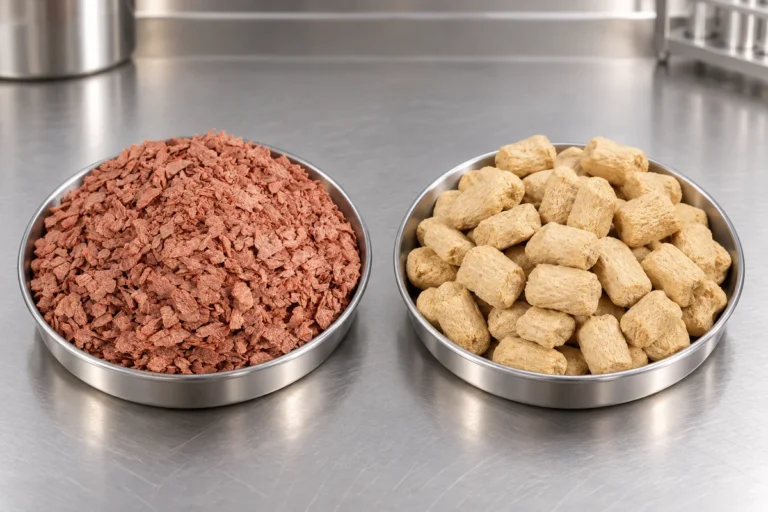
Fibrous soy protein is produced on the same fundamental principle but with a critical addition: a long cooling die attached after the extruder barrel. Instead of allowing explosive expansion at atmospheric pressure, the melt is held under pressure and cooled progressively while still flowing, typically from around 150°C down to 70–90°C over the length of the die. Laminar flow through that gradient orients the protein fibres along a single axis, producing anisotropic, pull-apart layering that resembles whole muscle.
This is materially harder to run. Cooling die temperature gradients must be held within a few degrees, throughput must be steady, and any surge produces a visible defect in fibre alignment. Fewer Chinese lines do this reliably, which is why fibrous grades carry a meaningful price premium and why supplier selection matters more in this tier than in standard TVP.
| Parameter | Standard TVP | Fibrous Soy Protein |
|---|---|---|
| Die type | Open expansion die | Long cooling die |
| Structure | Isotropic, sponge-like | Anisotropic, aligned fibres |
| Exit temperature | 140–180°C, flash expansion | Cooled to 70–90°C under pressure |
| Best application | Mince, fillings, stews | Whole-cut and premium analogues |
| Process tolerance | Moderate | Narrow — requires tight control |
Quality Systems Wrapped Around the Line
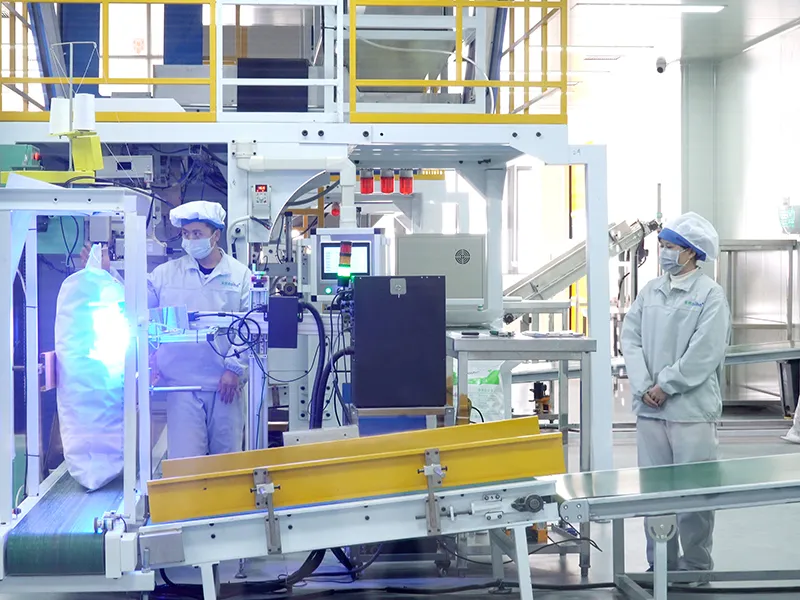
Process control without documentation is unverifiable. A credible plant runs a HACCP plan with defined critical control points at extrusion temperature, dryer outlet moisture and metal detection, embedded within ISO 22000 for food safety and ISO 9001 for quality management. Increasingly, European buyers also request ISO 14001 for environmental management and ISO 45001 for occupational health and safety, while IFS certification is a practical prerequisite for retail private label. HALAL and MUI Halal certification cover Muslim-majority export markets and are audited independently of food-safety schemes.
How to Audit a Line Without Being an Engineer
You do not need extrusion expertise to evaluate a supplier. Ask for barrel temperature profiles and screw configurations for your specific product code — a plant that cannot produce them is running by feel. Request three consecutive lot COAs and compare protein, moisture and bulk density variance; genuine control shows tight bands. Ask how the dryer outlet moisture is monitored and at what frequency. Finally, request samples from three different lots and run a hydration and cook test on each.
Baichuan operates controlled extrusion for both standard textured soy protein and fibrous soy protein, and shares parameter documentation because it is the only honest way to demonstrate consistency. Use the same questions on every supplier you shortlist. Supplier evaluation covers the full checklist.
FAQ
How is TVP processed?
TVP is usually made from defatted soy flour or soy protein concentrate. The material is mixed with water, heated and extruded under pressure, then dried into granules, chunks, strips or fibrous forms. This process creates a porous texture that can absorb water, seasoning and flavor during cooking.
Is TVP actually healthy?
TVP can be a healthy plant-based protein ingredient when used as part of a balanced diet. It is typically high in protein, low in fat and cholesterol-free. However, the health value of the final food also depends on added salt, oil, seasoning and processing methods.
Is TVP just tofu?
No. TVP and tofu both come from soy, but they are different products. Tofu is made by coagulating soy milk, while TVP is made by extruding soy protein into a dry textured form. TVP has a chewier, meat-like structure and is usually rehydrated before use.
Is TVP just soya chunks?
Not exactly. Soya chunks are one common form of TVP, but TVP also includes granules, strips, flakes and fibrous soy protein. So “soya chunks” are a type of TVP, but TVP is a broader category.
Is textured protein good for you?
Textured protein can be good for you because it provides plant-based protein with little fat and no cholesterol. It can help support high-protein diets, meat reduction and vegetarian or vegan meals. People with soy allergies should avoid soy-based textured protein.
What is a textured protein?
Textured protein is a plant-based protein ingredient processed to create a fibrous, chewy or meat-like texture. It is commonly made from soy, pea or wheat protein and used in meat alternatives, fillings, patties, ready meals, snacks and pet food.
References
- AOAC 992.23 — Crude protein determination, combustion method
- ISO 22000:2018 — Food safety management systems
- ISO 9001:2015 — Quality management systems
- Codex Alimentarius CAC/RCP 1-1969 — General Principles of Food Hygiene
Explore Baichuan: TVP & Fibrous Soy Protein Products · About Baichuan’s Manufacturing · Contact Us for Samples & Quotes