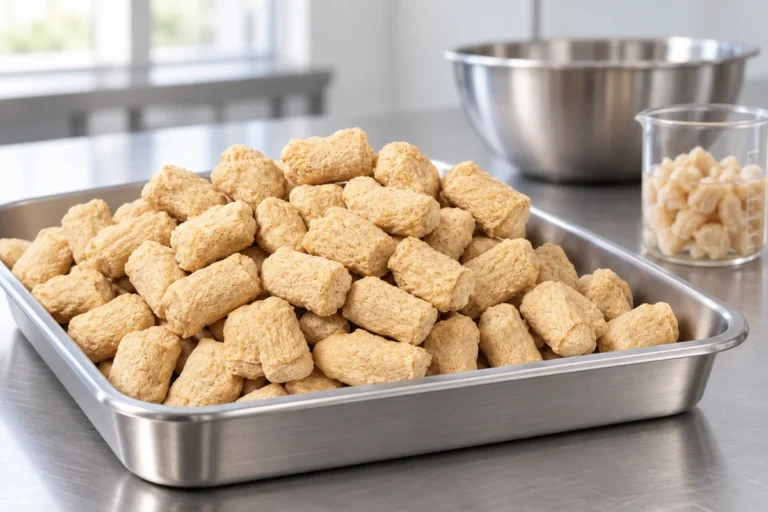
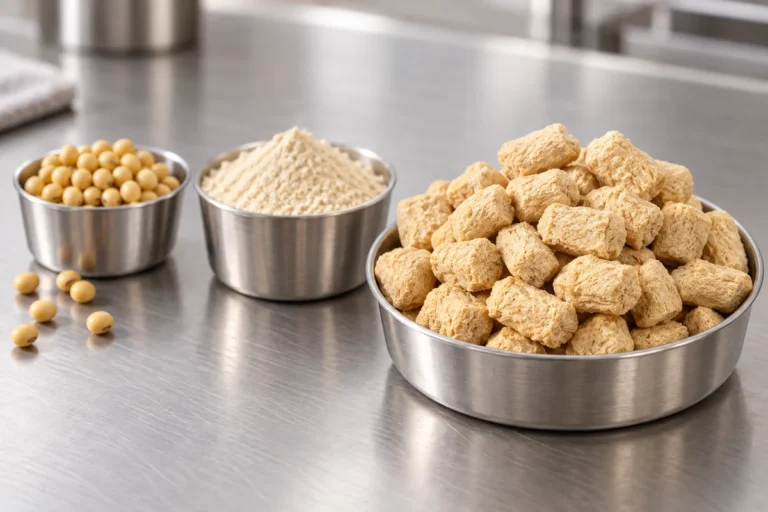
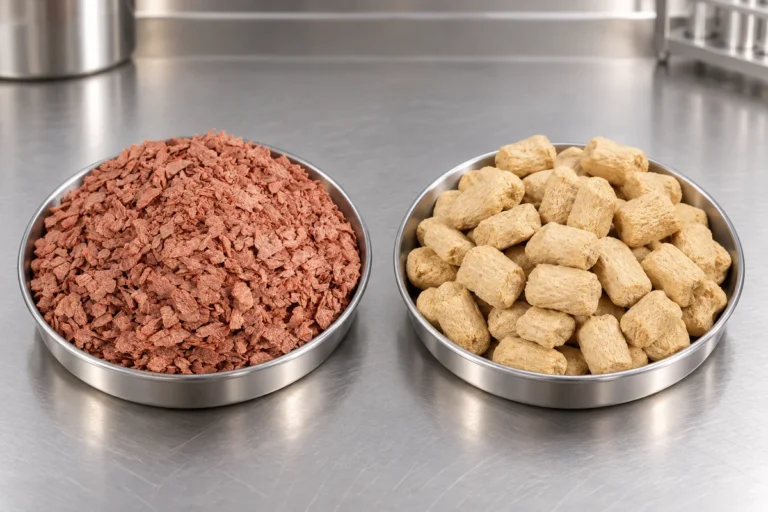
In Chicago, the CFO of a mid-market frozen-foods company was under pressure. Beef trim had risen 34% in eighteen months, and his flagship meatball SKU was three cents from going gross-margin negative. His first instinct — raise the retail price — tested badly and cost two listings. Reluctantly, he approved a reformulation trial replacing 30% of the ground meat with hydrated textured soy protein, fully expecting a consumer backlash on taste. The panel scores came back statistically indistinguishable from the original. Raw-material cost fell 22%, stated protein per serving rose slightly, and the saturated fat declaration dropped enough to qualify for a front-of-pack claim. The reversal was complete: the cheaper input had also improved the label. That is the pattern this ingredient repeats across categories. For sourcing context, our TVP manufacturer China resource maps the supplier landscape.
Benefit 1: High Protein Density
At 50–70% protein on a dry basis, verified by AOAC 992.23 combustion analysis, a modest inclusion delivers meaningful nutrition. Compare that to lean beef at roughly 21% protein as consumed, or chicken breast near 23%. Even after hydration at 1:2.5, textured soy protein still contributes 15–16 g protein per 100 g of prepared mass, which places it in the same nutritional band as lean meat while carrying under 1.5 g of fat.
Quality matters as much as quantity. Soy protein is one of the few plant proteins with a complete essential amino acid profile and a PDCAAS approaching 1.0, meaning it does not require complementary pairing to be nutritionally useful. For product developers, this allows a straightforward “high protein” claim in most jurisdictions without stacking multiple protein sources and complicating the ingredient statement.
| Benefit | Measurable Impact | Reference Point |
|---|---|---|
| Protein density | 50–70% dry basis | Lean beef ≈ 21% as consumed |
| Cost per kg protein | Typically 60–80% lower | Versus beef trim, 2024–2025 range |
| Shelf life | 12–24 months, ambient | Frozen meat: cold chain required |
| Yield after hydration | 2.2–3.2× dry weight | Format dependent |
| Fat content | 0.5–1.5% | Beef mince 15–20% |
| Carbon footprint | ≈ 1/10 of beef per kg protein | FAO livestock assessments |
Benefit 2: Cost Efficiency That Survives Audit
The cost case is often stated loosely, so here is the arithmetic. One kilogram of dry TVP hydrates to roughly 2.5–3 kg of usable mass. If dry material lands at a given delivered price, the effective cost per kilogram of hydrated product is therefore a third of that figure before any comparison to meat is made. Layer on the fact that meat loses 20–25% of its weight to cook shrink while hydrated TVP loses almost none, and the yield advantage compounds again in the finished product.
There is a second-order saving that finance teams frequently miss: price stability. Meat markets swing with feed costs, disease outbreaks and export bans, sometimes 30% within a quarter. Soy-based textured protein moves with a broader, deeper commodity and typically shows lower volatility, which makes annual budgeting and contract pricing far more defensible. The pricing guide works through the landed-cost math including freight and duty.
Benefit 3: Shelf Stability and Logistics Advantage
Dried to 8–10% moisture and packed in multi-layer bags, textured protein is ambient-stable for 12–24 months. That single property eliminates refrigerated warehousing, reefer container premiums and cold-chain failure risk across a global supply chain. A 40-foot dry container carries roughly 12–14 tonnes of dry TVP, which rehydrates to over 30 tonnes of usable material at destination — an effective freight efficiency no chilled protein can match.
For humanitarian, military and institutional feeding programmes, ambient stability is not a convenience but a prerequisite. It is also what allows brands in markets with unreliable electricity infrastructure to carry high-protein SKUs at all. See export packaging for moisture-barrier specifications and pallet configurations that protect that shelf life in transit.
Benefit 4: Formulation Versatility
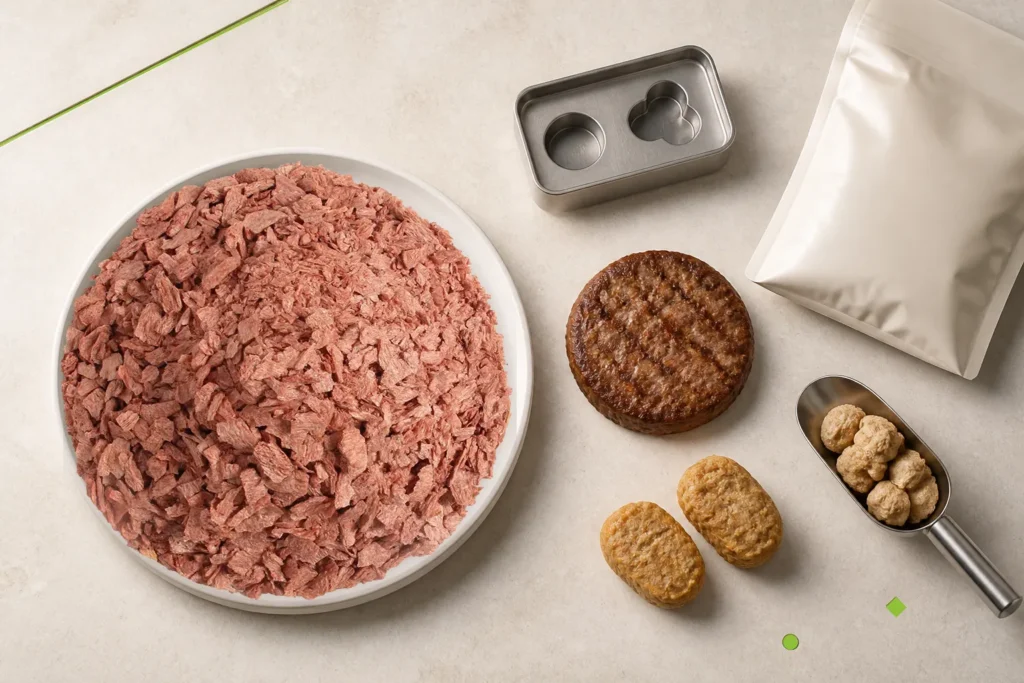
Granules, minced flakes, chunks, strips and fibrous soy protein cover nearly every application from taco filling to whole-cut analogues. Because the base is flavour-neutral and highly porous, it accepts marinades, hydrolysates, smoke, and fat systems with unusual efficiency — the same substrate can present as beef, chicken, pork or seafood depending entirely on the seasoning system applied during hydration.
Versatility also means risk reduction. A single raw material qualified once through your quality system can serve five product lines, reducing supplier audits, specification documents and warehouse SKUs. Learn how to cook it and then how to add it to recipes at correct substitution ratios.
Benefit 5: Sustainability With Numbers Attached
Life-cycle assessments consistently place soy protein at roughly one-tenth the greenhouse gas emissions of beef per kilogram of protein delivered, with land use lower by a similar order and water use dramatically reduced. For companies reporting under CSRD in Europe or setting science-based targets, protein-source substitution is one of the few levers that moves Scope 3 emissions materially without changing the customer proposition.
Credible sustainability claims require credible systems behind them. Look for suppliers holding ISO 14001 for environmental management and ISO 45001 for occupational health and safety alongside food-safety certifications — these are the documents auditors ask for when a sustainability claim is challenged.
Benefit 6: Label and Claim Advantages
Reformulation with textured protein frequently unlocks front-of-pack claims that were previously out of reach. Because the material carries 0.5–1.5% fat against 15–20% in standard beef mince, a 30% substitution can move a product below the saturated fat thresholds that gate “reduced saturated fat” declarations in most jurisdictions. Dietary fibre rises at the same time, often enough to support a “source of fibre” claim at 3 g per 100 g, and cholesterol falls toward zero.
The ingredient statement also stays short. A single-line declaration of textured soy protein — or textured soy flour, depending on the base — reads far cleaner than the multi-component protein blends often used to reach the same nutritional position. That simplicity matters commercially: retailer clean-label scorecards in Europe and North America penalise long ingredient lists, and a shorter statement can be the difference between listing and rejection during a range review.
Choosing a Supplier to Capture These Benefits
Benefits only materialise if the material is consistent. Specify protein by AOAC 992.23, moisture ceiling, particle size distribution, and a rehydration ratio tolerance. Require HACCP documentation, ISO 9001 and ISO 22000 certificates, plus HALAL or MUI Halal where your markets demand it, and IFS if you supply European retail private label. Then run a three-cycle cook test across three different production lots — average quality is easy, lot-to-lot consistency is the real differentiator.
Baichuan manufactures textured soy protein and fibrous soy protein against published specifications under these certification systems. Whether or not you buy from us, use that documentation set as the minimum benchmark when comparing quotations.
FAQs
Is textured protein cheaper than meat?
Substantially, on a per-kilogram-of-protein basis — typically 60–80% lower, and the gap widens once hydration yield and the absence of cook shrink are factored in. See the cost guide for landed-cost modelling including freight and duty.
Is textured protein cheaper than meat?
Substantially, on a per-kilogram-of-protein basis — typically 60–80% lower, and the gap widens once hydration yield and the absence of cook shrink are factored in. See the cost guide for landed-cost modelling including freight and duty.
Is textured protein good for you?
Textured protein can be a healthy protein source when used as part of a balanced diet. It is usually high in protein, low in fat, and cholesterol-free, but nutrition depends on the raw material, sodium level, additives, and final recipe.
Is TVP as healthy as tofu?
TVP and tofu can both be healthy, but they are different. TVP is usually higher in protein and more shelf-stable, while tofu is less processed, higher in moisture, and often contains beneficial minerals such as calcium if calcium-set.
Is TVP healthier than ground beef?
TVP is often lower in saturated fat and contains no cholesterol, making it a healthier option for some diets. However, ground beef provides heme iron, vitamin B12, and other nutrients, so the healthier choice depends on nutrition goals and recipe formulation.
Is TVP a highly processed food?
Yes, TVP is generally considered a processed food because it is made by extracting plant protein and texturizing it through extrusion or similar processing. However, processed does not automatically mean unhealthy; the ingredient quality and added salt, flavors, or additives matter.
How much does 1 cup of dry TVP make?
One cup of dry TVP usually makes about 2 to 2.5 cups after rehydration, depending on the particle size and how much water or broth is absorbed.
How much TVP to replace 500g mince?
To replace 500g of mince, you usually need about 150–180g of dry TVP, then rehydrate it with roughly equal or slightly greater weight of hot water or broth. After hydration, it will be close to the volume and usable amount of cooked mince.
References
- FAO — Sustainable protein sourcing and livestock environmental assessment briefs
- AOAC 992.23 — Crude protein determination, combustion method
- ISO 22000:2018 — Food safety management systems
- ISO 14001:2015 — Environmental management systems
- FAO/WHO — PDCAAS protein quality evaluation
Explore Baichuan: TVP & Fibrous Soy Protein Products · About Baichuan’s Manufacturing · Contact Us for Samples & Quotes