Lentils, beans, tofu and textured soy ingredients are useful plant based protein sources for vegan and vegetarian meals. The best choice depends on both the portion you will eat and the texture the dish needs. Cooked lentils can thicken a sauce, tofu can provide soft pieces, and textured soy can supply small crumbles or more distinct, chewy bites.
For a practical comparison, start with the meal you want to make. Then check nutrition on a consistent basis, choose the ingredient form and manage its water content before calculating the finished portion.
Where textured soy fits among plant protein sources
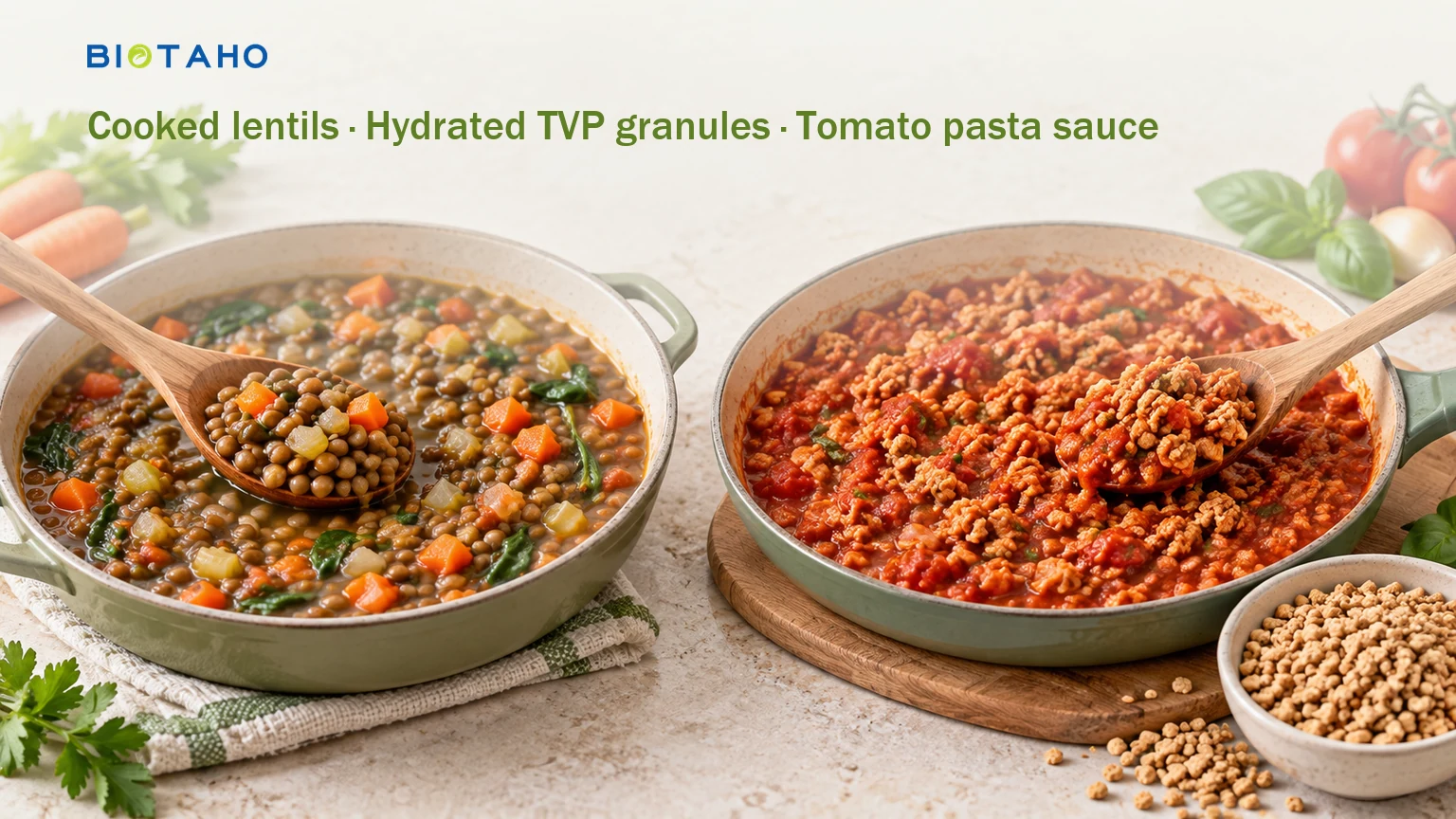
A tomato pasta sauce illustrates the choice well. Lentils bring a recognizable pulse texture and can soften into the sauce. Crumbled tofu gives a softer result whose moisture depends on the type used. Texturierte Sojaprotein is useful when you want pieces distributed through the sauce without relying on lentils to provide its body.
Baichuan lists its textured vegetable protein granules for sauces and fillings as irregular granules with a compact structure. That makes them a relevant ingredient to consider for a sauce with distinct crumbles. They are supplied as an ingredient to hydrate, season and cook, not as a ready-made meal.
Composition matters alongside shape. These granules combine soybean ingredients with wheat gluten and wheat flour; they are not pure soy isolate powder. The catering chunks also contain soy and wheat ingredients. Consequently, neither should be treated as gluten-free, and nutrition figures for soy isolate cannot be substituted for their own specifications.
Choose lentils, tofu or a textured ingredient for the eating quality you need, but do not assume that equal spoonfuls provide equal protein. That requires a separate comparison of their labels and prepared portions.
Compare ingredients on the same dry or cooked basis
Once you have identified suitable textures, compare dry ingredients with dry ingredients, or ready-to-eat foods with ready-to-eat foods. Hydration adds water to textured soy, just as cooking adds water to dry lentils. This lowers the protein concentration per unit of prepared weight without adding protein to the original amount.
The reference portions below help establish scale. They are not equal-weight servings and should not be used to rank protein concentration. The lentil figure comes from Harvard’s protein guidance; the soy food figures come from its soy guidance.
| Zutat | Stated portion and protein | How to use the figure |
|---|---|---|
| Cooked lentils | About 18 g per cup | Count the cooked portion added to the dish. |
| Mature soybeans, boiled | 15 g per half cup | Use the boiled serving, not dry bean weight. |
| Edamame, boiled | 11 g per half cup | Compare with other prepared portions. |
| Soft tofu | 8 g per 3 ounces | This is a soft-tofu reference, not a value for every tofu type. |
| Textured soy blends | Use the selected product’s nutrition specification | Confirm whether the figure refers to dry or hydrated weight. |
For packaged tofu or textured soy, use the actual product label where available. No ingredient-specific protein values are supplied for the textured products discussed here, so a numerical ranking against lentils or tofu would be premature.
As an explicitly hypothetical example, a label declaring 50 grams of protein per 100 grams dry would mean that 60 grams dry supplies 30 grams of protein. Dividing that ingredient equally between two servings gives 15 grams each. These are not Baichuan nutrient values. Keep that dry-weight record while choosing the form and preparing it.
Choose granules or chunks for the texture your meal needs
With the comparison basis established, select the shape that will deliver the intended bite. For the tomato sauce, Sojagranulat are the most directly relevant option because the supplier lists sauces among their applications. Whole lentils remain a different choice: they give identifiable pulse pieces, while hydrated crumbles distribute a different texture throughout the tomato mixture.
If the meal needs separate pieces among vegetables, consider the cubed fibrous soy protein chunks for catering. The supplier describes these as small, fibrous cubes. Their shape calls for attention to hydration through the centre before finishing them in a sauce.
For a cohesive filling, the soy protein flakes for stuffing and formed mixtures offer another format. Their listed applications include stuffing and meatballs, and the supplier highlights high water absorption. In a plant-based filling, that makes moisture control relevant to the mixture’s consistency; the application list does not establish a tested vegan formulation.
| Form | Relevant published detail | Published hydration window | Decision for the meal |
|---|---|---|---|
| Granulate | Irregular, compact pieces; listed for sauces and fillings | 40–55 minutes | Consider for crumbles spread through tomato sauce. |
| Small chunks | Cubed fibrous form; listed for catering and vegan cuisine | 60–65 minutes | Consider when separate bites are wanted. |
| Flocken | High water absorption; listed for stuffing and formed products | 15–20 minutes | Consider for a filling whose moisture can be adjusted. |
These are the supplier’s published time windows, not complete hydration instructions. Current directions must determine the water ratio, temperature and handling. Allow this hydration lead time separately from the dish’s cooking time, and treat the meal formulation as a starting point for recipe-specific trials.
Prepare the soy before combining it with other foods
After choosing the form, weigh the dry ingredient before adding water. Record its amount and the nutrition label’s basis, then hydrate according to the current directions. Keeping these steps separate lets you adjust texture without losing track of how much ingredient the batch contains.
The sequence below preserves that link between dry weight and prepared texture. Hydrated chunks weigh more because they contain added water; their expanded size cannot tell you how much protein a serving contains.
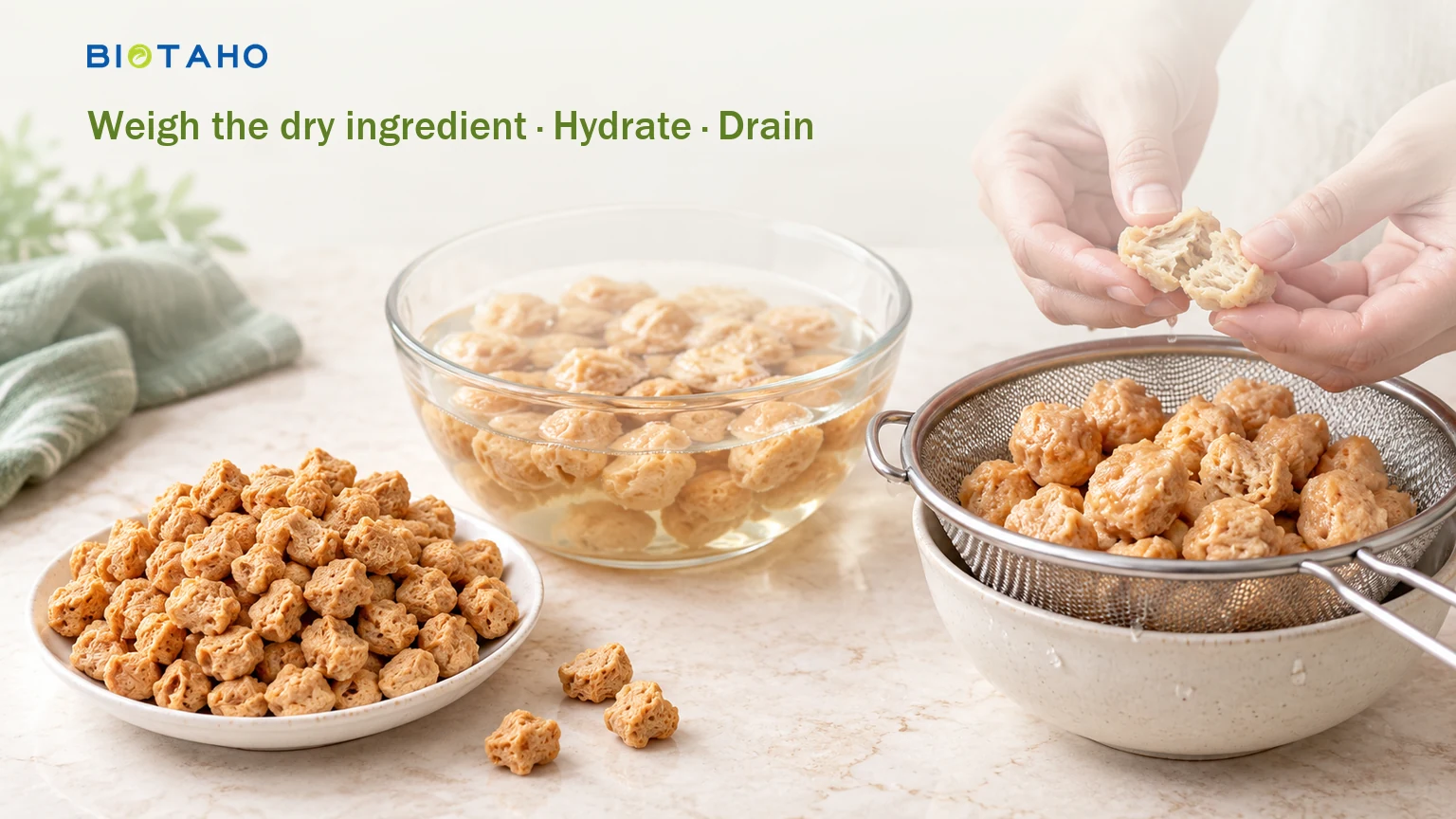
- Check a representative piece for even hydration. For chunks, inspect the centre; for granules, check for hard pieces within the batch. These are texture checks, not measures of food safety.
- Drain or gently press only as appropriate to the product directions and dish. Retained water affects how much liquid reaches the pan.
- For tomato sauce, assess the granules’ surface moisture before combining them with the sauce. Excess water can loosen a sauce that was already at the intended consistency.
- Season and finish cooking as directed. If browning is part of the method, manage surface moisture first so the ingredient does not simply release water into the pan.
- Weigh or otherwise record the completed batch and divide it into the portions actually served.
For flakes in a filling, assess the hydrated mixture before adding more liquid. For chunks, check how much sauce remains after combining, since water retained in the pieces also affects the finished consistency. Record the hydration and draining method during development so later batches can be compared meaningfully.
Use the product specification to assess the finished portion
Once the dish is finished, calculate its protein from the quantities used and their corresponding label values. If the textured ingredient’s declaration is on a dry basis, use the recorded dry weight. Add the contributions from lentils, tofu or other ingredients, then divide by the actual number of portions. Unequal portions will not contain equal amounts.
Assess more than the protein total. Harvard’s guidance emphasizes the wider nutritional package, including fibre, fats and sodium. For a prepared sauce, account for oil, salty seasonings and other additions as well as the protein ingredient. The name “Soya Fiber Protein” is a product-family name, not a dietary-fibre measurement.
Check the complete ingredient and allergen information before choosing a blend. Soy and wheat are major allergens identified by the FDA. The flakes’ online ingredient list ends with “etc,” so it cannot establish the absence of wheat; obtain the complete current declaration if gluten avoidance matters.
A measured plant-based protein portion is also only one part of a balanced diet. The NHS highlights planning for nutrients including vitamin B12, calcium, iron and iodine in vegan eating. Eggs and dairy may contribute to vegetarian meals, but they are not plant foods. Neither a strong protein total nor evidence about whole soy foods establishes the nutritional benefits of every soy-and-wheat blend.
Häufig gestellte Fragen
What is the highest source of plant-based protein?
There is no useful single ranking without specifying the portion and food state. A dry concentrated ingredient and cooked lentils contain very different amounts of water. Compare actual labels on an equal-weight, equal-state basis, then consider the portion you will eat.
How to get 40 grams of protein without meat?
Use measured portions and add their protein contributions. From the general soy reference figures, one cup of boiled mature soybeans plus half a cup of boiled edamame provides approximately 41 grams. This is a calculation for those portions, not a prescribed meal or a universal target.
Is there a downside to plant-based protein?
Preparation needs, allergens and composition vary. Dry textured ingredients need preparation, and soy-based blends may contain wheat. Looking only at protein can also obscure sodium, fats and other nutrients, so assess the complete product and finished meal.
How to get 100g of plant protein a day?
First establish whether that target suits your needs, then total measured portions using labels or reliable food references. A hypothetical split of 25 grams at breakfast, 30 at lunch, 30 at dinner and 15 in snacks totals 100 grams. It is an arithmetic example, not an individual recommendation.
Do vegans struggle with protein?
Difficulty is not inevitable. Regular portions of protein-containing foods can support a varied vegan diet. When adapting a familiar meal, replace the removed protein food deliberately and count the prepared portion instead of relying on a small garnish.
Does soy protein have a complete amino acid profile?
Harvard describes soy protein as containing all nine essential amino acids. That general fact does not provide an amino-acid score or protein content for a particular blended ingredient, nor does it make every soy-based meal nutritionally complete.
Hinweise
- Harvard Nutrition Source: Protein — cooked-lentil values, individual protein needs and the wider nutritional package.
- Harvard Nutrition Source: Straight Talk About Soy — soy food serving values and essential amino acids.
- NHS: Die vegane Ernährung — balanced vegan eating and nutrients requiring attention.
- FDA: Food Allergies—What You Need to Know — major food allergens and label reading.
For a sauce or filling trial, contact Baichuan about an ingredient sample and current preparation specifications.